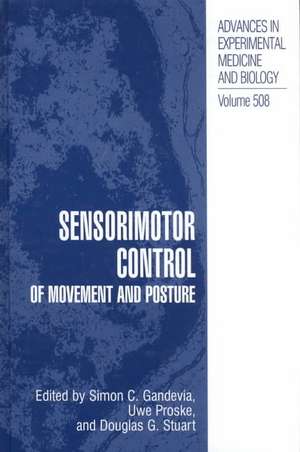
Sensorimotor Control of Movement and Posture
Editat de Simon C. Gandevia, Uwe Proske, Douglas G. Stuarten Limba Engleză Hardback – 31 iul 2002
Preț: 1909.93 lei
Preț vechi: 2329.18 lei
-18%
Puncte Express: 2865
Carte tipărită la comandă
Livrare economică 21 noiembrie-05 decembrie
Livrare prin curier în România Termenul estimat este afișat lângă disponibilitate.
Transport gratuit pentru acest produs Plată online sau ramburs, în funcție de opțiunile comenzii.
Retur gratuit în 14 zile Comandă securizată și suport în română.
Specificații
ISBN-13: 9780306472855
ISBN-10: 0306472856
Pagini: 548
Ilustrații: XXIII, 518 p.
Dimensiuni: 183 x 260 x 34 mm
Greutate: 1.15 kg
Ediția:2002
Editura: Springer
Locul publicării:New York, NY, United States
ISBN-10: 0306472856
Pagini: 548
Ilustrații: XXIII, 518 p.
Dimensiuni: 183 x 260 x 34 mm
Greutate: 1.15 kg
Ediția:2002
Editura: Springer
Locul publicării:New York, NY, United States
V-ar putea interesa
-
 The Private Life of the BrainBaroness Susan Greenfield-19%Preț: 62.85 lei77.76 lei
 -
 Conversations on ConsciousnessSusan Blackmore-18%Preț: 82.94 lei101.43 lei
 -
 Neurology of Cognitive and Behavioral DisordersOrrin Devinsky-26%Preț: 1195.36 lei1616.29 lei
 -
 -25%Preț: 365.70 lei488.02 lei
 -
 The Neuropsychology of VisionManfred Fahle-33%Preț: 1708.36 lei2547.59 lei
 -
 The Neurocognition of LanguageColin M. Brown-28%Preț: 483.69 lei671.65 lei
 -
 The Frontal Lobes and Voluntary ActionR. E. Passingham-28%Preț: 420.37 lei585.68 lei
 -
 Computational Neuroscience of VisionEdmund Rolls-33%Preț: 709.46 lei1060.86 lei
 -
 Emotion, Evolution and RationalityDylan Evans-33%Preț: 708.35 lei1052.71 lei
 -
 Explorations in Learning and the BrainTon De De JongPreț: 364.08 lei
 -
 The Self and Its Brain: An Argument for InteractionismJohn C. Eccles-15%Preț: 580.00 lei682.35 lei
 -
 Barrel CortexKevin Fox-5%Preț: 988.54 lei1040.57 lei
 -
 Computing Brain Activity Maps from fMRI Time-Series ImagesGordon E Sarty-20%Preț: 690.83 lei863.54 lei
 -
 Spiking Neuron ModelsWulfram Gerstner-19%Preț: 613.14 lei756.96 lei
 -
 Neurobehavioral Disorders of ChildhoodRobert Melillo-5%Preț: 1675.02 lei1763.18 lei
Public țintă
ResearchCuprins
Section I: Impulse Initiation and Central Transmission from Muscle and Skin.- 1. Signalling Properties of Muscle Spindles and Tendon Organs.- 2. Evidence for Activity-Dependent Modulation of Sensory-Terminal Excitability in Spindles by Glutamate Release from Synaptic-Like Vesicles.- 3. Electrophysiology of Corneal Cold Receptor Nerve Terminals.- 4. Discharge Properties of Group III and IV Muscle Afferents.- 5. Effects of Activity on Axonal Excitability: Implications for Motor Control Studies.- 6. Reflexes in the Hand: Strong Synaptic Coupling Between Single Tactile Afferents and Spinal Motoneurones.- 7. The Synaptic Linkage for Tactile and Kinaesthetic Inputs to the Dorsal Column Nuclei.- Section II: Proprioception in Limb Movements.- 8. Proprioception: Peripheral Inputs and Perceptual Interactions.- 9. Adaptation to Coriolis Force Perturbation of Movement Trajectory: Role of Proprioceptive and Cutaneous Somatosensory Feedback.- 10. Velocity Perception and Proprioception.- 11. The Effect of Muscle Contraction on Kinaesthesia.- 12. Proprioception and Joint Pathology.- Section III: Afferent Contributions to Balance and Posture.- 13. Consequences and Assessment of Human Vestibular Failure: Implications for Postural Control.- 14. The Role of Cutaneous Receptors in the Foot.- 15. What does Galvanic Vestibular Stimulation Stimulate?.- 16. Sensory Interactions for Human Balance Control Revealed by Galvanic Vestibular Stimulation.- 17. Vestibulospinal Control of Posture.- 18. Sensory Contributions to the Control of Stance: A Posture Control Model.- Section IV: Motoneurones and Motor Units.- 19. Selectivity of the Central Control of Sensory Information in the Mammalian Spinal Cord.- 20. Some Unresolved Issues in Motor Unit Research.- 21. Presynaptic and Disynaptic Inhibition Induced by Group I Muscle Afferents.- 22. Things We Know and Do Not Know about Motoneurones.- 23. A New Way of Using Modelling to Estimate the Size of a Motoneuron’s EPSP.- 24. What Can Be Learned about Motoneurone Properties from Studying Firing Patterns?.- 25. Relative Strengths and Distributions of Different Sources of Synaptic Input to the Motoneurone Pool: Implications for Motor Unit Recruitment.- 26. Plateau Potentials and Their Role in Regulating Motoneuronal Firing.- 27. Mechanisms Causing Plateau Potentials in Spinal Motoneurones.- 28. Recent Evidence for Plateau Potentials in Human Motoneurones.- 29. Patterns of Pathological Firing in Human Motor Units.- Section V: Propriospinal Neurones and Spinal Reflexes.- 30. Reflections on Spinal Reflexes.- 31. Spinal Intemeurones: Re-evaluation and Controversy.- 32. Functional Properties of Primate Spinal Intemeurones during Voluntary Hand Movements.- 33. A Cervical Propriospinal System in Man.- 34. Premotoneuronal and Direct Corticomotoneuronal Control in the Cat and Macaque Monkey.- 35. Interspecies Comparisons for the C3-C4 Propriospinal System: Unresolved Issues.- 36. Central Nervous System Lesions and Segmental Activity.- 37. Reflex Mechanisms for Motor Impairment in Spinal Cord Injury.- Section VI: Locomotion.- 38. Give Proprioceptors a Chance.- 39. Role of the Fusimotor System in Locomotion.- 40. The Role of Proprioceptive Feedback in the Regulation and Adaptation of Locomotor Activity.- 41. Sensory Control of Locomotion: Reflexes versus Higher-Level Control.- 42. Reflex Excitation of Muscles during Human Walking.- 43. H Reflexes Recorded during Locomotion.- Section VII: Supraspinal Control of Movement.- 44. fMRI Studies of the Sensory and Motor Areas Involved in Movement.- 45. Dynamic Use of Tactile AfferentSignals in Control of Dexterous Manipulation.- 46. Motor Cortex and the Distributed Anatomy of Finger Movements.- 47. Reward-Based Planning of Motor Selection in the Rostral Cingulate Motor Area.- 48. Functional Differences in Corticospinal Projections from Macaque Primary Motor Cortex and Supplementary Motor Area.- 49. Corticospinal Transmission After Voluntary Contractions.- 50. Afferent and Cortical Control of Human Masticatory Muscles.- 51. Mechanisms for Acute Changes in Sensory Maps.- 52. Vision as Motivation: Interhemispheric Oscillation Alters Perception.- Section VIII: Mechanics and Movement.- 53. Musculoskeletal Mechanics: A Foundation of Motor Physiology.- 54. The Importance of Biomechanics.- 55. The Role of the Length-Tension Curve in the Control of Movement.- 56. Intramuscular Force Transmission.- 57. Muscle and Tendon Relations in Humans: Power Enhancement in Counter-Movement Exercise.- 58. Relationship Between Neural Drive and Mechanical Effect in the Respiratory System.