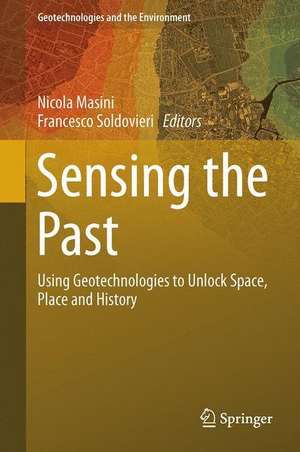
Sensing the Past: From artifact to historical site: Geotechnologies and the Environment, cartea 16
Editat de Nicola Masini, Francesco Soldovierien Limba Engleză Hardback – 21 apr 2017
Subliniem caracterul profund interdisciplinar al volumului Sensing the Past, o lucrare de referință care reușește să creeze un punct de întâlnire între geofizică, inginerie electronică, arheologie și istoria artei. Ne-a atras atenția modul în care editorii Nicola Masini și Francesco Soldovieri reușesc să transforme datele tehnice brute în instrumente vitale pentru conservarea patrimoniului cultural. Lucrarea nu se limitează doar la analiza artefactelor, ci extinde perspectiva către situl istoric și mediul înconjurător, oferind o viziune sistemică asupra protejării trecutului.
Structura volumului este una progresivă și riguroasă. Primele secțiuni explorează tehnologiile de teledetecție, precum LiDAR și senzorii SAR, esențiale pentru cartografierea peisajelor arheologice la scară largă. Partea a doua trece la o scară microscopică, analizând tehnologii non-invazive precum termografia în infraroșu și măsurătorile ultrasonice pentru studiul degradării pietrei naturale. Această tranziție de la macro la micro este completată de o secțiune dedicată tehnologiilor informației și comunicării (ICT), unde realitatea augmentată și tracking-ul de artefacte devin soluții pentru o interacțiune modernă și sigură cu publicul.
Sensing the Past completează perspectiva oferită de Remote Sensing for Archaeology and Cultural Landscapes de Diofantos G. Hadjimitsis, adăugând o componentă practică vastă prin studiile de caz internaționale și analiza detaliată a senzorilor hiperspectrali. În contextul operei editorului Nicola Masini, acest volum continuă direcția începută în The Ancient Nasca World și Machu Picchu in Context, rafinând integrarea științelor exacte în cercetarea antropologică și arheologică. Este un instrument tehnic esențial pentru gestionarea sustenabilă a monumentelor într-o epocă a digitalizării accelerate.
Din seria Geotechnologies and the Environment
- 15%
 Preț: 625.32 lei
 - 18%
 Preț: 973.13 lei
 - 18%
 Preț: 909.08 lei
 - 18%
 Preț: 920.98 lei
 - 24%
 Preț: 843.59 lei
 - 15%
 Preț: 625.84 lei
 - 18%
 Preț: 924.92 lei
 - 15%
 Preț: 617.28 lei
 - 15%
 Preț: 630.54 lei
 - 24%
 Preț: 807.81 lei
 - 24%
 Preț: 858.23 lei
 - 18%
 Preț: 915.73 lei
 - 18%
 Preț: 924.69 lei
 - 23%
 Preț: 614.78 lei
 - 24%
 Preț: 885.87 lei
 - 18%
 Preț: 956.95 lei
 - 18%
 Preț: 1334.87 lei
 - 18%
 Preț: 1184.59 lei
 - 5%
 Preț: 1063.72 lei
 - 18%
 Preț: 1167.76 lei
 - 15%
 Preț: 614.82 lei
 - 18%
 Preț: 934.64 lei
 - 15%
 Preț: 513.49 lei
Preț: 1353.99 lei
Preț vechi: 1651.20 lei
-18%
Carte disponibilă
Livrare economică 24 august-07 septembrie
Specificații
ISBN-10: 3319505165
Pagini: 575
Ilustrații: XII, 593 p. 301 illus., 238 illus. in color.
Dimensiuni: 155 x 235 mm
Greutate: 1.24 kg
Ediția:1st ed. 2017
Editura: Springer International Publishing
Colecția Springer
Seria Geotechnologies and the Environment
Locul publicării:Cham, Switzerland
V-ar putea interesa
-
 Polarisation: Applications in Remote SensingShane Cloude-8%Preț: 483.37 lei523.69 lei
 -
 -9%Preț: 550.87 lei605.35 lei
 -
 -18%Preț: 916.64 lei1117.85 lei
 -
 Thematic Cartography for the SocietyTemenoujka Bandrova-15%Preț: 653.67 lei769.02 lei
 -
 Geogames and GeoplayOla Ahlqvist-18%Preț: 915.54 lei1116.50 lei
 -
 -18%Preț: 910.71 lei1110.62 lei
 -
 Exploring the Marine Ecology from SpaceDmitry V. Pozdnyakov-18%Preț: 762.97 lei930.45 lei
 -
 Mapping Versatile Boundaries: Understanding the BalkansRegis Darques-24%Preț: 927.78 lei1220.77 lei
 -
 The Digital Arts and HumanitiesCharles Travis-18%Preț: 926.32 lei1129.66 lei
 -
 The Ancient Nasca WorldRosa Lasaponara-24%Preț: 1094.76 lei1440.47 lei
 -
 Acoustic Remote Sensing ApplicationsSagar Pal Singal-15%Preț: 659.70 lei776.11 lei
 -
 Preț: 402.90 lei
 -
 -13%Preț: 447.60 lei514.47 lei
 -
 GIS LandslideHiromitsu Yamagishi-18%Preț: 922.08 lei1124.49 lei
 -
 Satellite Remote SensingRosa Lasaponara-18%Preț: 1116.89 lei1362.06 lei
 -
 Applied Geography: Issues, Questions, and ConcernsM. S. KenzerPreț: 371.97 lei
 -
 Satellite Remote Sensing for Resources DevelopmentUnited Nations StaffPreț: 372.70 lei
De ce să citești această carte
Această lucrare este indispensabilă cercetătorilor și specialiștilor în conservare care doresc să stăpânească metodele non-invazive de diagnosticare. Cititorul câștigă o înțelegere tehnică profundă a modului în care sateliții, radarele și senzorii optici pot identifica structuri îngropate sau degradări invizibile ale monumentelor. Este un ghid metodologic complet pentru utilizarea geotehnologiilor moderne în serviciul istoriei, oferind soluții concrete pentru managementul riscurilor și restaurare.