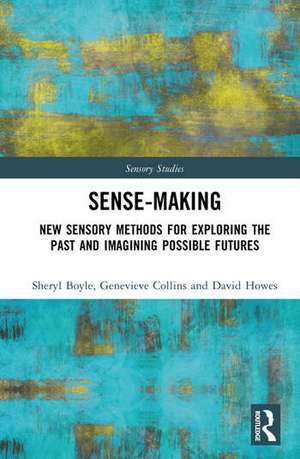
Sense-Making: New Sensory Methods for Exploring the Past and Imagining Possible Futures: Sensory Studies
Autor Sheryl Boyle, Genevieve Collins, David Howesen Limba Engleză Hardback – 22 aug 2025
The first part offers a survey and critique of extant work in sensory archeology and sensory futures. The second part presents a case study of sensory (re)construction in action, focusing on Thornbury Castle (1508—1521) in the UK. The third part probes the life of the senses on the "final frontier", the "next habitat" of humanity—namely, outer space. These sensory case studies are not purely architectural or purely futuristic. They are, at the same time, exercises in "arts-based practice" or "research-creation," where the authors do not just carry out bibliographic research and write about pasts and futures, they make them.
Sense-Making is necessary reading for the international community of sensory studies scholars, as well as those with interests spanning material culture, museum and heritage studies, visual and auditory culture, experimental psychology, design and digital technology.



Preț: 1154.29 lei
Preț vechi: 1407.67 lei
-18%
Puncte Express: 1731
Carte tipărită la comandă
Livrare economică 30 noiembrie-14 decembrie
Livrare prin curier în România Termenul estimat este afișat lângă disponibilitate.
Transport gratuit pentru acest produs Plată online sau ramburs, în funcție de opțiunile comenzii.
Retur gratuit în 14 zile Comandă securizată și suport în română.
Specificații
ISBN-13: 9781032908373
ISBN-10: 1032908378
Pagini: 288
Ilustrații: 26
Dimensiuni: 156 x 234 x 20 mm
Greutate: 0.69 kg
Ediția:1
Editura: Taylor & Francis
Colecția Routledge
Seria Sensory Studies
Locul publicării:Oxford, United Kingdom
ISBN-10: 1032908378
Pagini: 288
Ilustrații: 26
Dimensiuni: 156 x 234 x 20 mm
Greutate: 0.69 kg
Ediția:1
Editura: Taylor & Francis
Colecția Routledge
Seria Sensory Studies
Locul publicării:Oxford, United Kingdom
Public țintă
PostgraduateCuprins
Introduction Part One: Making Sense of Making and the Environment 1.1: Sensing the Past: Archaeologies of Perception 1.2: Sensing Ahead: Anthropologies of the Future Part Two: Sensory (Re)Construction as a Way of Knowing, the Case of Thornbury Castle 1508-21 2.0: Prelude 2.1: The Research Setting: A Narrative of a Building in the Making 2.2: Epistemic Objects: Trading Zones made Sensible in 16th Century England 2.3: Traces and Research Creation: Fragrant Walls and the Table of Delight: On the (re)making of Walls, Window, Chimney and Table Part Three: Probing the Cosmic Sensorium 3.1: Framing the Future: Staging ETHER 3.2: Speculative Space Habitats: Applying the Methodology of Sensory Extrapolation
Notă biografică
Sheryl Boyle is Director of the Carleton Sensory Architecture & Liminal Technology (CSALT) lab in Ottawa, Canada, where she supervises immersive materials research and innovative design and assembly processes.
Genevieve Collins is completing a PhD in Social Anthropology with Visual Media from the University of Manchester, UK. She has worked in the arts and cultural industry of Winnipeg, Canada, and is the co-creative director of a film production company.
David Howes is Distinguished Research Professor in the Department of Sociology and Anthropology and Co-Director of the Centre for Sensory Studies at Concordia University, Canada. In 2024, he was inducted into the Royal Society of Canada.
Genevieve Collins is completing a PhD in Social Anthropology with Visual Media from the University of Manchester, UK. She has worked in the arts and cultural industry of Winnipeg, Canada, and is the co-creative director of a film production company.
David Howes is Distinguished Research Professor in the Department of Sociology and Anthropology and Co-Director of the Centre for Sensory Studies at Concordia University, Canada. In 2024, he was inducted into the Royal Society of Canada.
Recenzii
"This book is required - and most engaging - reading for any historian interested in the 'world of the works'. Worlds which in hermeneutics must be described in words, appear through sensory (re)creations by means of original methodologies, revealing in their immediacy a plurality of meanings that must be considered to truly understand the past. Sense-Making is also crucial to open up significant and hopeful alternative futures in our compromised world. This book makes uncommon sense."
- Alberto Pérez-Gómez, McGill University
"This is an exceptionally rich book combining both broad critical overviews of the sensory studies literature and targeted case studies – or études sensorielles. It offers the reader methodological reflections on how to address the role of the senses in the past and future through detailed writing and imaginative artistic interventions probing the sensorial and material worlds and lives beyond the present. This book wonderfully accomplishes the difficult task of enabling the reader to imagine past or future sensations through engaging art-based practices. In this way, Sense-Making is a landmark contribution to the emerging literature within sensory studies centring on sensing and making sense in the absence of co-presence."
- Mikkel Bille, University of Copenhagen
"Sense-Making shatters temporal boundaries to reveal how we perceive, remember, and imagine across the vast expanse of human experience. This groundbreaking collection fearlessly traverses the archaeology of perception, the ethnography of the present, and the speculative sensoria of tomorrow—charting an exhilarating journey from a sixteenth-century castle to orbital space habitats. The volume unites archaeology, anthropology, history, geography, and sociology in a radical exploration of how culture tunes our neurons across time. Through immersive exhibitions that engage taste, touch, smell, sound, and sight, the contributors pioneer sensory extrapolation as both method and revelation—inviting readers to experience the ephemeral smells of medieval edifices, the hallucinatory intersensoriality of research-creation, and the imagined sensations of more-than-human entities in the cosmos. Moving beyond the tyranny of vision, Sense-Making champions proximity senses and embodied knowing, proving that perception isn't locked away in the human brain but emerges through cultural practice, artistic experimentation, and shared experience. This is scholarship you can taste, touch, and feel—a manifesto for the senses that demands we get our hands dirty in the material torrent of past, present, and future worlds."
- Anne W. Johnson, Universidad Iberoamericana
“Sense-Making urges us to tap into and communicate through the multiple sensory qualities of things, through an atmospheric and deontological approach, and to understand how space is mediated by the senses. It highlights the idea of objects as ‘sensorial assemblages’, and offers a new focus on the interconnectedness of the senses, along with memory, affect and time. All of this resonates with translators and encourages us to embrace the senses if we aspire to fathom the multiple meanings of what we translate.”
- Mª Carmen África Vidal Claramonte in Translation Studies
- Alberto Pérez-Gómez, McGill University
"This is an exceptionally rich book combining both broad critical overviews of the sensory studies literature and targeted case studies – or études sensorielles. It offers the reader methodological reflections on how to address the role of the senses in the past and future through detailed writing and imaginative artistic interventions probing the sensorial and material worlds and lives beyond the present. This book wonderfully accomplishes the difficult task of enabling the reader to imagine past or future sensations through engaging art-based practices. In this way, Sense-Making is a landmark contribution to the emerging literature within sensory studies centring on sensing and making sense in the absence of co-presence."
- Mikkel Bille, University of Copenhagen
"Sense-Making shatters temporal boundaries to reveal how we perceive, remember, and imagine across the vast expanse of human experience. This groundbreaking collection fearlessly traverses the archaeology of perception, the ethnography of the present, and the speculative sensoria of tomorrow—charting an exhilarating journey from a sixteenth-century castle to orbital space habitats. The volume unites archaeology, anthropology, history, geography, and sociology in a radical exploration of how culture tunes our neurons across time. Through immersive exhibitions that engage taste, touch, smell, sound, and sight, the contributors pioneer sensory extrapolation as both method and revelation—inviting readers to experience the ephemeral smells of medieval edifices, the hallucinatory intersensoriality of research-creation, and the imagined sensations of more-than-human entities in the cosmos. Moving beyond the tyranny of vision, Sense-Making champions proximity senses and embodied knowing, proving that perception isn't locked away in the human brain but emerges through cultural practice, artistic experimentation, and shared experience. This is scholarship you can taste, touch, and feel—a manifesto for the senses that demands we get our hands dirty in the material torrent of past, present, and future worlds."
- Anne W. Johnson, Universidad Iberoamericana
“Sense-Making urges us to tap into and communicate through the multiple sensory qualities of things, through an atmospheric and deontological approach, and to understand how space is mediated by the senses. It highlights the idea of objects as ‘sensorial assemblages’, and offers a new focus on the interconnectedness of the senses, along with memory, affect and time. All of this resonates with translators and encourages us to embrace the senses if we aspire to fathom the multiple meanings of what we translate.”
- Mª Carmen África Vidal Claramonte in Translation Studies
Descriere
In this highly innovative work, the senses are liberated from the confines of the present to serve as vehicles for accessing other historical periods and imagined futures. Sense-Making builds on the burgeoning field of sensory ethnography by introducing a pair of methodologie expressly devised to facilitate time-travel.