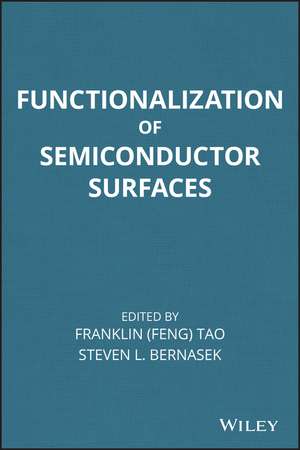
Semiconductor Surfaces
Autor Tao, Bernaseken Limba Engleză Hardback – 21 mar 2012
Preț: 991.01 lei
Preț vechi: 1089.02 lei
-9%
Puncte Express: 1487
Carte tipărită la comandă
Livrare economică 23 noiembrie-07 decembrie
Livrare prin curier în România Termenul estimat este afișat lângă disponibilitate.
Transport gratuit pentru acest produs Plată online sau ramburs, în funcție de opțiunile comenzii.
Retur gratuit în 14 zile Comandă securizată și suport în română.
Specificații
ISBN-13: 9780470562949
ISBN-10: 0470562943
Pagini: 454
Dimensiuni: 161 x 240 x 29 mm
Greutate: 0.85 kg
Editura: Wiley
Locul publicării:Hoboken, United States
ISBN-10: 0470562943
Pagini: 454
Dimensiuni: 161 x 240 x 29 mm
Greutate: 0.85 kg
Editura: Wiley
Locul publicării:Hoboken, United States
V-ar putea interesa
-
 Protecting PowersJudith MassonPreț: 502.51 lei
 -
 -8%Preț: 485.86 lei528.10 lei
 -
 Plasmid BiopharmaceuticalsPrazeres-5%Preț: 1132.31 lei1191.91 lei
 -
 Porous PolymersMichael S Silverstein-9%Preț: 883.97 lei971.39 lei
 -
 Lipids and Essential Oils as Antimicrobial AgentsHalldor Thormar-5%Preț: 1129.25 lei1188.68 lei
 -
 Plant Metabolism and BiotechnologyAshihara-9%Preț: 1171.04 lei1286.86 lei
 -
 Nuclear SystemsLee-9%Preț: 841.56 lei924.79 lei
 -
 RNA InterferencePaul H Johnson-5%Preț: 910.47 lei958.39 lei
 -
 Microbio CorrosionLittle-9%Preț: 766.26 lei842.03 lei
 -
 Progress in Physical Chemistry - Volume 1Helmut Baumgärtel-9%Preț: 1275.09 lei1401.20 lei
 -
 -9%Preț: 1317.76 lei1448.08 lei
 -
 Industrielle Organische ChemieHans-Jürgen Arpe-13%Preț: 1053.86 lei1211.33 lei
Public țintă
Graduate students and undergraduate students in chemistry, materials science, or physics, scientists in physical chemistry, materials chemistry, nanoscience and nanotechnology, engineers in materials engineering, electronic engineering, and semiconductor sensing technologiesNotă biografică
FRANKLIN (FENG) TAO, PhD, is Assistant Professor of Chemistry at the University of Notre Dame. His research group is actively involved in investigations of surface science, heterogeneous catalysis for efficient energy conversion, nanomaterials, and in situ studies of catalysts. Dr. Tao is the author of about 70 research articles and the recipient of the International Union of Pure and Applied Chemistry Prize for Young Chemists. STEVEN L. BERNASEK, PhD, is Professor of Chemistry at Princeton University. His research focuses on chirality in self-assembled monolayers, surface functionalization and modification, organometallic surface chemistry, and dynamics of gas-surface interactions. Dr. Bernasek is the author of more than 200 research articles. He is also the recipient of several awards, including the ACS Arthur W. Adamson Award for Distinguished Service in the Advancement of Surface Chemistry.
Textul de pe ultima copertă
Discover how an emerging field is leading to a new generation of enhanced semiconductors
Written by international leaders in the field, this book provides a complete and current review of the latest findings, practical applications, and active research in the organic functionalization of semiconductor surfaces. Readers will discover how the characteristics and properties of various organic functional groups when combined with inorganic semiconductor surfaces can lead to increasingly enhanced functional materials, including microchips and biosensors.
Functionalization of Semiconductor Surfaces addresses all the important research questions in the field, starting with the basics and then advancing to more complex functionalization chemistry. The text begins with an introduction to the field and a discussion of essential experimental methods. Next, it presents:
This book is invaluable for chemists, engineers, and students who are involved in investigations of the surface chemistry of semiconductors and organic functionalization of semiconductor surfaces. Moreover, the book sets the foundation for the development of the next generation of microelectronic computing, micro- and optoelectronic devices, microelectromechanical machines, three-dimensional memory chips, silicon-based nano sensors, and nano-patterned biomaterials.
Written by international leaders in the field, this book provides a complete and current review of the latest findings, practical applications, and active research in the organic functionalization of semiconductor surfaces. Readers will discover how the characteristics and properties of various organic functional groups when combined with inorganic semiconductor surfaces can lead to increasingly enhanced functional materials, including microchips and biosensors.
Functionalization of Semiconductor Surfaces addresses all the important research questions in the field, starting with the basics and then advancing to more complex functionalization chemistry. The text begins with an introduction to the field and a discussion of essential experimental methods. Next, it presents:
- Detailed descriptions of the structures of the relevant semiconductor surfaces
- Reviews of surface functionalization with progressively more complex organic functionalities
- Discussion of organic and biomaterial functionalization of semiconductor surfaces, including a chapter examining theoretical studies of these systems
- Both dry (vacuum) functionalization and wet chemical functionalization approaches
This book is invaluable for chemists, engineers, and students who are involved in investigations of the surface chemistry of semiconductors and organic functionalization of semiconductor surfaces. Moreover, the book sets the foundation for the development of the next generation of microelectronic computing, micro- and optoelectronic devices, microelectromechanical machines, three-dimensional memory chips, silicon-based nano sensors, and nano-patterned biomaterials.
Descriere
Functionalization of Semiconductor Surfaces presents both fundamental knowledge and latest achievements of this rapidly growing field in the last decade. Written by leaders in the field, this book provides a global, comprehensive perspective on the organic functionalization of semiconductor surfaces.