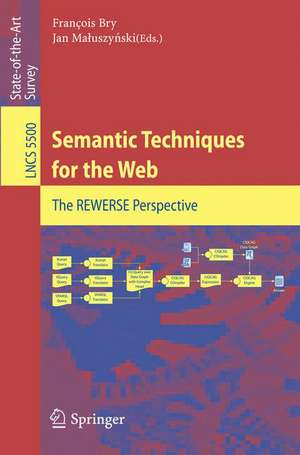
Semantic Techniques for the Web
Editat de Francois Bry, Jan Maluszynskien Limba Engleză Paperback – 23 sep 2009
Preț: 340.13 lei
Preț vechi: 425.16 lei
-20%
Puncte Express: 510
Carte tipărită la comandă
Livrare economică 23 noiembrie-07 decembrie
Livrare prin curier în România Termenul estimat este afișat lângă disponibilitate.
Transport gratuit de la 400.00 lei Plată online sau ramburs, în funcție de opțiunile comenzii.
Retur gratuit în 14 zile Comandă securizată și suport în română.
Specificații
ISBN-13: 9783642045806
ISBN-10: 3642045804
Pagini: 396
Ilustrații: XV, 377 p.
Dimensiuni: 155 x 235 x 22 mm
Greutate: 0.6 kg
Ediția:2009
Editura: Springer
Locul publicării:Berlin, Heidelberg, Germany
ISBN-10: 3642045804
Pagini: 396
Ilustrații: XV, 377 p.
Dimensiuni: 155 x 235 x 22 mm
Greutate: 0.6 kg
Ediția:2009
Editura: Springer
Locul publicării:Berlin, Heidelberg, Germany
V-ar putea interesa
-
 Internet & World Wide Web: How to ProgramHarvey Deitel-20%Preț: 605.11 lei756.38 lei
 -
 Modern Information RetrievalRicardo Baeza-Yates-20%Preț: 575.92 lei719.90 lei
 -
 Artificial Intelligence: A Guide to Intelligent SystemsMichael Negnevitsky-20%Preț: 645.15 lei806.45 lei
 -
 How to Read a PaperTrisha M Greenhalgh-5%Preț: 324.81 lei341.90 lei
 -
 -20%Preț: 134.29 lei167.85 lei
 -
 Agentic AI For DummiesPam Baker-20%Preț: 145.95 lei182.44 lei
 -
 Handbook of Metadata, Semantics and OntologiesSaurabh Pal-18%Preț: 1036.24 lei1263.71 lei
 -
 Web, Artificial Intelligence and Network ApplicationsLeonard Barolli-20%Preț: 1255.62 lei1569.53 lei
 -
 The Semantic Web - ISWC 2023Terry R. Payne-20%Preț: 552.76 lei690.95 lei
 -
 The Semantic WebAlbert Meroño Peñuela-20%Preț: 437.83 lei547.29 lei
 -
 Statistics for ScientistsUmberto Michelucci-20%Preț: 275.88 lei344.84 lei
 -
 Emerging Web Services Technology Volume IIIWalter Binder-20%Preț: 400.33 lei500.42 lei
 -
 -20%Preț: 678.21 lei847.76 lei
 -
 The Semantic Web: Research and ApplicationsLora Aroyo-20%Preț: 343.97 lei429.96 lei
 -
 -20%Preț: 322.61 lei403.26 lei
 -
 -20%Preț: 334.49 lei418.11 lei
 -
 -20%Preț: 328.16 lei410.20 lei
 -
 -20%Preț: 321.03 lei401.30 lei
 -
 Web Information Systems and TechnologiesJoaquim Filipe-20%Preț: 417.25 lei521.56 lei
 -
 Semantic IntelligenceSarika Jain-20%Preț: 1389.69 lei1737.11 lei
Public țintă
ResearchTextul de pe ultima copertă
The objective of this state-of-the-art survey is to give a coherent overview of the main topics and results achieved by the Network of Excellence REWERSE on "Reasoning on the Web", funded by the European Commission and Switzerland within the "6th Framework Programme" (FP6), from 2004 to 2008.
The material has been organized into eight chapters, each of which addresses one of the main topics of REWERSE: hybrid reasoning with rules and ontologies, lessons in versatility or how query languages adapt to the Web, evolution and reactivity in the Semantic Web, rule-based policy representations and reasoning, component models for Semantic Web languages, controlled English for reasoning on the Semantic Web, semantic search with GoPubMed, and information integration in bioinformatics with ontologies and standards.
Each chapter gives an in-depth coverage of the subject and provides an extensive bibliography with pointers to further literature.
The material has been organized into eight chapters, each of which addresses one of the main topics of REWERSE: hybrid reasoning with rules and ontologies, lessons in versatility or how query languages adapt to the Web, evolution and reactivity in the Semantic Web, rule-based policy representations and reasoning, component models for Semantic Web languages, controlled English for reasoning on the Semantic Web, semantic search with GoPubMed, and information integration in bioinformatics with ontologies and standards.
Each chapter gives an in-depth coverage of the subject and provides an extensive bibliography with pointers to further literature.