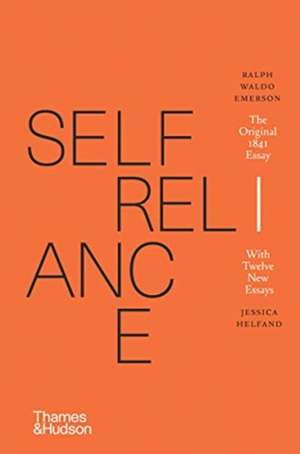
Self-Reliance
Autor Ralph Waldo Emerson Jessica Helfanden Limba Engleză Hardback – 18 mai 2021
Emerson's text is widely available to read online, but this new, graphically reimagined edition, produced with Design Observer, elevates his wisdom through the printed word and includes twelve contemporary essays by Jessica Helfand. To suggest, as Emerson's text does, that the richest lives are lived with an independent mind, spirit, and creativity surely deserves to be celebrated.
| Toate formatele și edițiile | Preț | Express |
|---|---|---|
| Paperback (6) | 36.21 lei 6-8 săpt. | |
| SOUND WISDOM – iul 2025 | 63.38 lei 3-5 săpt. | |
| ARC MANOR – 31 iul 2007 | 36.21 lei 6-8 săpt. | |
| CreateSpace Independent Publishing Platform – | 40.14 lei 3-5 săpt. | |
| CREATESPACE – | 59.09 lei 3-5 săpt. | |
| Lulu.Com – 8 mar 2019 | 60.36 lei 6-8 săpt. | |
| – | 60.91 lei 6-8 săpt. | |
| Hardback (2) | 54.05 lei 3-5 săpt. | +22.33 lei 6-10 zile |
| Thames & Hudson – 18 mai 2021 | 54.05 lei 3-5 săpt. | +22.33 lei 6-10 zile |
| Lulu.Com – 8 mar 2019 | 146.50 lei 6-8 săpt. |
Preț: 54.05 lei
Preț vechi: 68.31 lei
-21%
Puncte Express: 81
Preț estimativ în valută:
9.56€ • 11.34$ • 8.27£
9.56€ • 11.34$ • 8.27£
Carte disponibilă
Livrare economică 25 februarie-11 martie
Livrare express 10-14 februarie pentru 32.32 lei
Specificații
ISBN-13: 9780500024478
ISBN-10: 0500024472
Pagini: 96
Ilustrații: No illustrations
Dimensiuni: 132 x 200 x 14 mm
Greutate: 0.18 kg
Editura: Thames & Hudson
ISBN-10: 0500024472
Pagini: 96
Ilustrații: No illustrations
Dimensiuni: 132 x 200 x 14 mm
Greutate: 0.18 kg
Editura: Thames & Hudson
V-ar putea interesa
-
 Walden and Civil DisobedienceHenry David ThoreauPreț: 30.37 lei
 -
 Letters from a StoicRobin Campbell-21%Preț: 54.23 lei68.38 lei
 -
 Nature and Selected EssaysRalph Waldo Emerson-20%Preț: 71.02 lei89.20 lei
 -
 Civil Disobedience, and Other EssaysHenry David Thoreau-30%Preț: 16.79 lei24.09 lei
 -
 Self-Reliance, and Other EssaysRalph Waldo Emerson-36%Preț: 21.96 lei34.11 lei
 -
 MeditationsMarcus AureliusPreț: 31.49 lei
 -
 Nature and Other EssaysRalph Waldo EmersonPreț: 42.40 lei
 -
 Walden and Other WritingsHenry David ThoreauPreț: 36.02 lei
 -
 Preț: 167.20 lei
 -
 As a Man ThinkethJames Allen-27%Preț: 21.05 lei28.89 lei
 -
 Learning to Trust YourselfTama KievesPreț: 103.64 lei
 -
 Everyday EmersonRalph Waldo EmersonPreț: 130.05 lei
 -
 Notes on Being a ManScott Galloway-24%Preț: 88.36 lei116.38 leiRecomandat
 -
 ProphetKahlil GibranPreț: 24.54 lei
 -
 The Essential Writings of Ralph Waldo EmersonRalph Waldo EmersonPreț: 96.71 lei
 -
 NatureRalph Waldo EmersonPreț: 33.22 lei
 -
 The Spiritual EmersonRalph Waldo EmersonPreț: 68.14 lei
 -
 -30%Preț: 81.33 lei116.25 leiRecomandat
Descriere
A refreshed and covetable new edition of a timeless text.
Notă biografică
Ralph Waldo Emerson (May 25, 1803 - April 27, 1882) was an American essayist, lecturer, philosopher, and poet who led the transcendentalist movement of the mid-19th century. He was seen as a champion of individualism and a prescient critic of the countervailing pressures of society, and he disseminated his thoughts through dozens of published essays and more than 1,500 public lectures across the United States.Emerson gradually moved away from the religious and social beliefs of his contemporaries, formulating and expressing the philosophy of transcendentalism in his 1836 essay "Nature". Following this work, he gave a speech entitled "The American Scholar" in 1837, which Oliver Wendell Holmes Sr. considered to be America's "intellectual Declaration of Independence."[6]Emerson wrote most of his important essays as lectures first and then revised them for print. His first two collections of essays, Essays: First Series (1841) and Essays: Second Series (1844), represent the core of his thinking. They include the well-known essays "Self-Reliance", "The Over-Soul", "Circles", "The Poet", and "Experience." Together with "Nature", these essays made the decade from the mid-1830s to the mid-1840s Emerson's most fertile period. Emerson wrote on a number of subjects, never espousing fixed philosophical tenets, but developing certain ideas such as individuality, freedom, the ability for mankind to realize almost anything, and the relationship between the soul and the surrounding world. Emerson's "nature" was more philosophical than naturalistic: "Philosophically considered, the universe is composed of Nature and the Soul." Emerson is one of several figures who "took a more pantheist or pandeist approach by rejecting views of God as separate from the world. He remains among the linchpins of the American romantic movement, and his work has greatly influenced the thinkers, writers and poets that followed him. "In all my lectures," he wrote, "I have taught one doctrine, namely, the infinitude of the private man."Emerson is also well known as a mentor and friend of Henry David Thoreau, a fellow transcendentalist.Emerson was born in Boston, Massachusetts, on May 25, 1803, a son of Ruth Haskins and the Rev. William Emerson, a Unitarianminister. He was named after his mother's brother Ralph and his father's great-grandmother Rebecca Waldo.Ralph Waldo was the second of five sons who survived into adulthood; the others were William, Edward, Robert Bulkeley, and Charles. Three other children-Phebe, John Clarke, and Mary Caroline-died in childhood.[15] Emerson was entirely of English ancestry, and his family had been in New England since the early colonial period. Emerson's father died from stomach cancer on May 12, 1811, less than two weeks before Emerson's eighth birthday. Emerson was raised by his mother, with the help of the other women in the family; his aunt Mary Moody Emerson in particular had a profound effect on him. She lived with the family off and on and maintained a constant correspondence with Emerson until her death in 1863.