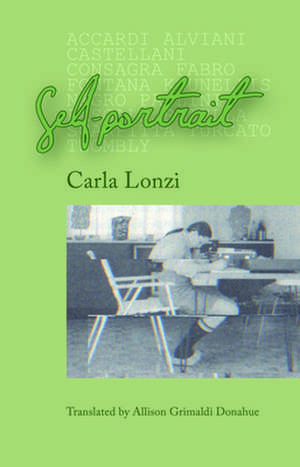
Self-Portrait
Autor Carla Lonzi Traducere de Allison Grimaldi Donahueen Limba Engleză Paperback – 16 dec 2021
Preț: 86.03 lei
Preț vechi: 103.40 lei
-17%
Puncte Express: 129
Carte disponibilă
Livrare economică 30 octombrie-10 noiembrie
Livrare express 14-20 octombrie pentru 50.68 lei
Livrare prin curier în România Termenul estimat este afișat lângă disponibilitate.
Transport gratuit de la 400.00 lei Plată online sau ramburs, în funcție de opțiunile comenzii.
Retur gratuit în 14 zile Comandă securizată și suport în română.
Specificații
ISBN-13: 9781916425088
ISBN-10: 1916425089
Pagini: 300
Dimensiuni: 142 x 218 x 22 mm
Greutate: 0.5 kg
Editura: Divided Publishing
Colecția Divided Publishing
Locul publicării:United Kingdom
ISBN-10: 1916425089
Pagini: 300
Dimensiuni: 142 x 218 x 22 mm
Greutate: 0.5 kg
Editura: Divided Publishing
Colecția Divided Publishing
Locul publicării:United Kingdom
V-ar putea interesa
-
 Preț: 205.41 lei
 -
 Life in ProgressHans Ulrich ObristPreț: 140.03 lei
 -
 Why Have There Been No Great Women Artists?Linda Nochlin-20%Preț: 74.63 lei92.81 lei
 -
 A World of Our OwnFrances Borzello-18%Preț: 187.63 lei229.86 lei
 -
 The Dehumanization of Art and Other Essays on Art, Culture, and LiteratureJosé Ortega Y. GassetPreț: 90.47 lei
 -
 Feminism. Art. Capitalism.Angela DimitrakakiPreț: 189.50 lei
 -
 -27%Preț: 143.09 lei195.60 lei
 -
 -32%Preț: 622.37 lei915.95 lei
 -
 Preț: 123.74 lei
 -
 Self Portrait with BoyRachel Lyon-18%Preț: 58.79 lei71.74 lei
 -
 -27%Preț: 89.19 lei121.90 lei
 -
 -27%Preț: 76.82 lei105.66 lei
 -
 -26%Preț: 59.47 lei79.89 lei
 -
 Artemisia Gentileschi and Feminism in Early Modern EuropeMary D. Garrard-12%Preț: 110.81 lei125.91 lei
 -
 Contemporary Korean ArtMina KimPreț: 312.17 lei
 -
 Feminism in RevoltCarla LonziPreț: 151.40 lei
 -
 Preț: 193.20 lei
 -
 Pissing WomenSophy Rickett-19%Preț: 81.04 lei99.98 lei
 -
 Luisa Lambri: AutoritrattoLuisa LambriPreț: 304.44 lei
Descriere
Carla Lonzi's Self-portrait transforms traditional conceptions of linear art historical thinking, reimagines the role of the critic, as well as the role of women in the world of art. For the first time now, Carla Lonzi can speak for herself in English, inviting readers to engage in her experimental writing and feminist thinking. Self-portrait is one of the earliest examples of an art critic focusing on artists' processes and subjectivity and transforming herself then, into an artist. This translation brings Carla Lonzi's work to an international audience and forces us to reconsider the trajectory of modern art in Italy and beyond since the 1960s.
Notă biografică
Carla Lonzi (b. 1931, Florence; d. 1982, Milan) was an art critic and feminist activist best known for her work with Rivolta Femminile, a feminist collective created in 1970. Following the publication of Autoritratto ('Self-portrait') in 1969, Lonzi published Manifesto di Rivolta femminile (1970), Sputiamo su Hegel. La donna clitoridea e la donna vaginale e altri scritti (1974) and Taci, anzi parla. Diario di una femminista (1977). Due to her uncodified practice, she occupies a singular position within postwar Italian politics and art, and is a crucial figure of European feminism.