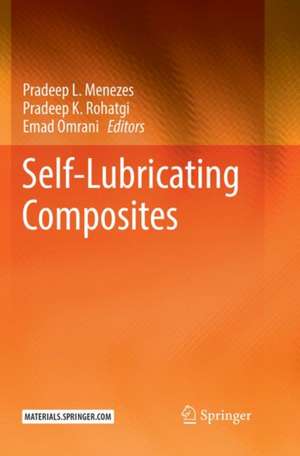
Self-Lubricating Composites
Editat de Pradeep L. Menezes, Pradeep K. Rohatgi, Emad Omranien Limba Engleză Paperback – 10 ian 2019
| Toate formatele și edițiile | Preț | Express |
|---|---|---|
| Paperback (2) | 747.12 lei 3-5 săpt. | +22.53 lei 4-10 zile |
| Springer – 5 ian 2023 | 747.12 lei 3-5 săpt. | +22.53 lei 4-10 zile |
| Springer Berlin, Heidelberg – 10 ian 2019 | 891.36 lei 38-44 zile | |
| Hardback (1) | 1072.09 lei 3-5 săpt. | |
| Springer Berlin, Heidelberg – 4 ian 2022 | 1072.09 lei 3-5 săpt. |
Preț: 891.36 lei
Preț vechi: 1157.61 lei
-23%
Puncte Express: 1337
Preț estimativ în valută:
157.58€ • 187.88$ • 136.67£
157.58€ • 187.88$ • 136.67£
Carte tipărită la comandă
Livrare economică 12-18 martie
Specificații
ISBN-13: 9783662585863
ISBN-10: 3662585863
Pagini: 286
Ilustrații: XIII, 288 p. 171 illus., 82 illus. in color.
Dimensiuni: 155 x 235 mm
Ediția:Softcover reprint of the original 1st ed. 2018
Editura: Springer Berlin, Heidelberg
Colecția Springer
Locul publicării:Berlin, Heidelberg, Germany
ISBN-10: 3662585863
Pagini: 286
Ilustrații: XIII, 288 p. 171 illus., 82 illus. in color.
Dimensiuni: 155 x 235 mm
Ediția:Softcover reprint of the original 1st ed. 2018
Editura: Springer Berlin, Heidelberg
Colecția Springer
Locul publicării:Berlin, Heidelberg, Germany
V-ar putea interesa
-
 -9%Preț: 1015.10 lei1115.49 lei
 -
 Leading-Edge Composite Material ResearchTobias G Wouters-30%Preț: 1149.13 lei1649.83 lei
 -
 Composite Laminates: Properties, Performance & ApplicationsAnders Doughett-31%Preț: 1765.39 lei2546.02 lei
 -
 -9%Preț: 1044.35 lei1147.64 lei
 -
 -21%Preț: 90.92 lei115.47 lei
 -
 Composites in Structural Engineering and ArchitectureThomas KellerPreț: 407.10 lei
 -
 Composite Materials: Science and EngineeringKrishan K. Chawla-18%Preț: 614.76 lei749.71 lei
 -
 Composite MaterialsBrian Wisner-18%Preț: 1327.22 lei1618.56 lei
 -
 -23%Preț: 1370.36 lei1779.69 lei
 -
 -18%Preț: 1508.93 lei1840.17 lei
 -
 -18%Preț: 2388.83 lei2913.21 lei
 -
 Recent Advances in Materials and Manufacturing: Proceedings of ISME 2023C. V. Chandrashekara-18%Preț: 1595.27 lei1945.45 lei
 -
 -18%Preț: 1347.87 lei1643.74 lei
 -
 Advancements in Multifunctional Composite MaterialsB. K. Behera-18%Preț: 1338.35 lei1632.13 lei
 -
 Advances in Materials EngineeringPramod Bhingole-18%Preț: 1180.54 lei1439.68 lei
 -
 -18%Preț: 969.72 lei1182.58 lei
 -
 -18%Preț: 1072.09 lei1307.42 lei
 -
 -18%Preț: 1080.43 lei1317.60 lei
 -
 -18%Preț: 1328.36 lei1619.96 lei
Cuprins
Fundamentals of Solid Lubricants.- Tribology of Self-Lubricating Metal Matrix Composites.- Self-Lubricating Polymer Composites.- Tribology of Self-Lubricating Polymer NanoComposites.- Recent Progress in Self-Lubricating Ceramic Composites.- Polymeric Solid Lubricant Transfer Films: Relating Quality to Wear Performance.- In Situ Generated Turbostratic 2D Graphite: A New Way to Obtain High Performance Self-Lubricating Iron Based Composites.- Surface Engineering Design of Alumina-Matrix Composites.- Molecular Dynamics Simulation of Friction in Self-Lubricating Materials: An Overview of Theories and Available Models.- Environmental Analysis of Self-Lubricating Composites – A Review.
Notă biografică
Pradeep L. Menezes (corresponding author) is an assistant professor in the Department of Mechanical Engineering at the University of Nevada, Reno, Nevada. Before joining this university, he worked as an adjunct assistant professor at the University of Wisconsin–Milwaukee (UWM), Wisconsin and as a research assistant professor at the University of Pittsburgh, Pennsylvania. Dr. Menezes’s productive research career has produced more than 70 peer-reviewed journal publications (citations more than 2000, h-index–24), 25 book chapters, and two books related to tribology. Pradeep K. Rohatgi is a UWM distinguished professor. He has coedited and coauthored 12 books and more than 400 scientific papers and has 19 U.S. patents. He is considered as a world leader in composites and materials policy for the developing world. He has served on committees of governments of United States and India in the areas of materials, especially those related to automotive sector, to promote collaboration. His research includes advanced manufacture of lightweight, energy absorbing, self-lubricating, and self-healing materials and components including micro- and nanocomposites and syntactic foams. He is the founder chief technology officer (CTO) of Intelligent Composites, LLC, Milwaukee, Wisconsin. Emad Omrani is a graduate student of Dr. Rohatgi at the UWM. He has coauthored 2 book chapters and 7 peer-reviewed scientific papers. At UWM, Dr. Menezes collaborated with Dr. Rohatgi and Mr. Omrani in the areas of Tribology and self-lubricating materials and published several research papers on the tribology of self-lubricating materials. Dr. Menezes and Dr. Rohatgi are well-known tribologists and self-lubricating materials scientists. These editors are therefore well known and well connected in this field to put forth an excellent book on this topic.
Caracteristici
No comprehensive literature on self-lubricating materials Rapid demand for advanced materials An awareness for industries to employ self-lubricating materials Replacing oil based lubricants with solid lubricants for different application Environmentally friend materials (green materials)