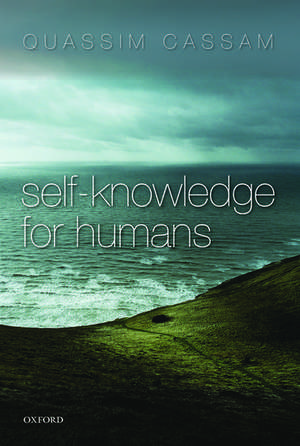
Self-Knowledge for Humans
Autor Quassim Cassamen Limba Engleză Hardback – 27 noi 2014
Preț: 447.19 lei
Preț vechi: 599.13 lei
-25%
Puncte Express: 671
Carte disponibilă
Livrare economică 30 octombrie-04 noiembrie
Livrare prin curier în România Termenul estimat este afișat lângă disponibilitate.
Transport gratuit pentru acest produs Plată online sau ramburs, în funcție de opțiunile comenzii.
Retur gratuit în 14 zile Comandă securizată și suport în română.
Specificații
ISBN-13: 9780199657575
ISBN-10: 0199657572
Pagini: 254
Dimensiuni: 164 x 241 x 20 mm
Greutate: 0.54 kg
Editura: Oxford University Press
Colecția OUP Oxford
Locul publicării:Oxford, United Kingdom
ISBN-10: 0199657572
Pagini: 254
Dimensiuni: 164 x 241 x 20 mm
Greutate: 0.54 kg
Editura: Oxford University Press
Colecția OUP Oxford
Locul publicării:Oxford, United Kingdom
V-ar putea interesa
-
 Self and WorldQuassim Cassam-20%Preț: 327.16 lei406.72 lei
 -
 The Metaphysics of ExperienceLeslie Stevenson-29%Preț: 343.90 lei481.12 lei
 -
 DisagreementRichard Feldman-12%Preț: 267.69 lei305.73 lei
 -
 -31%Preț: 746.12 lei1079.62 lei
 -
 The Possibility of KnowledgeQuassim Cassam-12%Preț: 357.74 lei404.85 lei
 -
 The Oxford Handbook of CausationHelen Beebee-18%Preț: 374.82 lei457.58 lei
 -
 -11%Preț: 331.92 lei373.04 lei
 -
 Knowledge in an Uncertain WorldJeremy Fantl-13%Preț: 302.35 lei346.74 lei
 -
 -12%Preț: 364.59 lei413.01 lei
 -
 The Oxford Handbook of SkepticismJohn Greco-29%Preț: 411.04 lei575.49 lei
 -
 The Girl with the Dragon Tattoo and PhilosophyEric BronsonPreț: 127.36 lei
 -
 In the Dust of This PlanetEugene ThackerPreț: 92.11 lei
 -
 ObjectivityLorraine DastonPreț: 253.29 lei
Recenzii
I highly recommend Cassam's book. It provides a deep, yet admirably accessible study of self-knowledge and surrounding issues, and is full of helpful and often surprising insights.
A particular virtue of the book is its unwavering insistence that philosophical views about self-knowledge must be judged by their fidelity to what self-knowledge actually is, namely, an untidy phenomenon in the lives of cognitively limited creatures...Cassam's realist outlook is sensible and refreshing, and his effort to bring philosophical attention to neglected issues about self-knowledge is commendable.
Valuable for those interested in epistemology, philosophy of mind, and philosophical psychology ... Highly recommended.
is a truly fine book. It is clearly and elegantly written, and metes out criticism fairly while developing a number of lines of powerful argument. It demonstrates where most philosophical discussions of self-knowledge have gone astray, puts forward a plausible positive theory of insubstantial self-knowledge, and makes an important start on the project of examining the nature and importance of substantial self-knowledge. It deserves to be widely read.
A particular virtue of the book is its unwavering insistence that philosophical views about self-knowledge must be judged by their fidelity to what self-knowledge actually is, namely, an untidy phenomenon in the lives of cognitively limited creatures...Cassam's realist outlook is sensible and refreshing, and his effort to bring philosophical attention to neglected issues about self-knowledge is commendable.
Valuable for those interested in epistemology, philosophy of mind, and philosophical psychology ... Highly recommended.
is a truly fine book. It is clearly and elegantly written, and metes out criticism fairly while developing a number of lines of powerful argument. It demonstrates where most philosophical discussions of self-knowledge have gone astray, puts forward a plausible positive theory of insubstantial self-knowledge, and makes an important start on the project of examining the nature and importance of substantial self-knowledge. It deserves to be widely read.
Notă biografică
Quassim Cassam is Professor of Philosophy at the University of Warwick. He was previously Knightbridge Professor of Philosophy at Cambridge, and has also taught at Oxford and UCL. He is the author of Self and World (OUP, 1997), The Possibility of Knowledge (OUP, 2007) and, with John Campbell, Berkeley's Puzzle: What Does Experience Teach Us? (OUP, 2014).
Cuprins
- Preface
- 1: Homo Philosophicus
- 2: The Disparity
- 3: Substantial Self-Knowledge
- 4: Self-Knowledge for Philosophers
- 5: Reality Check
- 6: Psychological Rationalism
- 7: Normative Rationalism
- 8: Predictably Irrational?
- 9: Looking Outwards
- 10: Looking Inwards
- 11: Self-Knowledge and Inference
- 12: Knowing Your Evidence
- 13: Knowing Yourself
- 14: Self-Ignorance
- 15: The Value of Self-Knowledge
- Bibliography
- Index