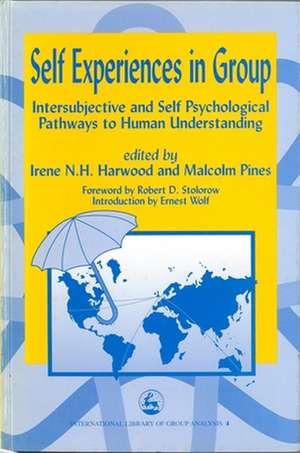
Self Experiences in Group: Intersubjective and Self Psychological Pathways to Human Understanding: International Library of Group Analysis
Editat de Irene Harwood, Malcolm Pinesen Limba Engleză Hardback – feb 1998
Among the topics covered in this volume are:
-the recent advances in hermeneutics, self psychology and intersubjectivity theory
-the universal need for a group object
-Kohut's thinking on archaic and mature twinship
-the applicability of new infant research
-the need to examine early childhood multiple cross-cultural selfobject and traumatic experiences within transferences
-the utilization of a co-therapy model
-and how to create optimal group environments.
Mixing new theoretical developments with clinical research and practice, Self Experiences in Group breaks new ground and illustrates how these concepts can be applied to work at infant, child or adult level.
Din seria International Library of Group Analysis
-
 Preț: 355.70 lei
 - 5%
 Preț: 283.51 lei
 -
 Preț: 167.11 lei
 - 25%
 Preț: 241.24 lei
 - 24%
 Preț: 276.43 lei
 -
 Preț: 296.27 lei
 -
 Preț: 352.60 lei
 -
 Preț: 373.08 lei
 -
 Preț: 369.63 lei
 - 24%
 Preț: 248.42 lei
 -
 Preț: 419.39 lei
 - 25%
 Preț: 241.24 lei
 -
 Preț: 419.70 lei
 - 21%
 Preț: 382.83 lei
 - 25%
 Preț: 268.09 lei
 - 24%
 Preț: 250.46 lei
Preț: 372.45 lei
Preț vechi: 532.13 lei
-30%
Puncte Express: 559
Carte disponibilă
Livrare economică 09-23 noiembrie
Livrare prin curier în România Termenul estimat este afișat lângă disponibilitate.
Transport gratuit de la 400.00 lei Plată online sau ramburs, în funcție de opțiunile comenzii.
Retur gratuit în 14 zile Comandă securizată și suport în română.
Specificații
ISBN-13: 9781853025969
ISBN-10: 1853025968
Pagini: 192
Dimensiuni: 159 x 235 x 15 mm
Greutate: 0.4 kg
Editura: JESSICA KINGSLEY PUBLISHERS
Colecția Jessica Kingsley Publishers
Seria International Library of Group Analysis
Locul publicării:London, United Kingdom
ISBN-10: 1853025968
Pagini: 192
Dimensiuni: 159 x 235 x 15 mm
Greutate: 0.4 kg
Editura: JESSICA KINGSLEY PUBLISHERS
Colecția Jessica Kingsley Publishers
Seria International Library of Group Analysis
Locul publicării:London, United Kingdom
V-ar putea interesa
-
 The Trauma TherapiesJohn Marzillier-21%Preț: 438.49 lei552.66 lei
 -
 Callen's Ultrasonography in Obstetrics and GynecologyMary E. Norton-5%Preț: 1043.37 lei1098.28 lei
 -
 Preț: 423.33 lei
 -
 Integrative Counselling & PsychotherapyAriana Faris-5%Preț: 424.71 lei447.06 lei
 -
 Preț: 422.02 lei
 -
 ObstetricsJyotsna Pundir-5%Preț: 333.33 lei350.87 lei
 -
 Core Principles Meditation for TherapyAnnellen M SimpkinsPreț: 310.37 lei
 -
 Group Therapy Homework Planner, with Download eBookLouis J BevilacquaPreț: 431.38 lei
 -
 Integrative Health through Music TherapySuzanne B. Hanser-5%Preț: 306.10 lei322.21 lei
 -
 Preț: 405.41 lei
 -
 -36%Preț: 308.31 lei484.35 lei
 -
 Preț: 373.08 lei
 -
 -5%Preț: 283.51 lei298.42 lei
 -
 -20%Preț: 161.87 lei202.11 lei
 -
 -28%Preț: 238.01 lei331.80 lei
 -
 Foundation and Form in Jungian SandplayLenore SteinhardtPreț: 296.78 lei
 -
 -5%Preț: 311.58 lei327.97 lei
 -
 Handbook of Consult and Inpatient GynecologyPaula C. Brady-5%Preț: 752.16 lei791.74 lei
Recenzii
This book is an important introduction to the theory and practice of adapting self psychology ideas to the analytic group setting.
Harwood, who is from the United States, comes together with Pines, who is from England, to edit this well-organised and well-written book …This book has an intimacy to it. One gets the feeling that the authors are a group unto themselves. They quote each other and influence one another, despite their coming from the United States, Italy, Norway and England. they are bold contributers to modern self-psychology who take on Freud, Kohut, Stolorow and others inculding themselves … As a woman, Irene Harwood's perspective is refreshing. One is immersed in hearing about Freud and Kohut and how they practive in their office. Then on to Stolorow, Lachmann, and other men who are doing dyadic therapy. Dr Harwood brings the reader into the real world of working moms and child-care workers, other cultures where the extended family presides, and to war, where traumas take place and reperation does not happen therapists' offices.
This is the first book published which has attempted to apply the self-psychology of Kohut to group psychotherapy. With a distinguished selection of international contributors the authors discuss the application of the basic theory to the realities of current group pschotherapy ppractice. A succinct chapter by Harwood outlines the elements of self-psychology and how these have developed and been modified in recent years. She also demonstrates by reference to clinical vignettes how the group is a rich setting for the exploration of self-psychology concepts. An important chapter by Silvers on the co-therapy model stresses the value of introducing various aspects of co-therapy which allow for examination of the multiple-selves and the relationships to significant others in the network of successive care-givers. The book is one of a series in the recently introduced International Library Of Group Analysis. I cannot reccomend it too highly for its clarity and the depth of its intellectual understanding on the topic.
The first collection of papers dedicated to linking the ideas of self psychology with the practice of group psychotherapy... a very good introduction to this topic. It covers an interesting range of topics: Kohut's own views, intersubjectivity, group self, infant research, the notion of cure, the relationship between self psychology and group analysis, among others. Newcomers to the field of groups will find good starting points (especially in the chapter by Pines), while experienced practitioners will find much to be stimulated by in the rest... Those of you with an interest in group psychotherapy should familiarise yourselves with its content.
Harwood, who is from the United States, comes together with Pines, who is from England, to edit this well-organised and well-written book …This book has an intimacy to it. One gets the feeling that the authors are a group unto themselves. They quote each other and influence one another, despite their coming from the United States, Italy, Norway and England. they are bold contributers to modern self-psychology who take on Freud, Kohut, Stolorow and others inculding themselves … As a woman, Irene Harwood's perspective is refreshing. One is immersed in hearing about Freud and Kohut and how they practive in their office. Then on to Stolorow, Lachmann, and other men who are doing dyadic therapy. Dr Harwood brings the reader into the real world of working moms and child-care workers, other cultures where the extended family presides, and to war, where traumas take place and reperation does not happen therapists' offices.
This is the first book published which has attempted to apply the self-psychology of Kohut to group psychotherapy. With a distinguished selection of international contributors the authors discuss the application of the basic theory to the realities of current group pschotherapy ppractice. A succinct chapter by Harwood outlines the elements of self-psychology and how these have developed and been modified in recent years. She also demonstrates by reference to clinical vignettes how the group is a rich setting for the exploration of self-psychology concepts. An important chapter by Silvers on the co-therapy model stresses the value of introducing various aspects of co-therapy which allow for examination of the multiple-selves and the relationships to significant others in the network of successive care-givers. The book is one of a series in the recently introduced International Library Of Group Analysis. I cannot reccomend it too highly for its clarity and the depth of its intellectual understanding on the topic.
The first collection of papers dedicated to linking the ideas of self psychology with the practice of group psychotherapy... a very good introduction to this topic. It covers an interesting range of topics: Kohut's own views, intersubjectivity, group self, infant research, the notion of cure, the relationship between self psychology and group analysis, among others. Newcomers to the field of groups will find good starting points (especially in the chapter by Pines), while experienced practitioners will find much to be stimulated by in the rest... Those of you with an interest in group psychotherapy should familiarise yourselves with its content.
Cuprins
Foreword, Robert D. Stolorow, Institute of Contemporary Psychoanalysis, Los Angeles. Preface, Irene N.H. Harwood. Acknowledgements. Introduction, Ernest Wolf, Chicago Institute for Psychoanalysis. 1. A Consideration of Kohut's views on group psychotherapy, Frederic Arensberg, Postgraduate Center for Mental Health, New York. 2. The self as a group: the group as a self, Malcolm Pines. 3. Advances in group psychotherapy and self psychology: an intersubjective approach, Irene N.H. Harwood. 4 Intersubjectivity in archaic and mature twinship in group psychotherapy, Emanuel Shapiro, Postgraduate Center for Mental Health, New York. 5. Harvest of fire: archaic twinship and fundamental conflict within a community and in group therapy, Martin S. Livingston, New York Institute for Psychoanalytic Self-Psychology. 6. How does group psychotherapy Cure? A reconceptualization of the group process: from self psychology to the intersubjective perspective, Franco Paparo, Psychiatric Public Hospital and Gianni Nebbiosi, Institute for the P~sychoanalytic Study of Subjectivity, Rome. 7. The group self, empathy, intersubjectivity and hermeneutics: a group analytic perspective, Sigmund W Rarterud, University of Oslo. 8. Infant research and intersubjective responsiveness in group therapy, Joan Schain- West California Institute for Clinical Social Work. 9. Examining early childhood multiple cross-cultural extended selfobject and traumatic experiences and creating optimum treatment environments, Irene N.H. Harwood. 10. A multiple selfobject and traumatizing experiences: co-therapy model at work, Damon L. Silvers, Institute of Contemporary Psychotherapy, Washington, DC. 11. Motivational Systems and group object theory: implications for group therapy, Rosemary A. Segalla, Institute of Contemporary Psychotherapy. 12. Can group analysis/psychotherapy provide a wide angle lens for self psychology? Irene N.H. Harwood. 13. Notes on optimal responsiveness in the group process, Howard A. Bacal, Institute of Contemporary Psychoanalysis, Los Angeles. List of Contributors. Subject Index.