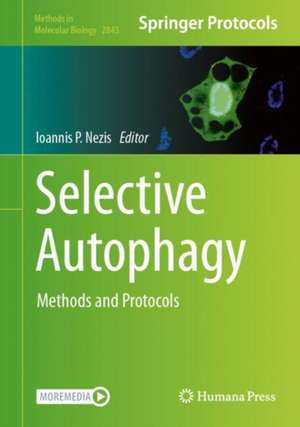
Selective Autophagy: Methods in Molecular Biology, cartea 2845
Editat de Ioannis P. Nezisen Limba Engleză Hardback – 9 aug 2024
Cutting-edge and comprehensive, Selective Autophagy: Methods and Protocols is a valuable resource for novice and expert researchers who want to learn more about this interesting and developing field.
Chapter 3 is available open access under a Creative Commons Attribution 4.0 International License via link.springer.com.
Din seria Methods in Molecular Biology
- 5%
 Preț: 752.32 lei
 - 5%
 Preț: 753.38 lei
 - 5%
 Preț: 762.24 lei
 - 5%
 Preț: 767.04 lei
 - 15%
 Preț: 682.63 lei
 - 18%
 Preț: 1056.83 lei
 - 5%
 Preț: 756.75 lei
 - 18%
 Preț: 942.11 lei
 - 15%
 Preț: 683.53 lei
 - 15%
 Preț: 673.77 lei
 - 18%
 Preț: 1459.88 lei
 - 5%
 Preț: 762.94 lei
 - 18%
 Preț: 1001.24 lei
 - 15%
 Preț: 679.26 lei
 - 5%
 Preț: 759.52 lei
 - 18%
 Preț: 1014.54 lei
 - 5%
 Preț: 755.09 lei
 - 5%
 Preț: 760.91 lei
 - 18%
 Preț: 992.42 lei
 - 15%
 Preț: 672.54 lei
 - 5%
 Preț: 1087.05 lei
 - 18%
 Preț: 1005.26 lei
 - 18%
 Preț: 2199.73 lei
 - 5%
 Preț: 1345.68 lei
 - 18%
 Preț: 1441.01 lei
 - 18%
 Preț: 1446.89 lei
 - 18%
 Preț: 1171.86 lei
 - 18%
 Preț: 1461.94 lei
 - 18%
 Preț: 1166.54 lei
 - 18%
 Preț: 1001.54 lei
 - 5%
 Preț: 1347.38 lei
 - 5%
 Preț: 1150.76 lei
 - 5%
 Preț: 755.42 lei
 - 18%
 Preț: 1160.38 lei
 - 18%
 Preț: 991.80 lei
 - 18%
 Preț: 1453.36 lei
 - 5%
 Preț: 1331.69 lei
 - 18%
 Preț: 1285.76 lei
 - 18%
 Preț: 1275.27 lei
 - 5%
 Preț: 1704.75 lei
 - 5%
 Preț: 1159.98 lei
 - 5%
 Preț: 1470.11 lei
 - 18%
 Preț: 811.84 lei
 - 5%
 Preț: 1674.66 lei
 - 5%
 Preț: 1142.35 lei
 - 5%
 Preț: 1355.98 lei
 - 5%
 Preț: 1679.79 lei
 - 18%
 Preț: 786.39 lei
 - 5%
 Preț: 1211.72 lei
Preț: 1156.76 lei
Preț vechi: 1410.69 lei
-18%
Puncte Express: 1735
Carte tipărită la comandă
Livrare economică 08-22 decembrie
Livrare prin curier în România Termenul estimat este afișat lângă disponibilitate.
Transport gratuit pentru acest produs Plată online sau ramburs, în funcție de opțiunile comenzii.
Retur gratuit în 14 zile Comandă securizată și suport în română.
Specificații
ISBN-13: 9781071640661
ISBN-10: 1071640666
Pagini: 260
Ilustrații: CCLXX, 270 p. 53 illus., 42 illus. in color.
Dimensiuni: 183 x 260 x 20 mm
Greutate: 0.63 kg
Ediția:2024
Editura: Humana
Colecția Methods in Molecular Biology
Seria Methods in Molecular Biology
Locul publicării:New York, NY, United States
ISBN-10: 1071640666
Pagini: 260
Ilustrații: CCLXX, 270 p. 53 illus., 42 illus. in color.
Dimensiuni: 183 x 260 x 20 mm
Greutate: 0.63 kg
Ediția:2024
Editura: Humana
Colecția Methods in Molecular Biology
Seria Methods in Molecular Biology
Locul publicării:New York, NY, United States
Cuprins
Using Fluorescence Microscopy and Immunoblotting for Monitoring Mitophagy in Budding Yeast.- Methods to Monitor Nucleophagy in Yeast.- Synthetic Dimerization Approaches for In Vivo Studies in Saccharomyces cerevisiae.- Assays to Study Mitophagy in Plants.- Assessing Neuronal Mitophagy during Development in the Nematode Caenorhabditis elegans.- In Vivo Monitoring of Nucleophagy in Caenorhabditis elegans.- Analysis of Mitophagy Reporters in Drosophila.- Studying Selective Autophagy of Protein Aggregates using Particles Induced by Multimerization (PIMs).- Methods for Monitoring ER-phagy.- Quantitative Super-Resolution Imaging of ER-phagy Initiation in Cells.- Fluorescence Methods to Measure Pexophagy.- Methods for Monitoring Mitophagy using mt-Keima.- Monitoring Mitophagy Dynamics in Live Cells.- Methods for Monitoring NCOA4-Mediated Ferritinophagy.- Method to Purify Phase-Separated p62 Bodies using Fluorescence-Activated Particle Sorting.- In Silico Assessment of LIR Motif-Containing Proteins Binding to ATG8-Family Proteins.- High Throughput Screening for LC3/GABARAP Binders Utilizing the Fluorescence Polarization Assay.- Thermodynamic Characterization of LC3/GABARAP:Ligand Interactions by Isothermal Titration Calorimetry.- Determination of hATG8 Binding Selectivity of Autophagy-Interacting Motif (AIM) Peptides Using Native Electrospray Ionization Mass Spectrometry.
Textul de pe ultima copertă
This volume presents the latest techniques used by researchers to study selective autophagy in a broad range of organisms such as yeast, plants, worms, fruit flies, and mammals. The chapters in this book cover several types of selective autophagy such as mitophagy, aggrephagy, ER-phagy, ferritinophagy, pexophagy, and nucleophagy. Written in the highly successful Methods in Molecular Biology series format, chapters include introductions to their respective topics, lists of the necessary materials and reagents, step-by-step, readily reproducible laboratory protocols, and tips on troubleshooting and avoiding known pitfalls.
Cutting-edge and comprehensive, Selective Autophagy: Methods and Protocols is a valuable resource for novice and expert researchers who want to learn more about this interesting and developing field.
Chapter 3 is available open access under a Creative Commons Attribution 4.0 International License via link.springer.com.
Cutting-edge and comprehensive, Selective Autophagy: Methods and Protocols is a valuable resource for novice and expert researchers who want to learn more about this interesting and developing field.
Chapter 3 is available open access under a Creative Commons Attribution 4.0 International License via link.springer.com.
Caracteristici
Includes cutting-edge methods and protocols Provides step-by-step detail essential for reproducible results Contains key notes and implementation advice from the experts