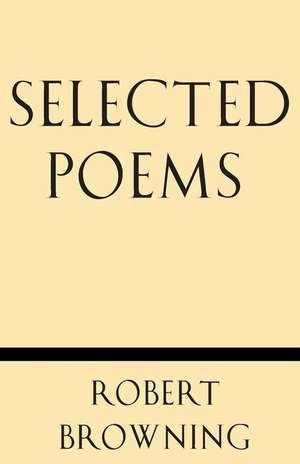
Selected Poems
Autor Robert Browningen Limba Engleză Paperback
By Robert Browning
Contents
My Star
Incident of the French Camp
Home Thoughts from Abroad
Rabbi Ben Ezra
Memorabilia
Abt Vogler
The Lost Leader
The Boy and the Angel
Andrea del Sarto
"Good News from Ghent"
By the Fireside
My Last Duchess
Introduction
Robert Browning was born at Camberwell, a suburb of London, May 7, 1812. From his earliest years he was fond of writing verses, and when twelve years of age had produced poems enough to form a volume. His first published poem, "Pauline," appeared in 18333, but his real introduction to the public was through "Paracelsus," a drama, published in 1835. In 1837 the tragedy of "Strafford" was unsuccessfully presented at Drury Lane Theater. In 1840 the epic "Sordello" was published, one of his most characteristic and most difficult works. In 1841-1846 appeared the series of "Bells and Pomegranates," in eight shilling parts, containing much of his finest poetry, including the tragedy "A Blot in the 'Scutcheon" and the graceful dramatic poem "Pippa Passes." In 1846 he was married to the distinguished poetess, Elizabeth Barrett, and soon after established his home in Italy. "Christmas Eve and Easter Day" appeared in 1850, followed by two volumes of short poems, "Men and Women," 1855, and "Dramatis Personae," 1864. His greatest work, "The Ring and teh Book," appeared in 1868-9, closely followed by many other important poems, chief of which are "Fifine at the Fair," 1872; "Red Cotton Night-cap country," 1873; "Aristophanes' Apology" and "The Inn Album," 1875. Most important of his latest works are "Dramatic Idyls," 1879-80; "Jocoseria," 1883; "Ferishtah's Fancies," 1885; and "Parleyings with Certain People of Importance in their Day," 1887.
The first and perhaps the final impression we receive from the works of Robert Browning is that of a great nature, an immense personality. The poet in him is made up of many men. He is dramatist, humorist, lyrist, painter, musician, philosopher, and scholar, each in full measure, and he includes and dominates them all. In richness of nature, in scope and penetration of mind and vision, in all the potentialities of poetry, he is probably second among English poets to Shakespeare alone. In art, in the power of...
------------------------------------------------------------------------------------------------------------------------------------------
Windham Press is committed to bringing the lost cultural heritage of ages past into the 21st century through high-quality reproductions of original, classic printed works at affordable prices.
This book has been carefully crafted to utilize the original images of antique books rather than error-prone OCR text. This also preserves the work of the original typesetters of these classics, unknown craftsmen who laid out the text, often by hand, of each and every page you will read. Their subtle art involving judgment and interaction with the text is in many ways superior and more human than the mechanical methods utilized today, and gave each book a unique, hand-crafted feel in its text that connected the reader organically to the art of bindery and book-making.
We think these benefits are worth the occasional imperfection resulting from the age of these books at the time of scanning, and their vintage feel provides a connection to the past that goes beyond the mere words of the text.
Preț: 74.80 lei
Puncte Express: 112
Carte disponibilă
Livrare economică 07-21 noiembrie
Livrare prin curier în România Termenul estimat este afișat lângă disponibilitate.
Transport gratuit de la 400.00 lei Plată online sau ramburs, în funcție de opțiunile comenzii.
Retur gratuit în 14 zile Comandă securizată și suport în română.
Specificații
ISBN-13: 9781628452747
ISBN-10: 1628452749
Pagini: 58
Dimensiuni: 140 x 216 x 3 mm
Greutate: 0.08 kg
Editura: Windham Press
ISBN-10: 1628452749
Pagini: 58
Dimensiuni: 140 x 216 x 3 mm
Greutate: 0.08 kg
Editura: Windham Press
V-ar putea interesa
-
 The Penguin Book of Victorian VerseDaniel KarlinPreț: 152.54 lei
 -
 The Poetical Works of Robert Browning: Volume VI: Dramatis PersonæRobert Inglesfield-33%Preț: 1221.10 lei1814.82 lei
 -
 The Major WorksRobert Browning-16%Preț: 88.17 lei104.43 lei
 -
 The New Oxford Book of Victorian VerseChristopher Ricks-17%Preț: 97.08 lei117.13 lei
 -
 Final HarvestEmily DickinsonPreț: 113.02 lei
 -
 Selected PoemsEmily Dickinson-51%Preț: 17.53 lei35.42 lei
 -
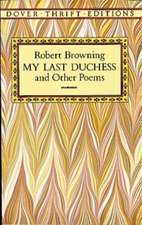 My Last Duchess and Other PoemsRobert BrowningPreț: 31.89 lei
 -
 Preț: 22.87 lei
 -
 The PoemsWilliam ShakespearePreț: 58.34 lei
 -
 A. E. HousmanA. E. HousmanPreț: 68.99 lei
 -
 Ezra PoundEzra PoundPreț: 69.31 lei
 -
 Robert BrowningJohn WoolfordPreț: 290.56 lei
 -
 The Poetry of Robert FrostRobert FrostPreț: 155.70 lei
 -
 The Collected Poems of Wilfred OwenWilfred OwenPreț: 81.90 lei
 -
 Selected PoemsJen Hadfield-35%Preț: 68.31 lei105.52 lei
 -
 Elizabeth Barrett Browning: Much-loved poems from one of the greatest Romantic poetsElizabeth Barrett Browning-28%Preț: 40.63 lei56.12 lei
 -
 Browning: PoemsRobert BrowningPreț: 99.03 lei
 -
 The Pied Piper of HamelinRobert BrowningPreț: 37.71 lei
 -
 Victorian Poetry: An AnthologyErik Gray-24%Preț: 452.16 lei594.01 lei
 -
 The Collected Poems of Elizabeth Barrett BrowningElizabeth Barrett BrowningPreț: 35.38 lei
Notă biografică
Robert Browning was born on May 7, 1812, in Camberwell, London), the first-born of Robert and Sarah Browning. His mother was a Non-Conformist and an accomplished pianist. Mr. Browning senior had forgone a fortune after objecting to the slavery on the family's plantation in the West Indies. He became instead a clerk in the Bank of England. Despite his modest salary he was able to marry, raise a family, and to acquire a library of some 6,000 books.Most of the poet's education came at home. He was an extremely bright child and an omnivorous reader and learned Latin, Greek, French and Italian before his mid-teens. He attended the University of London in 1828, the year it first opened (now University College London), but left after a year to continue his further education at his own pace.In the 1830s he met the actor William Macready and wrote several verse dramas, without much in the way of success. At the same time he was developing his verse syle with an emphasis on dramatic situations and character analysis. His first publication, 'Pauline', printed anonymously and with a subvention from his father, failed to find a single buyer. His next, 'Paracelsus', failed also to find many readers amongst the wider public, but did create a name for him amongst the literati. His third volume, 'Sordello' (1840) came close to ruining his reputation for good, as almost no-one understood what he was trying to do. Subsequent to this failure he further developed the dramatic monologue as his favoured form, with the narrator invariably not being the author himself, and presenting a slippery notion of reality and truth.In the mid-1840s, after having read and admired the work of Elizabeth Barrett (1806-1861), he arranged to meet her. She was a semi-invalid and lived under the thumb of a domineering father, who forbade any of his children to marry. Despite this, the two fell in love, and eloped, living in Italy-mostly in Florence-until Elizabeth's death. While they were together, Elisabeth was much the better-known poet, but Robert began to develop his own public from the mid-1850s onwards and became lionised after his return to London, following the death of his wife. His ascent into the living pantheon was achieved with the monumental verse-novel 'The Ring and the Book' (1868-9), and his reputation continued to remain high until his death, despite some of his later books not finding favour-Browning continued to push the boundaries of taste, and could upset the genteel Victorian reading public with works such as 'Red Cotton Night-Cap Country' (a dismal title for what is in fact another interesting verse novel). His last book, 'Asolando', appeared on the day he died and went through fourteen editions-a contrast to 'Sordello', which only sold some 150 copies in its first 15 years.
Cuprins
Selected PoemsIntroduction
Note on the Text
Porphyria's Lover
Johannes Agricola in Meditation
Song from Pippa Passes ("The year's at the spring")
Scene from Pippa Passes ("There goes a swallow to Venice...")
My Last Duchess
Soliloquy of the Spanish Cloister
The Pied Piper of Hamelin; A Chld's Story
"How They Brought the Good News from Ghent to Aix"
The Lost Leader
Meeting at Night
Parting at Morning
Home-Thoughts, from Abroad
The Bishop Orders His Tomb at Saint Praxed's Church
Love Among the Ruins
A Lovers' Quarrel
Up at a Villa - Down in the City
Fra Lippo Lippi
A Toccata of Galuppi's
An Epistle Containing the Strange Medical Experience of Karshish, the Arab Physician
Mesmerism
A Serenade at the Villa
"Childe Roland to the Dark Tower Came"
The Statue and the Bust
How It Strikes a Contemporary
The Patriot
Memorabilia
Andrea del Sarto
In a Year
Cleon
Two in the Campagna
A Grammarian's Funeral
James Lee's Wife
I. James Lee's Wife Speaks at the Window
II. By the Fireside
III. In the Doorway
IV. Along the Beach
V. On the Cliff
VI. Reading a Book, Under the Cliff
VII. Among the Rocks
VIII. Beside the Drawing-Board
IX. On Deck
Gold Hair: A Story of Pornic
Dis Aliter Visum; or, Le Byron de Nos Jours
A Death in the Desert
Caliban upon Setebos; or, Natural Theology in the Island
Confessions
Youth and Art
A Likeness
Mr. Sludge, "The Medium"
Apparent Failure
Epilogue [to Dramatis Personae]
House
Saint Martin's Summer
Ned Bratts
Clive
[Wanting is - what?]
Donald
Never the Time and the Place
The Names
Now
Beatric Signorini
Spring Song
Notes
Index of Titles
Index of First Lines
Note on the Text
Porphyria's Lover
Johannes Agricola in Meditation
Song from Pippa Passes ("The year's at the spring")
Scene from Pippa Passes ("There goes a swallow to Venice...")
My Last Duchess
Soliloquy of the Spanish Cloister
The Pied Piper of Hamelin; A Chld's Story
"How They Brought the Good News from Ghent to Aix"
The Lost Leader
Meeting at Night
Parting at Morning
Home-Thoughts, from Abroad
The Bishop Orders His Tomb at Saint Praxed's Church
Love Among the Ruins
A Lovers' Quarrel
Up at a Villa - Down in the City
Fra Lippo Lippi
A Toccata of Galuppi's
An Epistle Containing the Strange Medical Experience of Karshish, the Arab Physician
Mesmerism
A Serenade at the Villa
"Childe Roland to the Dark Tower Came"
The Statue and the Bust
How It Strikes a Contemporary
The Patriot
Memorabilia
Andrea del Sarto
In a Year
Cleon
Two in the Campagna
A Grammarian's Funeral
James Lee's Wife
I. James Lee's Wife Speaks at the Window
II. By the Fireside
III. In the Doorway
IV. Along the Beach
V. On the Cliff
VI. Reading a Book, Under the Cliff
VII. Among the Rocks
VIII. Beside the Drawing-Board
IX. On Deck
Gold Hair: A Story of Pornic
Dis Aliter Visum; or, Le Byron de Nos Jours
A Death in the Desert
Caliban upon Setebos; or, Natural Theology in the Island
Confessions
Youth and Art
A Likeness
Mr. Sludge, "The Medium"
Apparent Failure
Epilogue [to Dramatis Personae]
House
Saint Martin's Summer
Ned Bratts
Clive
[Wanting is - what?]
Donald
Never the Time and the Place
The Names
Now
Beatric Signorini
Spring Song
Notes
Index of Titles
Index of First Lines
Descriere
Descriere de la o altă ediție sau format:
Presents a selection of poems by the author. This book contains such poems as "My Last Duchess", "Fra Lippo Lippi" and "The Pied Piper of Hamelin". It displays the author's innovative techniques of diction, rhythm and symbol, which transformed Victorian poetry and influenced major poets of the twentieth century such as Ezra Pound, and T S Eliot.
Presents a selection of poems by the author. This book contains such poems as "My Last Duchess", "Fra Lippo Lippi" and "The Pied Piper of Hamelin". It displays the author's innovative techniques of diction, rhythm and symbol, which transformed Victorian poetry and influenced major poets of the twentieth century such as Ezra Pound, and T S Eliot.