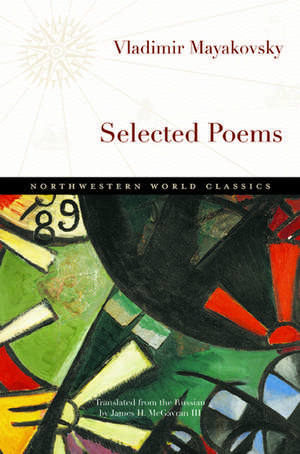
Selected Poems: Northwestern World Classics
Autor Vladimir Mayakovsky Traducere de James H. McGavran III, III, James H. McGavran, IIIen Limba Engleză Paperback – 30 iun 2013





Preț: 124.04 lei
Puncte Express: 186
Carte indisponibilă temporar
Doresc să fiu notificat când acest titlu va fi disponibil:
Se trimite...
Specificații
ISBN-13: 9780810129078
ISBN-10: 0810129078
Pagini: 404
Dimensiuni: 130 x 197 x 25 mm
Greutate: 0.45 kg
Ediția:New.
Editura: Northwestern University Press
Colecția Northwestern University Press
Seria Northwestern World Classics
ISBN-10: 0810129078
Pagini: 404
Dimensiuni: 130 x 197 x 25 mm
Greutate: 0.45 kg
Ediția:New.
Editura: Northwestern University Press
Colecția Northwestern University Press
Seria Northwestern World Classics
Notă biografică
VLADIMIR MAYAKOVSKY (1893–1930), one of Russia’s greatest twentieth-century writers, was a Futurist, early Bolshevik, and champion of the avant-garde.
JAMES H. McGAVRAN III is a visiting assistant professor of Russian at St. Olaf College in Northfield, Minnesota.
JAMES H. McGAVRAN III is a visiting assistant professor of Russian at St. Olaf College in Northfield, Minnesota.
Descriere
James McGavran’s new translation of Vladimir Mayakovsky’s poetry is the first to fully capture the Futurist and Soviet agitprop artist’s voice. Because of his work as a propagandist for the Soviet regime, and because of his posthumous enshrinement by Stalin as “the best and most talented poet of our Soviet epoch,” Mayakovsky has most often been interpreted—and translated—within a political context. McGavran’s translations reveal a more nuanced poet who possessed a passion for word creation and linguistic manipulation. Mayakovsky’s bombastic metaphors and formal élan shine through in these translations, and McGavran’s commentary provides vital information on Mayakovsky, illuminating the poet’s many references to the Russian literary canon, his contemporaries in art and culture, and Soviet figures and policies.