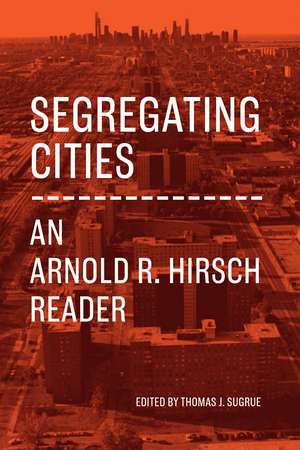
Segregating Cities: An Arnold R. Hirsch Reader: Historical Studies of Urban America
Autor Arnold R. Hirsch Editat de Thomas J. Sugrueen Limba Engleză Paperback – 7 mai 2026
Arnold R. Hirsch (1949–2018) was one of the preeminent urban historians of his generation, a reputation cemented by his landmark book, Making the Second Ghetto. With compelling clarity, Hirsch demonstrated that segregation is not the inevitable result of individual choices, natural tendencies, or cultural traits—it is a structural phenomenon, reinforced on every level by state power.
Segregating Cities collects the author’s key essays, some previously unpublished, to reveal a more complete picture of a remarkable scholar and his exploration of race, place, politics, and policy in the twentieth-century American city. Together, these essays can help us see segregation for what it is, so that we can then begin to truly work to overcome it.
Din seria Historical Studies of Urban America
-
 Preț: 224.52 lei
 -
 Preț: 148.00 lei
 -
 Preț: 244.98 lei
 -
 Preț: 240.71 lei
 -
 Preț: 201.25 lei
 - 8%
 Preț: 614.77 lei
 -
 Preț: 203.62 lei
 -
 Preț: 259.72 lei
 -
 Preț: 211.13 lei
 -
 Preț: 355.60 lei
 - 8%
 Preț: 612.68 lei
 -
 Preț: 350.57 lei
 -
 Preț: 224.59 lei
 -
 Preț: 267.91 lei
 -
 Preț: 208.68 lei
 -
 Preț: 241.04 lei
 -
 Preț: 242.49 lei
 -
 Preț: 249.45 lei
 -
 Preț: 254.93 lei
 -
 Preț: 210.15 lei
 -
 Preț: 276.02 lei
 -
 Preț: 280.45 lei
 -
 Preț: 244.24 lei
 -
 Preț: 264.40 lei
 -
 Preț: 276.65 lei
 -
 Preț: 224.09 lei
 -
 Preț: 192.00 lei
 -
 Preț: 244.68 lei
 -
 Preț: 287.57 lei
 -
 Preț: 277.59 lei
 -
 Preț: 299.23 lei
 -
 Preț: 252.49 lei
 -
 Preț: 295.95 lei
 -
 Preț: 251.29 lei
 -
 Preț: 312.54 lei
 -
 Preț: 252.45 lei
 -
 Preț: 266.54 lei
 -
 Preț: 329.99 lei
 -
 Preț: 266.60 lei
 -
 Preț: 364.02 lei
 -
 Preț: 338.38 lei
 -
 Preț: 309.41 lei
 -
 Preț: 241.08 lei
Preț: 262.58 lei
Puncte Express: 394
Carte disponibilă
Livrare economică 05-19 noiembrie
Livrare express 22-28 octombrie pentru 46.61 lei
Livrare prin curier în România Termenul estimat este afișat lângă disponibilitate.
Transport gratuit de la 400.00 lei Plată online sau ramburs, în funcție de opțiunile comenzii.
Retur gratuit în 14 zile Comandă securizată și suport în română.
Specificații
ISBN-13: 9780226744544
ISBN-10: 022674454X
Pagini: 560
Ilustrații: 7 halftones, 4 tables
Dimensiuni: 152 x 229 x 33 mm
Greutate: 0.69 kg
Editura: University of Chicago Press
Colecția University of Chicago Press
Seria Historical Studies of Urban America
ISBN-10: 022674454X
Pagini: 560
Ilustrații: 7 halftones, 4 tables
Dimensiuni: 152 x 229 x 33 mm
Greutate: 0.69 kg
Editura: University of Chicago Press
Colecția University of Chicago Press
Seria Historical Studies of Urban America
Notă biografică
Arnold R. Hirsch (1949–2018) was the Ethel and Herman L. Midlo Endowed Chair for New Orleans Studies at the University of New Orleans. The author of the influential Making the Second Ghetto: Race and Housing in Chicago, 1940–1960, Hirsch’s research showed how racism pervaded every stratum of American society. Thomas J. Sugrue is the Julius Silver Professor of Social and Cultural Analysis and History at New York University. He is the author of Not Even Past: Barack Obama and the Burden of Race, Sweet Land of Liberty: The Forgotten Struggle for Civil Rights in the North, and The Origins of the Urban Crisis: Race and Inequality in Postwar Detroit, as well as coauthor of These United States: A Nation in the Making, 1890 to the Present.
Cuprins
Editor’s Preface
Introduction: The Hard Work of Segregation: Arnold Hirsch and Critical Histories of Race by Thomas J. Sugrue
Part I: First and Second Ghettos
1. With or Without Jim Crow: Black Residential Segregation in the United States
2. E Pluribus Duo?: Thoughts on “Whiteness” and Chicago’s “New” Immigration as a Transient Third Tier
3. Massive Resistance in the Urban North: Trumbull Park, Chicago, 1953–1966
4. Second Thoughts on the Second Ghetto
Part II: Aiming Low and Falling Short: Segregation and the State
5. “Containment” on the Home Front: Race and Federal Housing Policy from the New Deal to the Cold War
6. Searching for a “Sound Negro Policy”: A Racial Agenda for the Housing Acts of 1949 and 1954
7. “The Last and Most Difficult Barrier”: Segregation and Federal Housing Policy in the Eisenhower Administration, 1953–1960
8. Less Than Plessy: The Inner-City, Suburbs and State-Sanctioned Residential Segregation in the Age of Brown
Part III: The Devil Is in the Details: Segregation in Practice
9. Original Sins: Micro-Decisions and the Legacy of Segregation in Chicago’s Public Housing
10. Public Policy and Residential Segregation in Baltimore, 1910–1968
11. Race and Renewal in the Cold War South: New Orleans, 1947–1968
Part IV: Race and Urban Politics
12. Chicago: The Cook County Democratic Organization and the Dilemma of Race, 1931–1987
13. Harold and Dutch Revisited: A Comparative Look at the First Black Mayors of Chicago and New Orleans
Acknowledgments
Index
Introduction: The Hard Work of Segregation: Arnold Hirsch and Critical Histories of Race by Thomas J. Sugrue
Part I: First and Second Ghettos
1. With or Without Jim Crow: Black Residential Segregation in the United States
2. E Pluribus Duo?: Thoughts on “Whiteness” and Chicago’s “New” Immigration as a Transient Third Tier
3. Massive Resistance in the Urban North: Trumbull Park, Chicago, 1953–1966
4. Second Thoughts on the Second Ghetto
Part II: Aiming Low and Falling Short: Segregation and the State
5. “Containment” on the Home Front: Race and Federal Housing Policy from the New Deal to the Cold War
6. Searching for a “Sound Negro Policy”: A Racial Agenda for the Housing Acts of 1949 and 1954
7. “The Last and Most Difficult Barrier”: Segregation and Federal Housing Policy in the Eisenhower Administration, 1953–1960
8. Less Than Plessy: The Inner-City, Suburbs and State-Sanctioned Residential Segregation in the Age of Brown
Part III: The Devil Is in the Details: Segregation in Practice
9. Original Sins: Micro-Decisions and the Legacy of Segregation in Chicago’s Public Housing
10. Public Policy and Residential Segregation in Baltimore, 1910–1968
11. Race and Renewal in the Cold War South: New Orleans, 1947–1968
Part IV: Race and Urban Politics
12. Chicago: The Cook County Democratic Organization and the Dilemma of Race, 1931–1987
13. Harold and Dutch Revisited: A Comparative Look at the First Black Mayors of Chicago and New Orleans
Acknowledgments
Index
Recenzii
“Hirsch’s prose is at once careful and cutting, laying bare the structural and social forces that shaped our urban environment. Segregating Cities is authoritative, urgent, and humane scholarship. It’s a model and inspiration for anyone who values the truth about America and race.”
“Every scholar today who writes about racism, segregation, class, immigration, liberalism, housing, cities, mob violence, municipal, state or federal politics, or the construction of whiteness owes a debt to Arnold R. Hirsch. This fine collection of Hirch’s brilliant and bracing articles, including several that were never-before published, demonstrates why.”
“The influence of Hirsch’s scholarship on how historians today conceive and write about race, power, and politics in twentieth-century American cities cannot be overstated. This compilation of Hirsch’s most important essays, including previously unpublished work, will be essential reading for anyone seeking to understand how the structures and institutions that fuel racial segregation and inequality were built and maintained, as well as for those who are working to dismantle them.”
“Segregating Cities is an important collection of the work of Arnold R. Hirsch, a historian who reframed the discussion of race, ethnicity, and social class in the American city. This compilation demonstrates the vast scope of Hirsch’s work and adds to the continuing discussion of his concept of the Second Ghetto and its impact on American urban life. It is a worthy partner to his classic study, Making the Second Ghetto, and a vital book for anyone interested in the ongoing discussion of race in the United States.”
“As he did over four decades ago, Hirsch continues to enlighten us on the key actors, guiding principles, and policy choices that shaped US cities and their racial composition in the post-World War era. Lest we think that segregation, particularly in northern cities, happened naturally or by accident, Hirsch dives deep into local and federal policymakers’ and elected officials’ deliberations, their private comments, public pronouncements, and the frequent contradictions between the two. He shows us the consequences of their actions. He also highlights those who had the courage to defend racial liberalism, integration, and equitable policies for African Americans and other minorities. Hirsch has left an extraordinary legacy for urban historians.”
“Every scholar today who writes about racism, segregation, class, immigration, liberalism, housing, cities, mob violence, municipal, state or federal politics, or the construction of whiteness owes a debt to Arnold R. Hirsch. This fine collection of Hirch’s brilliant and bracing articles, including several that were never-before published, demonstrates why.”
“The influence of Hirsch’s scholarship on how historians today conceive and write about race, power, and politics in twentieth-century American cities cannot be overstated. This compilation of Hirsch’s most important essays, including previously unpublished work, will be essential reading for anyone seeking to understand how the structures and institutions that fuel racial segregation and inequality were built and maintained, as well as for those who are working to dismantle them.”
“Segregating Cities is an important collection of the work of Arnold R. Hirsch, a historian who reframed the discussion of race, ethnicity, and social class in the American city. This compilation demonstrates the vast scope of Hirsch’s work and adds to the continuing discussion of his concept of the Second Ghetto and its impact on American urban life. It is a worthy partner to his classic study, Making the Second Ghetto, and a vital book for anyone interested in the ongoing discussion of race in the United States.”
“As he did over four decades ago, Hirsch continues to enlighten us on the key actors, guiding principles, and policy choices that shaped US cities and their racial composition in the post-World War era. Lest we think that segregation, particularly in northern cities, happened naturally or by accident, Hirsch dives deep into local and federal policymakers’ and elected officials’ deliberations, their private comments, public pronouncements, and the frequent contradictions between the two. He shows us the consequences of their actions. He also highlights those who had the courage to defend racial liberalism, integration, and equitable policies for African Americans and other minorities. Hirsch has left an extraordinary legacy for urban historians.”