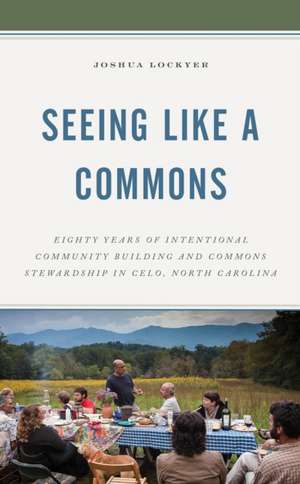
Seeing Like a Commons: Eighty Years of Intentional Community Building and Commons Stewardship in Celo, North Carolina
Autor Joshua Lockyeren Limba Engleză Paperback – 27 ian 2023
Preț: 221.62 lei
Preț vechi: 307.39 lei
-28%
Puncte Express: 332
Carte tipărită la comandă
Livrare economică 27 noiembrie-11 decembrie
Livrare prin curier în România Termenul estimat este afișat lângă disponibilitate.
Transport gratuit de la 400.00 lei Plată online sau ramburs, în funcție de opțiunile comenzii.
Retur gratuit în 14 zile Comandă securizată și suport în română.
Specificații
ISBN-13: 9781498592901
ISBN-10: 1498592902
Pagini: 278
Ilustrații: 10 b/w photos; 1 tables;
Dimensiuni: 152 x 228 x 17 mm
Greutate: 0.38 kg
Editura: Bloomsbury Publishing
Colecția Lexington Books
Locul publicării:New York, United States
ISBN-10: 1498592902
Pagini: 278
Ilustrații: 10 b/w photos; 1 tables;
Dimensiuni: 152 x 228 x 17 mm
Greutate: 0.38 kg
Editura: Bloomsbury Publishing
Colecția Lexington Books
Locul publicării:New York, United States
Cuprins
Part I: Introduction and History
Introduction: Intentional Community, Commons, and Utopia
Chapter 1: Arthur Morgan, Utopianism, and the Founding of Celo Community
Chapter 2: Cultivating Intentional Community Commons: A History of Celo Community
Chapter 3: A Commons Community Today: Celo through the Lens of Transformative Utopianism
Part II: Design Principles for a Commons Community
Chapter 4: Common Land and Community Membership: Celo's Social and Spatial Boundaries
Chapter 5: Creating Our Own Commons Rules
Chapter 6: Governing Ourselves and Our Commons
Chapter 7: Keeping Each Other Honest
Chapter 8: When One of Us is Not Honest
Chapter 9: Dealing with Disputes on the Commons
Chapter 10: Gaining Official Recognition
Chapter 11: The Commons and Larger Democratic Systems
Chapter 12: Beyond the Design Principles: Other Factors that Make Celo Work
Conclusion: Cultivating Commons Subjects in and Beyond Intentional Community
Introduction: Intentional Community, Commons, and Utopia
Chapter 1: Arthur Morgan, Utopianism, and the Founding of Celo Community
Chapter 2: Cultivating Intentional Community Commons: A History of Celo Community
Chapter 3: A Commons Community Today: Celo through the Lens of Transformative Utopianism
Part II: Design Principles for a Commons Community
Chapter 4: Common Land and Community Membership: Celo's Social and Spatial Boundaries
Chapter 5: Creating Our Own Commons Rules
Chapter 6: Governing Ourselves and Our Commons
Chapter 7: Keeping Each Other Honest
Chapter 8: When One of Us is Not Honest
Chapter 9: Dealing with Disputes on the Commons
Chapter 10: Gaining Official Recognition
Chapter 11: The Commons and Larger Democratic Systems
Chapter 12: Beyond the Design Principles: Other Factors that Make Celo Work
Conclusion: Cultivating Commons Subjects in and Beyond Intentional Community
Recenzii
Seeing Like a Commons is a worthy addition to the scholarly literature on intentional communities. It focuses on Celo, an 80-year-old, 1,200-acre intentional community located in rural North Carolina.. Lockyer sees Celo as a dynamic, ongoing, and largely successful social experiment. He uses the concept of the community as a commons to explain Celo, defining the commons as both a resource (e.g., land) and as an internal social system for managing the resource by a group that shares values and feelings of community identity. He draws heavily on the work of Elinor Ostrom, discussing Celo's implementation of several of her commons design principles. Lockyer's book has relevance for students across the social sciences who are interested in social change as implemented by a long-standing alternative community. Recommended. General readers through faculty.
Seeing Like a Commons is the definitive study of the famous Celo community founded by Arthur Morgan, the Tennessee Valley Authority chairman. Now, after Celo's first eighty years, Joshua Lockyer's research reveals the processes that make it one of the longest enduring secular communal utopias in America. Lockyer's effective application of the Community Design Principles identified by Nobel Prize winning political economist Elinor Ostrom provide both a practical and theoretical framework for his on-sight ethnographic observations, interviews, and for the book itself. Seeing Like a Commons is the first work to apply Ostrom's commons concept to the field of communal studies. Lockyer's own theory of transformative utopianism and use of the theory of developmental communalism also add to a deeper understanding of Celo's success. Engaging vignettes, with which Lockyer opens chapters, personalize for the reader the inner workings of Celo's governance and resolution of interpersonal conflicts. In all, Seeing Like a Commons is ethnography, history, and communal utopian studies at their best.
Lockyer's study goes into rich detail about the lives of Celo's members and how Celo deals with such perennial community issues as decision-making, rule enforcement, new members, interactions with neighbors, and stewardship of natural resources. Seeing Like a Commons is much more than an ethnography, for Lockyer skillfully contextualizes Celo's goals of creating a more just, resilient, and sustainable world. Lockyer's hope that Celo can show all of us 'a different way of living in the belly of the beast' is sure to be realized in this excellent book.
With rich ethnographical and historical material from Celo, North Carolina, this book illuminates efforts to re-animate heritages of long-term cooperation in contexts dominated by competitive individualism and utilitarian market relations. Drawing on Ostrom's studies of commons that have evolved over millennia among place-based communities managing socio-ecosystems worldwide, Lockyer engages work by Bollier, Escobar, Scott, and Gibson-Graham to elegantly theorize contemporary practices of commoning and community. Lockyer motivates students and scholars to ally with endeavors to reestablish local commoning, arguing that, in a world facing deep socio-environmental crises, such efforts contribute toward sociocultural changes necessary to revive our global commons.
Seeing Like a Commons is the definitive study of the famous Celo community founded by Arthur Morgan, the Tennessee Valley Authority chairman. Now, after Celo's first eighty years, Joshua Lockyer's research reveals the processes that make it one of the longest enduring secular communal utopias in America. Lockyer's effective application of the Community Design Principles identified by Nobel Prize winning political economist Elinor Ostrom provide both a practical and theoretical framework for his on-sight ethnographic observations, interviews, and for the book itself. Seeing Like a Commons is the first work to apply Ostrom's commons concept to the field of communal studies. Lockyer's own theory of transformative utopianism and use of the theory of developmental communalism also add to a deeper understanding of Celo's success. Engaging vignettes, with which Lockyer opens chapters, personalize for the reader the inner workings of Celo's governance and resolution of interpersonal conflicts. In all, Seeing Like a Commons is ethnography, history, and communal utopian studies at their best.
Lockyer's study goes into rich detail about the lives of Celo's members and how Celo deals with such perennial community issues as decision-making, rule enforcement, new members, interactions with neighbors, and stewardship of natural resources. Seeing Like a Commons is much more than an ethnography, for Lockyer skillfully contextualizes Celo's goals of creating a more just, resilient, and sustainable world. Lockyer's hope that Celo can show all of us 'a different way of living in the belly of the beast' is sure to be realized in this excellent book.
With rich ethnographical and historical material from Celo, North Carolina, this book illuminates efforts to re-animate heritages of long-term cooperation in contexts dominated by competitive individualism and utilitarian market relations. Drawing on Ostrom's studies of commons that have evolved over millennia among place-based communities managing socio-ecosystems worldwide, Lockyer engages work by Bollier, Escobar, Scott, and Gibson-Graham to elegantly theorize contemporary practices of commoning and community. Lockyer motivates students and scholars to ally with endeavors to reestablish local commoning, arguing that, in a world facing deep socio-environmental crises, such efforts contribute toward sociocultural changes necessary to revive our global commons.