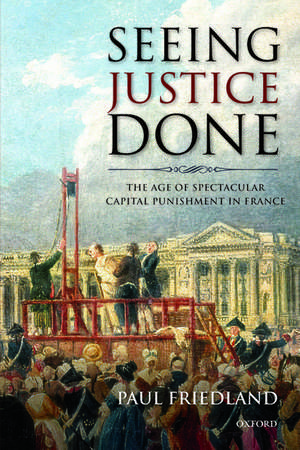
Seeing Justice Done: The Age of Spectacular Capital Punishment in France
Autor Paul Friedlanden Limba Engleză Paperback – 3 iul 2014
Preț: 304.60 lei
Preț vechi: 378.95 lei
-20%
Puncte Express: 457
Carte tipărită la comandă
Livrare economică 03-08 decembrie
Livrare prin curier în România Termenul estimat este afișat lângă disponibilitate.
Transport gratuit de la 400.00 lei Plată online sau ramburs, în funcție de opțiunile comenzii.
Retur gratuit în 14 zile Comandă securizată și suport în română.
Specificații
ISBN-13: 9780198715993
ISBN-10: 0198715994
Pagini: 346
Ilustrații: 15 black and white images
Dimensiuni: 157 x 234 x 18 mm
Greutate: 0.49 kg
Editura: OUP OXFORD
Colecția OUP Oxford
Locul publicării:Oxford, United Kingdom
ISBN-10: 0198715994
Pagini: 346
Ilustrații: 15 black and white images
Dimensiuni: 157 x 234 x 18 mm
Greutate: 0.49 kg
Editura: OUP OXFORD
Colecția OUP Oxford
Locul publicării:Oxford, United Kingdom
V-ar putea interesa
-
 The Structure of Soviet History: Essays and DocumentsRonald Grigor Suny-23%Preț: 631.86 lei822.29 lei
 -
 -31%Preț: 562.71 lei810.91 lei
 -
 -31%Preț: 949.34 lei1379.37 lei
 -
 -12%Preț: 308.99 lei350.21 lei
 -
 -20%Preț: 303.12 lei380.82 lei
 -
 Saltpeter: The Mother of GunpowderDavid Cressy-11%Preț: 352.74 lei397.67 lei
 -
 -27%Preț: 375.36 lei515.85 lei
 -
 -13%Preț: 302.85 lei347.00 lei
 -
 Preț: 390.48 lei
 -
 OdessaCharles KingPreț: 109.73 lei
 -
 Preț: 61.96 lei
 -
 German Orientalism in the Age of EmpireSuzanne L. MarchandPreț: 379.08 lei
 -
 The Business of WarDavid ParrottPreț: 298.17 lei
 -
 France Divided: The French and the Civil War in SpainDavid Wingeate PikePreț: 471.64 lei
Recenzii
Seeing Justice Done would be a worthwhile addition to any academic law library or other library seeking to enhance its legal history collection and to provide its users with a unique and educational book selection ... It is highly recommended.
Highly recommended.
This thoughtful and thought-provoking book is filled with interesting, arcane information. The argument is clear and the research admirable.
Paul Friedland's book provides a scholarly, coherent and lucid analysis of legal change, social attitudes and the mechanics of crime and punishment in France during the late middle ages and the early modern period, focusing on capital punishment.Anyone wanting to understand how capital punishment developed in the first place, both in France and on the wider European stage, and how the move towards its diminution and abolition began, should read this book.
This book's impressive timespan provides the reader with access to an extraordinary range of interrelated material, which Friedland astutely juggles into a cohesive whole.
"By concentrating on the history of capital punishment when it was performed publicly in France, Friedland hopes to provoke reflection on the continued use of the death penalty in the United States today... [Friedland] has written a sweeping intellectual and cultural history that challenges a number of prevailing explanations about the rise and fall of public executions in France."
Highly recommended.
This thoughtful and thought-provoking book is filled with interesting, arcane information. The argument is clear and the research admirable.
Paul Friedland's book provides a scholarly, coherent and lucid analysis of legal change, social attitudes and the mechanics of crime and punishment in France during the late middle ages and the early modern period, focusing on capital punishment.Anyone wanting to understand how capital punishment developed in the first place, both in France and on the wider European stage, and how the move towards its diminution and abolition began, should read this book.
This book's impressive timespan provides the reader with access to an extraordinary range of interrelated material, which Friedland astutely juggles into a cohesive whole.
"By concentrating on the history of capital punishment when it was performed publicly in France, Friedland hopes to provoke reflection on the continued use of the death penalty in the United States today... [Friedland] has written a sweeping intellectual and cultural history that challenges a number of prevailing explanations about the rise and fall of public executions in France."
Notă biografică
Paul Friedland is an affiliate of the Minda de Gunzburg Center for European Studies at Harvard University. He is currently a fellow of the Shelby Cullom Davis Center for Historical Studies at Princeton University (2011-2012). His first book, Political Actors: Representative Bodies and Theatricality in the Age of the French Revolution (2002), was awarded the Pinkney Prize for the best book of the year by the Society for French Historical Studies.
Cuprins
- Introduction: Reading and Writing a History of Punishment
- Part I: The Roots of Modern Punishment in Pre-Modern Europe
- 1: The Fall and Rise of Rome: Compensation, Atonement, and Deterrence in the Early Middle Ages
- 2: Criminal Intent and Spectacular Punishment: The Infiltration of Roman Legal Theory and Practice into French Customary Law
- PART II: Executioners and the Ritual of Execution
- 3: Extraordinary Beings: The Life and Work of Executioners
- 4: The Execution of Justice: The Ritual of Punishment in Medieval and Early Modern France
- PART III: Spectators and Spectacle
- 5: From Ritual to Spectacle: The Rise of the Penal Voyeur in Early Modern France
- 6: Executions, Spectator Emotions, and the Naturalization of Sympathy
- 7: A Spectacular Crisis: Watching Executions in the Age of Sensibilité
- Part IV: A Death Penalty for the Modern Age
- 8: Theorizing a New Death Penalty: Penal Reform on the Eve of the Revolution
- 9: Legislating the New Death Penalty: The Simple Deprivation of Life
- 10: Executing the New Death Penalty: The Invisible Spectacle of the Guillotine
- Epilogue: The Play Over, The Actors (Slowly) Leave the Stage (1794-1939)
- Conclusion: Punishment Past and Present