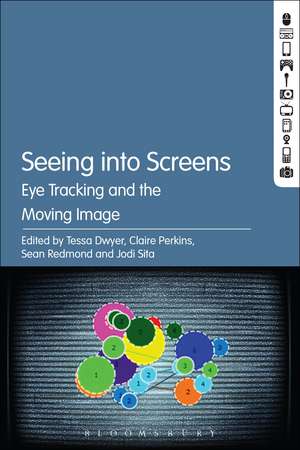
Seeing into Screens: Eye Tracking and the Moving Image
Editat de Professor Tessa Dwyer, Claire Perkins, Professor Sean Redmond, Jodi Sitaen Limba Engleză Hardback – 25 ian 2018
The editors divide their collection into the following four sections: eye tracking performance, which addresses the ways viewers respond to screen genre, actor and star, auteur, and cinematography; eye tracking aesthetics which explores the way viewers gaze upon colour, light, movement, and space; eye tracking inscription, which examines the way the viewer responds to subtitles, translation, and written information found in the screen world; and eye tracking augmentation which examines the role of simulation, mediation, and technological intervention in the way viewers engage with screen content. At a time when the nature of viewing the screen is extending and diversifying across different platforms and exhibitions, Seeing into Screens is a timely exploration of how viewers watch the screen.
Preț: 773.20 lei
Preț vechi: 1152.70 lei
-33%
Puncte Express: 1160
Carte tipărită la comandă
Livrare economică 03-17 decembrie
Livrare prin curier în România Termenul estimat este afișat lângă disponibilitate.
Transport gratuit pentru acest produs Plată online sau ramburs, în funcție de opțiunile comenzii.
Retur gratuit în 14 zile Comandă securizată și suport în română.
Specificații
ISBN-13: 9781501329029
ISBN-10: 1501329022
Pagini: 288
Ilustrații: 44 bw illus
Dimensiuni: 152 x 229 x 23 mm
Greutate: 0.55 kg
Editura: Bloomsbury Publishing
Colecția Bloomsbury Academic
Locul publicării:New York, United States
ISBN-10: 1501329022
Pagini: 288
Ilustrații: 44 bw illus
Dimensiuni: 152 x 229 x 23 mm
Greutate: 0.55 kg
Editura: Bloomsbury Publishing
Colecția Bloomsbury Academic
Locul publicării:New York, United States
Cuprins
Introduction: the Blackest and Whitest of Swans (Tessa Dwyer, Monash University, Australia; Claire Perkins, Monash University, Australia; Sean Redmond, Deakin University, Australia; Jodi Sita, Australian Catholic University, Australia)
Section 1: Seeing the Eye
1. In Order to See, You Must Look Away: Thinking About the Eye (William Brown, University of Roehampton, London, UK)
2. Invisible Rhythms: Tracking Aesthetic Perception in Film and the Visual Arts (Paul Atkinson, Monash University, Melbourne, Australia)
3. The Development of Eye Tracking in Empirical Research on Subtitling and Captioning: from Individual Measures to Constructs of Visual Attention, Cognitive Load, and Psychological Immersion (Stephen Doherty, University of New South Wales, Australia, Jan-Louis Kruger, Macquarie University, Australia)
4. Into the film with Music. Measuring Eyeblinks to Explore the Role of Film Music for Emotional Arousal and Narrative Transportation (Ann-Kristin Wallengren and Alexander Strukelj, Lund University, Sweden)
5. Looking at Sound: Sound Design and the Audiovisual Influences on Gaze (Jonathan P. Batten and Tim J. Smith, Birkbeck, University of London, UK)
6. Passing Time: Eye Tracking Slow Cinema (Tessa Dwyer and Claire Perkins, Monash University, Australia)
Section 2: The Eye Seeing
7. Shaping Abstractions: Eye Tracking Experimental Film (Sean Redmond, Deakin, Australia and Jodi Sita, Australian Catholic University, Australia)
8. Audiences as Detectives: Eye Tracking and Problem Solving in Screen Mysteries (Jared Orth, University of Melbourne, Australia)
9. Discordant Faces, Duplicitous Feelings: The Eye's Affective Lures of Drive (Laura Henderson, Monash University, Australia)
10. Using Eye Tracking and Raiders of the Lost Ark (1981) to Investigate Stardom (Sarah Thomas, Aberystwyth University, UK, Adam Qureshi and Amy Bell, Edge Hill University, UK)
11. A proposed workflow for the creation of integrated titles - Based on eye tracking data (Wendy Fox, Johannes Gutenberg University of Mainz, Germany)
12. Eye-tracking, Subtitling and Accessible Filmmaking (Pablo Romero-Fresco, University of Roehampton, London, UK)
Bibliography
Index
Section 1: Seeing the Eye
1. In Order to See, You Must Look Away: Thinking About the Eye (William Brown, University of Roehampton, London, UK)
2. Invisible Rhythms: Tracking Aesthetic Perception in Film and the Visual Arts (Paul Atkinson, Monash University, Melbourne, Australia)
3. The Development of Eye Tracking in Empirical Research on Subtitling and Captioning: from Individual Measures to Constructs of Visual Attention, Cognitive Load, and Psychological Immersion (Stephen Doherty, University of New South Wales, Australia, Jan-Louis Kruger, Macquarie University, Australia)
4. Into the film with Music. Measuring Eyeblinks to Explore the Role of Film Music for Emotional Arousal and Narrative Transportation (Ann-Kristin Wallengren and Alexander Strukelj, Lund University, Sweden)
5. Looking at Sound: Sound Design and the Audiovisual Influences on Gaze (Jonathan P. Batten and Tim J. Smith, Birkbeck, University of London, UK)
6. Passing Time: Eye Tracking Slow Cinema (Tessa Dwyer and Claire Perkins, Monash University, Australia)
Section 2: The Eye Seeing
7. Shaping Abstractions: Eye Tracking Experimental Film (Sean Redmond, Deakin, Australia and Jodi Sita, Australian Catholic University, Australia)
8. Audiences as Detectives: Eye Tracking and Problem Solving in Screen Mysteries (Jared Orth, University of Melbourne, Australia)
9. Discordant Faces, Duplicitous Feelings: The Eye's Affective Lures of Drive (Laura Henderson, Monash University, Australia)
10. Using Eye Tracking and Raiders of the Lost Ark (1981) to Investigate Stardom (Sarah Thomas, Aberystwyth University, UK, Adam Qureshi and Amy Bell, Edge Hill University, UK)
11. A proposed workflow for the creation of integrated titles - Based on eye tracking data (Wendy Fox, Johannes Gutenberg University of Mainz, Germany)
12. Eye-tracking, Subtitling and Accessible Filmmaking (Pablo Romero-Fresco, University of Roehampton, London, UK)
Bibliography
Index
Recenzii
An absorbing collection that is bound to become a key text in the emerging areas of eye tracking studies and psychocinematics. Seeing into Screens brings together leading scholars in the field who offer rich and nuanced readings of screen examples through eye tracking analysis. In unison, they reveal the dramatic ways in which eye tracking analysis can enrich traditional approaches to film and screen studies, including aesthetics, cognition, narrative immersion, sound and music, and embodiment. A must read!