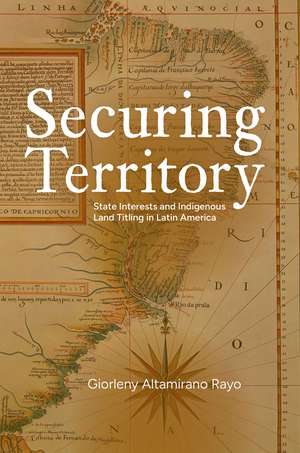
Securing Territory: State Interests and Indigenous Land Titling in Latin America
Autor Giorleny Altamirano Rayoen Limba Engleză Hardback – 4 feb 2025
Preț: 421.98 lei
Preț vechi: 547.40 lei
-23%
Puncte Express: 633
Carte tipărită la comandă
Livrare economică 24-29 septembrie
Livrare prin curier în România Termenul estimat este afișat lângă disponibilitate.
Transport gratuit pentru acest produs Plată online sau ramburs, în funcție de opțiunile comenzii.
Retur gratuit în 14 zile Comandă securizată și suport în română.
Specificații
ISBN-13: 9780197770863
ISBN-10: 019777086X
Pagini: 272
Dimensiuni: 156 x 234 x 19 mm
Greutate: 0.59 kg
Editura: Oxford University Press
Colecția OUP USA
Locul publicării:New York, United States
ISBN-10: 019777086X
Pagini: 272
Dimensiuni: 156 x 234 x 19 mm
Greutate: 0.59 kg
Editura: Oxford University Press
Colecția OUP USA
Locul publicării:New York, United States
V-ar putea interesa
-
 -32%Preț: 648.06 lei959.74 lei
 -
 Settler-Colonial Sovereignty: Visions of Improvement and Indigenous ErasureLiam Midzain-GobinPreț: 257.89 lei
 -
 Savages and Citizens: How Indigeneity Shapes the StateAndrew CanessaPreț: 482.92 lei
 -
 Indigenous Alliance Making: Histories of Agency in Colonial Lowland South AmericaJames Andrew WhitakerPreț: 264.15 lei
 -
 Preț: 239.04 lei
 -
 Red Skin, White Masks: Rejecting the Colonial Politics of RecognitionGlen Sean CoulthardPreț: 172.99 lei
 -
 Preț: 389.93 lei
 -
 Explorations in Legal Geography: Law, Space and RegulationMariana Valverde-8%Preț: 441.34 lei479.71 lei
 -
 -21%Preț: 143.00 lei181.05 lei
 -
 -31%Preț: 130.54 lei189.49 lei
 -
 The Age of the BorderlandsAndrew C. IsenbergPreț: 245.24 lei
 -
 Preț: 207.58 lei
 -
 At the Margins of the Modern StateSeyla BenhabibPreț: 156.71 lei
 -
 -36%Preț: 550.64 lei865.93 lei
 -
 Preț: 138.33 lei
 -
 The ServiceberryRobin Wall KimmererPreț: 104.44 lei
 -
 -19%Preț: 156.12 lei193.10 lei
 -
 -19%Preț: 210.12 lei260.52 lei
 -
 On PowerMark R. Levin-20%Preț: 107.08 lei133.67 leiRecomandat
 -
 Territorialising Space in Latin AmericaAndrew Boni Noguez-17%Preț: 514.39 lei619.75 lei
Recenzii
It is very unusual to find a study that tackles the question of indigenous titling across different macro regions of the world (Latin America, Africa, and Southeast Asia) as this one does, and even more unusual to find a work that does so with a clear theoretical argument about the drivers of titling. Running against the grain of much work in this area, Altamirano Rayo shows why and how indigenous land titling can happen in concert with state interests (and sometimes at state initiative), and how it can limit indigenous autonomy while reinforcing the advantages and prerogatives of the state. The book is an impressive achievement that will widen policy and theoretical debates on this topic.
This book offers a thorough testing of the theory of state control in relation to titling of Indigenous lands. Altamirano Rayo's argument that by granting land titles to Indigenous communities, the authorities curb the internal threat to state sovereignty is significant and has not been studied in such detail previously. Another merit is the extensive and at times very revealing interview material with high-ranking administrators and officials which overall contributes greatly to the depth of the analysis in the book.
This book offers a thorough testing of the theory of state control in relation to titling of Indigenous lands. Altamirano Rayo's argument that by granting land titles to Indigenous communities, the authorities curb the internal threat to state sovereignty is significant and has not been studied in such detail previously. Another merit is the extensive and at times very revealing interview material with high-ranking administrators and officials which overall contributes greatly to the depth of the analysis in the book.
Notă biografică
Giorleny Altamirano Rayo is an Instructor in the Heinz College of Information Systems and Public Policy at Carnegie Mellon University. She is a lawyer, political scientist, and applied researcher interested in property rights, natural resource management, and political-economic development issues in Latin America in a comparative perspective. Her work has been funded by Fulbright, the National Science Foundation, Carnegie Mellon University, the University of Texas at Austin, and Vanderbilt University. She is the author of numerous articles about the Global South and also the translator of original work about historical and contemporary Latin American politics. In addition to her scholarly work, she serves as a Chief Data Scientist and Responsible AI Official at the United States Department of State, served as a diplomat in the Nicaraguan Ministry of Foreign Affairs, and as an applied researcher at Vanderbilt University. She has been working and conducting research in and about the GlobalSouth for over fifteen years. The views expressed in this and other works are her own and not necessarily those of the U.S. Government and the U.S. Department of State.