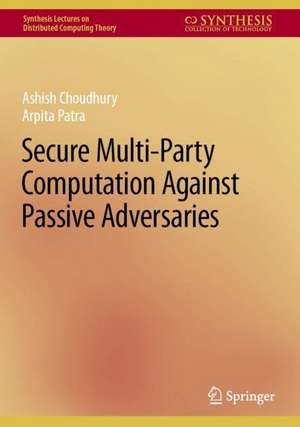
Secure Multi-Party Computation Against Passive Adversaries: Synthesis Lectures on Distributed Computing Theory
Autor Ashish Choudhury, Arpita Patraen Limba Engleză Hardback – 8 oct 2022
Din seria Synthesis Lectures on Distributed Computing Theory
- 20%
 Preț: 219.23 lei
 - 20%
 Preț: 218.56 lei
 - 20%
 Preț: 260.97 lei
 - 20%
 Preț: 369.94 lei
 - 20%
 Preț: 372.72 lei
 - 20%
 Preț: 374.47 lei
 - 20%
 Preț: 371.69 lei
 - 20%
 Preț: 203.10 lei
 - 20%
 Preț: 322.36 lei
 - 20%
 Preț: 197.27 lei
 - 20%
 Preț: 290.62 lei
 - 20%
 Preț: 259.44 lei
 - 20%
 Preț: 221.80 lei
 - 20%
 Preț: 218.21 lei
 - 20%
 Preț: 218.74 lei
 - 20%
 Preț: 262.67 lei
 - 20%
 Preț: 237.04 lei
 - 20%
 Preț: 370.95 lei
 - 20%
 Preț: 366.46 lei
 - 20%
 Preț: 262.46 lei
Preț: 419.42 lei
Preț vechi: 524.28 lei
-20%
Puncte Express: 629
Carte tipărită la comandă
Livrare economică 25 noiembrie-01 decembrie
Livrare prin curier în România Termenul estimat este afișat lângă disponibilitate.
Transport gratuit pentru acest produs Plată online sau ramburs, în funcție de opțiunile comenzii.
Retur gratuit în 14 zile Comandă securizată și suport în română.
Specificații
ISBN-13: 9783031121630
ISBN-10: 3031121635
Pagini: 248
Ilustrații: XIII, 231 p. 85 illus., 50 illus. in color.
Dimensiuni: 173 x 246 x 20 mm
Greutate: 0.54 kg
Ediția:1st ed. 2022
Editura: Springer
Colecția Synthesis Lectures on Distributed Computing Theory
Seria Synthesis Lectures on Distributed Computing Theory
Locul publicării:Cham, Switzerland
ISBN-10: 3031121635
Pagini: 248
Ilustrații: XIII, 231 p. 85 illus., 50 illus. in color.
Dimensiuni: 173 x 246 x 20 mm
Greutate: 0.54 kg
Ediția:1st ed. 2022
Editura: Springer
Colecția Synthesis Lectures on Distributed Computing Theory
Seria Synthesis Lectures on Distributed Computing Theory
Locul publicării:Cham, Switzerland
Cuprins
Introduction.- Relevant Topics from Abstract Algebra.- Secret Sharing.- A Toy MPC Protocol.- The BGW Perfectly-Secure MPC Protocol for Linear Functions.- The BGW Perfectly-Secure MPC Protocol for Any Arbitrary Function.- Perfectly-Secure MPC in the Pre-Processing Model.- Perfectly-Secure MPC Tolerating General Adversaries.- Perfectly-Secure MPC for Small Number of parties.- The GMW MPC Protocol.- Oblivious Transfer.
Notă biografică
Arpita Patra: Arpita Patra is presently an Associate Professor at the Indian Institute of Science. She previously held several industry positions, such as (a) visiting faculty at Silence Laboratories, Singapore, in the summer of 2024 and (b) visiting faculty researcher at Google Research between 2022-2023. Her area of interest is Cryptography, focusing on theoretical and practical aspects of secure multiparty computation protocols. She received her PhD from the Indian Institute of Technology (IIT), Madras and held post-doctoral positions at the University of Bristol, UK, ETH Zurich, Switzerland, and Aarhus University, Denmark. Her research has been recognized with the Prof. S. K. Chatterjee Award for Outstanding Woman Researcher or Industry Leader 2023 by IISc (2023), Google Privacy Research Faculty Award 2023, J P Morgan Chase Faculty Award 2022, SONY Faculty Innovation Award 2021, Google Research Award 2020, NASI Young Scientist Platinum Jubilee Award 2018, SERB Women Excellence award 2016, INAE Young Engineer award 2016 and associateships with various scientific bodies such as Indian Academy of Sciences (IAS), Indian National Academy of Engineering (INAE), The World Academy of Sciences (TWAS) and Indian Association for Research in Computing Science (IARCS). She has co-authored a research monogram on Multi-party Computation titled "Secure Multiparty Computation against Passive Adversaries". Ashish Choudhury: Ashish Choudhury received his PhD in Computer Science from IIT Madras, India. He held postdoctoral positions at the University of Bristol and the Indian Statistical Institute. Dr. Choudhury received the Infosys Foundation Career Development Chair Professor award and the Visvesvaraya Young Faculty Research Fellow award. He has been selected for the ACM India eminent speaker program. His research interest is in the theoretical aspect of cryptography, with a special focus on designing and analyzing multi-party computation protocols. He has offered multiple courses on cryptography and secure multiparty computation on NPTEL, a project funded by the Govt. of India, which offers free online courses in various science and engineering disciplines. He has co-authored a book titled "Secure Multi-Party Computation Against Passive Adversaries".
Textul de pe ultima copertă
This book focuses on multi-party computation (MPC) protocols in the passive corruption model (also known as the semi-honest or honest-but-curious model). The authors present seminal possibility and feasibility results in this model and includes formal security proofs. Even though the passive corruption model may seem very weak, achieving security against such a benign form of adversary turns out to be non-trivial and demands sophisticated and highly advanced techniques. MPC is a fundamental concept, both in cryptography as well as distributed computing. On a very high level, an MPC protocol allows a set of mutually-distrusting parties with their private inputs to jointly and securely perform any computation on their inputs. Examples of such computation include, but not limited to, privacy-preserving data mining; secure e-auction; private set-intersection; and privacy-preserving machine learning. MPC protocols emulate the role of an imaginary, centralized trusted third party (TTP) that collects the inputs of the parties, performs the desired computation, and publishes the result. Due to its powerful abstraction, the MPC problem has been widely studied over the last four decades.
In addition, this book:
- Includes detailed security proofs for seminal protocols and state-of-theart efficiency improvement techniques
- Presents protocols against computationally bounded as well as computationally unbounded adversaries
- Focuses on MPC protocols in the passive corruption model, presents seminal possibility and feasibility results, and features companion video lectures