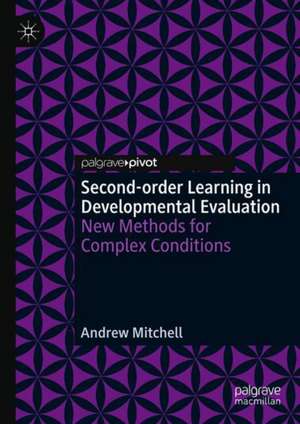
Second-order Learning in Developmental Evaluation
Autor Andrew Mitchellen Limba Engleză Hardback – oct 2018
Preț: 397.04 lei
Puncte Express: 596
Carte tipărită la comandă
Livrare economică 27 noiembrie-11 decembrie
Livrare prin curier în România Termenul estimat este afișat lângă disponibilitate.
Transport gratuit de la 400.00 lei Plată online sau ramburs, în funcție de opțiunile comenzii.
Retur gratuit în 14 zile Comandă securizată și suport în română.
Specificații
ISBN-13: 9783319993706
ISBN-10: 3319993704
Pagini: 160
Ilustrații: XI, 146 p. 2 illus.
Dimensiuni: 153 x 216 x 14 mm
Greutate: 0.29 kg
Ediția:1st ed. 2019
Editura: Springer
Locul publicării:Cham, Switzerland
ISBN-10: 3319993704
Pagini: 160
Ilustrații: XI, 146 p. 2 illus.
Dimensiuni: 153 x 216 x 14 mm
Greutate: 0.29 kg
Ediția:1st ed. 2019
Editura: Springer
Locul publicării:Cham, Switzerland
Cuprins
Introduction.- Evaluating complexity.- Second-order learning systems.- Community-based sustainability initiatives as learning systems.- Concluding remarks.
Notă biografică
Andrew Mitchell is a Research Fellow at De Montfort University in Leicester, UK. His background is in community based projects, working with complex and wicked problems. He undertakes qualitative research in project-based learning as well as socio-economic evaluations of project impacts.
Textul de pe ultima copertă
This book aims to account for how project learning and adaptation occurs through Developmental Evaluation (DE), especially under conditions of uncertainty, complexity and change. Drawing on enactive cognitive science, the author presents a DE framework designed to augment traditional monitoring and evaluation activities. Discussing this framework in detail, the author also reports upon an extended case project investigating the sustainability of a market town in the UK. The framework aims to support the reader in capturing second-order learning and exploring opportunities for innovative responses to dynamic, uncertain and complex operational conditions. Recommendations are offered for future research, and how the framework might be incorporated into the design and funding of projects deployed to work with wicked problems.
Caracteristici
Provides a Developmental Education framework which augments traditional monitoring and evaluation Details a case study investigating the sustainability of a town in the UK Investigates how project learning and adaptation occur via Developmental Education Provides guidance for policy responses to wicked problems and accompanying funding recommendations