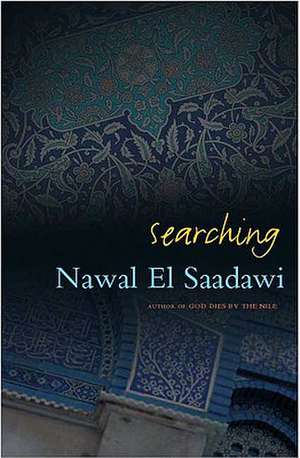
Searching
Autor Nawal El-Saadawien Limba Engleză Hardback – 8 apr 2009
Fouada meets Farid, her lover, every Tuesday in a restaurant overlooking the Nile. But this week their usual table is deserted. She calls his home, but the shrilling of the telephone echoes in an empty room. Farid has disappeared.
As she searches for him, Fouada becomes tormented by questions. She is a trained research chemist, but works in a dead-end ministry job. Convinced that she has something to give to the world, she cannot find it. What is it? Why does she search? 'Searching' expresses the poignancy of loss and doubt with the hypnotic intensity of a remembered dream.Preț: 422.17 lei
Preț vechi: 751.11 lei
-44%
Puncte Express: 633
Carte disponibilă
Livrare economică 30 octombrie-13 noiembrie
Livrare prin curier în România Termenul estimat este afișat lângă disponibilitate.
Transport gratuit pentru acest produs Plată online sau ramburs, în funcție de opțiunile comenzii.
Retur gratuit în 14 zile Comandă securizată și suport în română.
Specificații
ISBN-13: 9781848132221
ISBN-10: 1848132220
Pagini: 152
Dimensiuni: 129 x 198 x 15 mm
Greutate: 0.25 kg
Ediția:0002
Editura: ZED BOOKS
Colecția Zed Books
ISBN-10: 1848132220
Pagini: 152
Dimensiuni: 129 x 198 x 15 mm
Greutate: 0.25 kg
Ediția:0002
Editura: ZED BOOKS
Colecția Zed Books
Descriere
Fouada meets Farid, her lover, every Tuesday in a restaurant overlooking the Nile. But this week their usual table is deserted. Farid has disappeared. As she searches for him, Fouada becomes tormented by questions.
Recenzii
Reading Searching again, in light of a growing body of work in the Arab world on gender, feminism and social change, is like taking a look at this body from the inside out and seeing it in its raw state.
Searching is an intense psychological exploration of the state of mind of a young Egyptian woman who longs for both professional and personal meaning in her life, but finds herself isolated and adrift in a kafkaesque world of senseless work, with a dying mother and a lover who has gone missing. Nawal El Saadawi creates a hellish vision of Cairo. Her protagonist finds heself utterly alone in a world dominated by casual, brutal patriarchy and a shadowy authoritarian state. Searching is a disturbing text that makes the reader feel trapped in a world that often feels like a particularly bad recurrent dream.
In Searching, Nawal El Saadawi once again presents a psychological drama that will take you into the depths of a woman's despair. Intimate details and vivid descriptions fill this story of an ordinary person who ends up teetering over the abyss of insanity. Disappointed in love, Fouada wanders away from her job as biochemical researcher in a government agency, the emblem of soul-deadening routine. She calls her beloved obsessively, but he does not answer the phone's urgent ring. Questions fill her mind, as she doubts the basis of their love. With her mother's financial help, she starts up a little laboratory in an apartment without caring what people would think in a place where a woman living alone is assumed to be for sale. She pays little heed to her loving mother who worries about her daughter and her deteriorating health. Disgust with the attention paid her by the landlord who turns out to be an important government official adds to her self-absorption. Then the world and life come crashing back. This is a novel of Cairo with the languid Nile winding its way through a story of love, guilt, betrayal and redemption.
Nawal El Saadawi writes with directness and passion
Searching is an intense psychological exploration of the state of mind of a young Egyptian woman who longs for both professional and personal meaning in her life, but finds herself isolated and adrift in a kafkaesque world of senseless work, with a dying mother and a lover who has gone missing. Nawal El Saadawi creates a hellish vision of Cairo. Her protagonist finds heself utterly alone in a world dominated by casual, brutal patriarchy and a shadowy authoritarian state. Searching is a disturbing text that makes the reader feel trapped in a world that often feels like a particularly bad recurrent dream.
In Searching, Nawal El Saadawi once again presents a psychological drama that will take you into the depths of a woman's despair. Intimate details and vivid descriptions fill this story of an ordinary person who ends up teetering over the abyss of insanity. Disappointed in love, Fouada wanders away from her job as biochemical researcher in a government agency, the emblem of soul-deadening routine. She calls her beloved obsessively, but he does not answer the phone's urgent ring. Questions fill her mind, as she doubts the basis of their love. With her mother's financial help, she starts up a little laboratory in an apartment without caring what people would think in a place where a woman living alone is assumed to be for sale. She pays little heed to her loving mother who worries about her daughter and her deteriorating health. Disgust with the attention paid her by the landlord who turns out to be an important government official adds to her self-absorption. Then the world and life come crashing back. This is a novel of Cairo with the languid Nile winding its way through a story of love, guilt, betrayal and redemption.
Nawal El Saadawi writes with directness and passion
Notă biografică
Nawal El Saadawi was an internationally renowned writer, novelist and fighter for women's rights both within Egypt and abroad.
Born in 1931, in a village outside Cairo, she wrote her first novel, Diary of a Child Called Souad, at the age of thirteen. Unusually, she and her brothers and sisters were educated together. After graduating from the University of Cairo Medical School in 1955, specializing in psychiatry, she practised as a medical doctor for two years.
From 1963 until 1972, Saadawi worked for the Egyptian government as Director General for Public Health Education. During this time, she studied at Columbia University in New York, where she received her Master's degree in Public Health in 1966. In 1972, however, she lost her job in the government as a result of political pressure. The magazine Health, which she founded and had edited for more than three years, was closed down.
From 1973 to 1978 Saadawi worked at the High Institute of Literature and Science. It was at this time that she began to write, in works of fiction and non-fiction, the books on the oppression of Arab women for which she has become famous. Her most renowned novel, Woman at Point Zero, was published in Beirut in 1973. It was followed in 1976 by God Dies by the Nile and in 1977 by her study of Arab women, The Hidden Face of Eve.
In 1981 Nawal El Saadawi publicly criticized the one-party rule of President Anwar Sadat, and was subsequently arrested and imprisoned. She was released one month after Sadat's assassination. In 1982, she established the Arab Women's Solidarity Association, which was outlawed in 1991. For some years during the Mubarak regime, Saadawi lived in exile, teaching in universities in the USA and Europe, including Duke University and Washington State University. Saadawi returned to Egypt in 1996. In 2004 she presented herself as a candidate for the presidential elections in Egypt, with a platform of human rights, democracy and greater freedom for women. In July 2005, however, she was forced to withdraw her candidacy in the face of ongoing government persecution.
Nawal El Saadawi achieved widespread international recognition for her work. She held honorary doctorates from, among others, the universities of York, Illinois at Chicago, St Andrews and Tromso as well as Universidad Nacional Autónoma de México. Her many prizes and awards include the Premi Internacional Catalunya in 2003, the Council of Europe North-South Prize in 2004, the Women of the Year Award (UK) in 2011, the Sean MacBride Peace Prize (Ireland) in 2012, and the French National Order of Merit in 2013. Her books have been translated into over forty languages worldwide. They are taught in universities across the world.