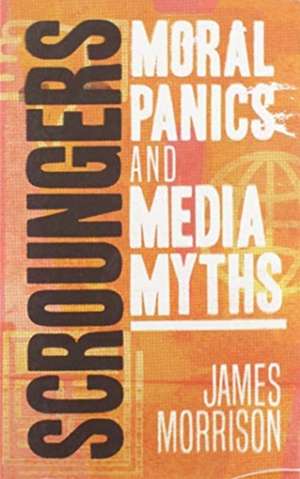
Scroungers: Moral Panics and Media Myths
Autor James Morrisonen Limba Engleză Paperback – 15 feb 2019
These are just are some of the terms that are typically used, with increasing frequency, to describe the most vulnerable in our society, whether they be the sick, the disabled, or the unemployed. Long a popular scapegoat for all manner of social ills, under austerity we've seen hostility towards benefit claimants reach new levels of hysteria, with the 'undeserving poor' blamed for everything from crime to even rising levels of child abuse.
While the tabloid press has played its role in fuelling this hysteria, the proliferation of social media has added a disturbing new dimension to this process, spreading and reinforcing scare stories, while normalising the perception of poverty as a form of 'deviancy' that runs contrary to the neoliberal agenda. Provocative and illuminating, Scroungers explores and analyses the ways in which the poor are portrayed both in print and online, placing these attitudes in a wider breakdown of social trust and community cohesion.
Preț: 167.14 lei
Preț vechi: 208.17 lei
-20%
Puncte Express: 251
Carte disponibilă
Livrare economică 02-16 noiembrie
Livrare prin curier în România Termenul estimat este afișat lângă disponibilitate.
Transport gratuit de la 400.00 lei Plată online sau ramburs, în funcție de opțiunile comenzii.
Retur gratuit în 14 zile Comandă securizată și suport în română.
Specificații
ISBN-13: 9781786992130
ISBN-10: 1786992132
Pagini: 304
Ilustrații: 4 bw tables
Dimensiuni: 136 x 214 x 20 mm
Greutate: 0.42 kg
Editura: Bloomsbury Publishing
Colecția Zed Books
Locul publicării:London, United Kingdom
ISBN-10: 1786992132
Pagini: 304
Ilustrații: 4 bw tables
Dimensiuni: 136 x 214 x 20 mm
Greutate: 0.42 kg
Editura: Bloomsbury Publishing
Colecția Zed Books
Locul publicării:London, United Kingdom
Cuprins
Introduction: Scroungerphobia Revisited: Shirker-Bashing and Feral Freak-Shows
1. Moral Panics, Scapegoating and the Persistence of Pauper Folk-Devils
2. Problem Families and 'The Workless': The Rhetorical Roots of Shirkerphobia
3. Framing the Poor: Images of Welfare and Poverty in Today's Press
4. Deliberating Deservingness: The Public's Role in Constructing Scroungers
5. Incidental Scroungers: Normalizing Anti-Welfarism in Wider Press Narratives
Conclusion: From Division to Unity: A Manifesto for Rebuilding Trust
Appendix 1: Framing Analysis Methodology
Appendix 2: Sentiment Analysis Methodology
1. Moral Panics, Scapegoating and the Persistence of Pauper Folk-Devils
2. Problem Families and 'The Workless': The Rhetorical Roots of Shirkerphobia
3. Framing the Poor: Images of Welfare and Poverty in Today's Press
4. Deliberating Deservingness: The Public's Role in Constructing Scroungers
5. Incidental Scroungers: Normalizing Anti-Welfarism in Wider Press Narratives
Conclusion: From Division to Unity: A Manifesto for Rebuilding Trust
Appendix 1: Framing Analysis Methodology
Appendix 2: Sentiment Analysis Methodology
Recenzii
Scroungers makes many salient and persuasive arguments, most notably regarding the incompatibility between the abstract fetishisation of work and the grim reality of neoliberal Britain.
In his new book Scroungers (Zed), James Morrison . explores and analyses the way in which the poor are portrayed in print and online.
Unmasks the motives and mechanisms behind anti-welfare discourses through a forensic analysis of ideological ploys by right-wing politicians, wilfully distorted narratives in traditional media and vitriolic outpourings in social media. A highly original contribution to the sociology of hate.
Meticulously revisits and dissects press and TV misrepresentation of so-called "shirkers". The book is ultimately optimistic, appearing at a time when many are now questioning the neo-liberal consensus that has sustained these anti-welfare narratives.
If there was any doubt that scroungerphobia was accidental, Morrison shows us the opposite - it is a carefully constructed and dangerous discourse attached to the "undeserving" in society. This book provides an essential counter-narrative to this hysteria.
Morrison examines how the press helped to prepare public opinion for the government's unprecedented attack on Britain's welfare state. A robust and important contribution to the debate on how the media shapes attitudes towards the poor.
The demonising of the poor has long been at the core of British social policy. Morrison's important study brings this story into the digital age, and is essential to understanding the role of the media in sustaining this brutal rhetoric.
From "scroungerphobia" to "shirkophobia", Morrison throws a penetrating light on the politics of the pernicious demonization and othering of social security claimants in the social media age.
In his new book Scroungers (Zed), James Morrison . explores and analyses the way in which the poor are portrayed in print and online.
Unmasks the motives and mechanisms behind anti-welfare discourses through a forensic analysis of ideological ploys by right-wing politicians, wilfully distorted narratives in traditional media and vitriolic outpourings in social media. A highly original contribution to the sociology of hate.
Meticulously revisits and dissects press and TV misrepresentation of so-called "shirkers". The book is ultimately optimistic, appearing at a time when many are now questioning the neo-liberal consensus that has sustained these anti-welfare narratives.
If there was any doubt that scroungerphobia was accidental, Morrison shows us the opposite - it is a carefully constructed and dangerous discourse attached to the "undeserving" in society. This book provides an essential counter-narrative to this hysteria.
Morrison examines how the press helped to prepare public opinion for the government's unprecedented attack on Britain's welfare state. A robust and important contribution to the debate on how the media shapes attitudes towards the poor.
The demonising of the poor has long been at the core of British social policy. Morrison's important study brings this story into the digital age, and is essential to understanding the role of the media in sustaining this brutal rhetoric.
From "scroungerphobia" to "shirkophobia", Morrison throws a penetrating light on the politics of the pernicious demonization and othering of social security claimants in the social media age.