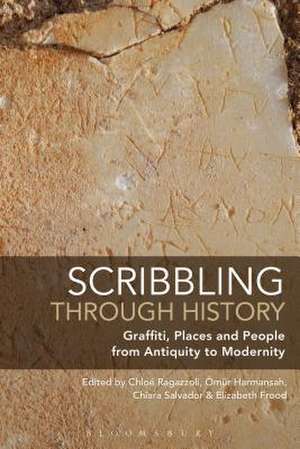
Scribbling through History: Graffiti, Places and People from Antiquity to Modernity
Editat de Professor Chloé Ragazzoli, Professor Ömür Harmansah, Chiara Salvador, Professor Elizabeth Frooden Limba Engleză Paperback – 25 iul 2019
This book shows that graffiti, a very ancient practice long hidden behind modern disapproval and street culture, have been integral to literacy and self-expression throughout history. Graffiti bear witness to social events and religious practices that are difficult to track in normative and official discourses. This book addresses graffiti practices, in cultures ranging from ancient China and Egypt through early modern Europe to modern Turkey, in illustrated short essays by specialists. It proposes a holistic approach to graffiti as a cultural practice that plays a key role in crucial aspects of human experience and how they can be understood.
Preț: 258.14 lei
Preț vechi: 337.98 lei
-24%
Puncte Express: 387
Carte tipărită la comandă
Livrare economică 08-22 decembrie
Livrare prin curier în România Termenul estimat este afișat lângă disponibilitate.
Transport gratuit de la 400.00 lei Plată online sau ramburs, în funcție de opțiunile comenzii.
Retur gratuit în 14 zile Comandă securizată și suport în română.
Specificații
ISBN-13: 9781350122383
ISBN-10: 1350122386
Pagini: 264
Ilustrații: 72 bw illus
Dimensiuni: 152 x 232 x 16 mm
Greutate: 0.4 kg
Editura: Bloomsbury Publishing
Colecția Bloomsbury Academic
Locul publicării:London, United Kingdom
ISBN-10: 1350122386
Pagini: 264
Ilustrații: 72 bw illus
Dimensiuni: 152 x 232 x 16 mm
Greutate: 0.4 kg
Editura: Bloomsbury Publishing
Colecția Bloomsbury Academic
Locul publicării:London, United Kingdom
V-ar putea interesa
-
 Medieval GraffitiMatthew Champion-26%Preț: 107.25 lei143.99 lei
 -
 Graffiti Art Coloring BookJeremy ElderPreț: 20.76 lei
 -
 Training DaysHenry Chalfant-16%Preț: 93.58 lei110.79 lei
 -
 From the Platform 2: More NYC Subway Graffiti, 1983–1989Paul CavalieriPreț: 249.76 lei
 -
 Born to RunTod LangePreț: 249.28 lei
 -
 Street Art in the Middle EastSabrina de Turk-38%Preț: 726.59 lei1168.28 lei
Cuprins
Preface (C. Ragazzoli, Université de Paris-Sorbonne, France)
Introduction (C. Ragazzoli, O. Harmansah, C. Salvador)
Part 1: Graffiti and the Landscape (with an introduction by O. Harmansah)
Chapter 1: The Scribes' Cave: Graffiti and the Production of Social Space in Ancient Egypt circa
1500 BC
(C. Ragazzoli, Université de Paris-Sorbonne, France)
Chapter 2: Christian Graffiti in Egypt: Case Studies on the Theban Mountain
(A. Delattre, Université libre de Bruxelles (ULB), École pratique des hautes études (EPHE), Belgium)
Chapter 3: Graffiti or Monument? Inscription of Place at Anatolian Rock Reliefs
(Ö. Harmansah, University of Illinois at Chicago, USA)
Chapter 4: Tweets from Antiquity: Literacy, Graffiti, and Their Uses in the Towns and Deserts of Ancient Arabia
(M. Macdonald, University of Oxford, UK)
Chapter 5: Gezi Graffiti: Shout-Outs to Resistance and Rebellion in Contemporary Turkey
(C. Gruber, University of Michigan, Ann Arbor)
Part 2: Graffiti and the Wall (with an introduction by C. Salvador)
Chapter 6: Gladiators, Greetings, and Poetry: Graffiti in First Century Pompeii
(R. Benefiel, Washington and Lee University, USA)
Chapter 7: A New Look at Maya Graffiti from Tikal
(E. Olton, Institute of American Indian Arts, Santa Fe, New Mexico, USA)
Chapter 8: Visitors' Inscriptions in the Memphite Pyramid Complexes in Ancient Egypt (c. 1543-1292 BC)
(H. Navratilova, Metropolitan Museum of Art, Egyptian Expedition)
Chapter 9: Carving Lines and Shaping Monuments: Mortuary Graffiti and Jews in the Ancient Mediterranean
(K. Stern, Brooklyn College, USA)
Part 3: Graffiti and the Written Page (with an introduction by C. Ragazzoli)
Chapter 10: Verses on Walls in Medieval China
(G. Dudbridge, University of Oxford, UK)
Chapter 11: Graffiti and the Medieval Margin
(J. Rogers, Mount Allison University, Canada)
Chapter 12: Graffiti under Control: Annotation Practices in Social Book Platforms
(M. Jahjah, Université de Paris-Sorbonne, France)
Bibliography
Index
Introduction (C. Ragazzoli, O. Harmansah, C. Salvador)
Part 1: Graffiti and the Landscape (with an introduction by O. Harmansah)
Chapter 1: The Scribes' Cave: Graffiti and the Production of Social Space in Ancient Egypt circa
1500 BC
(C. Ragazzoli, Université de Paris-Sorbonne, France)
Chapter 2: Christian Graffiti in Egypt: Case Studies on the Theban Mountain
(A. Delattre, Université libre de Bruxelles (ULB), École pratique des hautes études (EPHE), Belgium)
Chapter 3: Graffiti or Monument? Inscription of Place at Anatolian Rock Reliefs
(Ö. Harmansah, University of Illinois at Chicago, USA)
Chapter 4: Tweets from Antiquity: Literacy, Graffiti, and Their Uses in the Towns and Deserts of Ancient Arabia
(M. Macdonald, University of Oxford, UK)
Chapter 5: Gezi Graffiti: Shout-Outs to Resistance and Rebellion in Contemporary Turkey
(C. Gruber, University of Michigan, Ann Arbor)
Part 2: Graffiti and the Wall (with an introduction by C. Salvador)
Chapter 6: Gladiators, Greetings, and Poetry: Graffiti in First Century Pompeii
(R. Benefiel, Washington and Lee University, USA)
Chapter 7: A New Look at Maya Graffiti from Tikal
(E. Olton, Institute of American Indian Arts, Santa Fe, New Mexico, USA)
Chapter 8: Visitors' Inscriptions in the Memphite Pyramid Complexes in Ancient Egypt (c. 1543-1292 BC)
(H. Navratilova, Metropolitan Museum of Art, Egyptian Expedition)
Chapter 9: Carving Lines and Shaping Monuments: Mortuary Graffiti and Jews in the Ancient Mediterranean
(K. Stern, Brooklyn College, USA)
Part 3: Graffiti and the Written Page (with an introduction by C. Ragazzoli)
Chapter 10: Verses on Walls in Medieval China
(G. Dudbridge, University of Oxford, UK)
Chapter 11: Graffiti and the Medieval Margin
(J. Rogers, Mount Allison University, Canada)
Chapter 12: Graffiti under Control: Annotation Practices in Social Book Platforms
(M. Jahjah, Université de Paris-Sorbonne, France)
Bibliography
Index
Recenzii
This volume highlights the enormous value of using ancient graffiti to understand the ancient environment, social interactions, and, ultimately, the human experience.
Though historical specificities and differences are made clear in the essays, a shared quality does emerge over this collection. Various approaches are tapped to explain this, most compellingly the idea of marginality discussed in Janine Rogers's "Graffiti and the Medieval Margin".
Fascinating ... All-in-all this is a nice book which provides a different way of thinking about graffiti.
This volume actualizes a unique meeting of different corpora of graffiti, treating graffiti making as a "practice" that is well-embedded in its immediate physical and socio-cultural context.
These fascinating local studies demonstrate the importance of graffiti as an archival resource and as a topic of rising conceptual significance.
Offers an excellent introduction to, and many astute observations on, the issues and methodologies involved in studying ancient (and modern) graffiti and is thus recommended to anyone working on this fascinating category of evidence.
Though historical specificities and differences are made clear in the essays, a shared quality does emerge over this collection. Various approaches are tapped to explain this, most compellingly the idea of marginality discussed in Janine Rogers's "Graffiti and the Medieval Margin".
Fascinating ... All-in-all this is a nice book which provides a different way of thinking about graffiti.
This volume actualizes a unique meeting of different corpora of graffiti, treating graffiti making as a "practice" that is well-embedded in its immediate physical and socio-cultural context.
These fascinating local studies demonstrate the importance of graffiti as an archival resource and as a topic of rising conceptual significance.
Offers an excellent introduction to, and many astute observations on, the issues and methodologies involved in studying ancient (and modern) graffiti and is thus recommended to anyone working on this fascinating category of evidence.