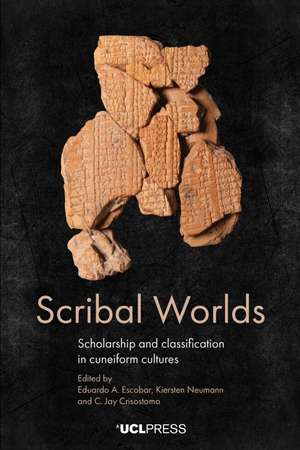
Scribal Worlds: Scholarship and Classification in Cuneiform Cultures
Editat de Eduardo A. Escobar, Kiersten Neumann, C. Jay Crisostomoen Limba Engleză Hardback – 6 dec 2026
Cuneiform is the world’s first preserved writing system, yet cuneiform texts and the associated cultures and practices remain undervalued across several disciplines. Scribal Worlds: Scholarship and Classification in Cuneiform Cultures explores the history of the earliest writing cultures of the ancient Middle East. Case studies reconstruct the intellectual frameworks and the transmission of knowledge of scribal cultures to show how specific texts and objects can be interpreted within their cultural contexts.
Preț: 474.77 lei
Preț vechi: 516.05 lei
-8% Precomandă
Puncte Express: 712
Carte nepublicată încă
Livrare prin curier în România Precomanda se expediază când titlul devine disponibil.
Transport gratuit pentru acest produs Plată online sau ramburs, în funcție de opțiunile comenzii.
Retur gratuit în 14 zile Comandă securizată și suport în română.
Doresc să fiu notificat când acest titlu va fi disponibil:
Se trimite...
Specificații
ISBN-13: 9781806550807
ISBN-10: 1806550806
Pagini: 480
Ilustrații: 81
Dimensiuni: 156 x 234 mm
Greutate: 0.45 kg
Editura: UCL Press
Colecția UCL Press
ISBN-10: 1806550806
Pagini: 480
Ilustrații: 81
Dimensiuni: 156 x 234 mm
Greutate: 0.45 kg
Editura: UCL Press
Colecția UCL Press
Notă biografică
Eduardo A. Escobar is assistant professor of the history of science in the Department of Philosophy at the University of Bologna. Kiersten Neumann is a curator of the Institute for the Study of Ancient Cultures Museum, Chicago, research associate at the Institute for the Study of Ancient Cultures, and lecturer in the Department of Art History at the University of Chicago. She is coeditor of The Routledge Handbook of the Senses in the Ancient Near East.C. Jay Crisostomo is the George G. Cameron Professor of Ancient Near Eastern Languages and Civilizations and associate professor of Assyriology at the University of Michigan. He is the author of Translation as Scholarship: Language, Writing, and Bilingual Education in Ancient Babylonia.
Cuprins
List of figures
List of tables
List of contributors
Abbreviations
Editorial conventions
Introduction: Learning from a Once Broken List
C. Jay Crisostomo, Kiersten Neumann, Eduardo A. Escobar
Part I: Frameworks
1 The order-of-the-world: Things, lumps, and texts
Francesca Rochberg
2 Is there a Mesopotamian ontology?
Marian H. Feldman
Part II: Categories and Classification
3 What’s in a name? Material self-referentiality, aesthetic values, and stone classification
Kiersten Neumann
4 Imperial Hermeneutics: Classifying the Assyrian Group Vocabularies
Eduardo A. Escobar and C. Jay Crisostomo
5 Gods in stone and clay: Classifying figurines in Hellenistic Babylonia
Stephanie M. Langin-Hooper
6 Raven, falcon, dove: Birds and the Mesopotamian exorcist
Gina Konstantopoulos
Part III: Scribal Education and Knowledge Transmission
7 Back to House F: On community, temporality, and locality in Old Babylonian scribal schooling
Eleanor Robson
8 The role of Sumerian model contracts in Old Babylonian scribal education: Standardisation and variants
Gabriella Spada
9 On the formal and social aspects of the acquisition of literacy in Old Assyrian times
Cécile Michel and Piotr Michalowski
10 Ezekiel in the Edubba
Laurie E. Pearce
11 Young Anu-belšunu: Two rare tablets from Hellenistic Uruk
Enrique Jiménez
Part IV: Texts and Signs
12 The Old Babylonian transmission of the Early Dynastic Proverb Collection 1
Jana Matuszak
13 Writing Akkadian in Sumer: Scenes from the Mesag archive
Emmanuelle Salgues
14 Mesopotamian personal name lists: Classification, education, or scholarship?
Paul Delnero
15 A Sumerian Šu'ila-prayer to Ištar of Nineveh and her akitu festival in Nineveh
Daisuke Shibata
16 Wedge order and the character-forming rules of Neo-Assyrian cuneiform
Jonathan Taylor
List of tables
List of contributors
Abbreviations
Editorial conventions
Introduction: Learning from a Once Broken List
C. Jay Crisostomo, Kiersten Neumann, Eduardo A. Escobar
Part I: Frameworks
1 The order-of-the-world: Things, lumps, and texts
Francesca Rochberg
2 Is there a Mesopotamian ontology?
Marian H. Feldman
Part II: Categories and Classification
3 What’s in a name? Material self-referentiality, aesthetic values, and stone classification
Kiersten Neumann
4 Imperial Hermeneutics: Classifying the Assyrian Group Vocabularies
Eduardo A. Escobar and C. Jay Crisostomo
5 Gods in stone and clay: Classifying figurines in Hellenistic Babylonia
Stephanie M. Langin-Hooper
6 Raven, falcon, dove: Birds and the Mesopotamian exorcist
Gina Konstantopoulos
Part III: Scribal Education and Knowledge Transmission
7 Back to House F: On community, temporality, and locality in Old Babylonian scribal schooling
Eleanor Robson
8 The role of Sumerian model contracts in Old Babylonian scribal education: Standardisation and variants
Gabriella Spada
9 On the formal and social aspects of the acquisition of literacy in Old Assyrian times
Cécile Michel and Piotr Michalowski
10 Ezekiel in the Edubba
Laurie E. Pearce
11 Young Anu-belšunu: Two rare tablets from Hellenistic Uruk
Enrique Jiménez
Part IV: Texts and Signs
12 The Old Babylonian transmission of the Early Dynastic Proverb Collection 1
Jana Matuszak
13 Writing Akkadian in Sumer: Scenes from the Mesag archive
Emmanuelle Salgues
14 Mesopotamian personal name lists: Classification, education, or scholarship?
Paul Delnero
15 A Sumerian Šu'ila-prayer to Ištar of Nineveh and her akitu festival in Nineveh
Daisuke Shibata
16 Wedge order and the character-forming rules of Neo-Assyrian cuneiform
Jonathan Taylor