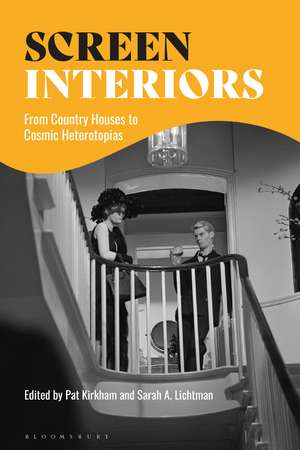
Screen Interiors
Editat de Pat Kirkham, Sarah A Lichtmanen Limba Engleză Hardback – 6 mai 2021
Această monografie în format hardback, publicată de BLOOMSBURY ACADEMIC, ne propune o incursiune senzorială în arhitectura spațiilor fictive care ne-au modelat percepția vizuală. Recomandăm Screen Interiors ca pe o explorare metodică a modului în care decorul încetează să fie un simplu fundal, devenind un personaj activ care amplifică emoția și dictează ritmul acțiunii. De la interioarele domestice din cinematografia sovietică a anilor '20 și până la estetica minimalistă a New York-ului anilor '70, volumul demonstrează cum obiectele și compartimentarea spațiului reflectă clasa socială, genul și identitatea. Pe raftul de artă, alături de Cinematic Style, acest album se distinge prin rigoarea academică aplicată unor genuri extrem de variate, refuzând să se limiteze doar la estetică și migrând spre o analiză profundă a culturii materiale. Considerăm că experiența de lectură este îmbogățită de prezența fotogramelor atent selectate, care permit privitorului să vizualizeze imediat disjungerea dintre designul interior și cel exterior discutat în text. Structura este organizată tematic, debutând cu secțiunea „House and Home”, unde confortul și ierarhiile sociale sunt analizate prin prisma spațiului locuit, și continuând cu explorări despre „The Curated Home”. Această lucrare continuă preocupările editorului Pat Kirkham, cunoscută pentru History of Design, extinzând analiza de la obiectul istoric la cel proiectat pe ecran. Spre deosebire de Creating Interior Atmosphere, care se concentrează pe tehnica mise-en-scène-ului, Screen Interiors funcționează ca un instrument critic care decodifică limbajul vizual al decorului în contextul istoriei globale a filmului.
Preț: 618.96 lei
Preț vechi: 913.89 lei
-32%
Carte disponibilă
Livrare economică 28 octombrie-11 noiembrie
Specificații
ISBN-10: 1350150584
Pagini: 368
Ilustrații: 47 bw illus
Dimensiuni: 162 x 223 x 23 mm
Greutate: 0.74 kg
Editura: BLOOMSBURY ACADEMIC
Locul publicării:London, United Kingdom
V-ar putea interesa
-
 Silver ScreensJane CrowtherPreț: 161.62 lei
 -
 Designs on FilmCathy Whitlock-8%Preț: 397.40 lei431.96 lei
 -
 Preț: 388.03 lei
 -
 Interior Design Since 1900Anne Massey-16%Preț: 92.93 lei111.22 lei
 -
 Cinematic Style: Fashion, Architecture and Interior Design on FilmProfessor Jess Berry-20%Preț: 179.43 lei223.51 lei
 -
 Interiors in the Age of EnlightenmentStacey Sloboda-25%Preț: 183.16 lei243.78 lei
 -
 Exhibition as Interior, Interior as ExhibitionPenny Sparke-27%Preț: 506.94 lei692.48 lei
 -
 -16%Preț: 184.75 lei220.11 lei
 -
 -11%Preț: 266.31 lei299.67 lei
 -
 50 Film Ideas You Really Need to KnowHelen O’Hara-28%Preț: 50.70 lei70.25 lei
 -
 Live Like Wes: Home Decor Inspired by Wes Anderson MoviesJessie Atkinson-24%Preț: 123.42 lei162.39 lei
 -
 A History of Interior DesignJohn Pile-8%Preț: 407.06 lei442.46 lei
 -
 Watch This SpaceHoward Griffin-23%Preț: 706.28 lei917.25 lei
 -
 Making SpaceJane HallPreț: 349.31 lei
 -
 Interior Style: CoastalJena Quinn-25%Preț: 92.03 lei122.49 lei
 -
 Wes AndersonJohanna Agerman Ross-19%Preț: 224.60 lei278.27 lei
 -
 Brutalist InteriorsBlake Gopnik-30%Preț: 220.29 lei316.52 lei
 -
 Fashion & InteriorsRomy CockxPreț: 361.50 lei
 -
 Read Frame Type FilmCatherine De Smet-17%Preț: 294.46 lei356.51 lei
De ce să citești această carte
Ne adresăm pasionaților de scenografie, istoria artei și critică de film care doresc să înțeleagă mecanismele invizibile din spatele camerei. Cititorul câștigă o perspectivă nouă asupra modului în care un interior bine proiectat poate defini psihologia unui personaj. Este o resursă esențială pentru a învăța cum să „citești” un spațiu cinematografic, oferind argumente teoretice solide susținute de exemple iconice din istoria filmului.
Descriere
Essays address questions related to interiors and objects in film and television from the early 1900s up until the present day. Authors explore how interior film design can facilitate action and amplify tensions, how rooms are employed as structural devices and how designed spaces can contribute to the construction of identities. Case studies look at disjunctions between interior and exterior design and the inter-relationship of production design and narrative.
With a lens on class, sexuality and identity across a range of films including Twilight of a Woman's Soul (1913), The Servant (1963), Caravaggio (1986), and Passengers (2016), and illustrated with film stills throughout, Screen Interiors showcases an array of methodological approaches for the study of film and design history.
Cuprins
Acknowledgements
Introduction, Pat Kirkham (Kingston University, UK) and Sarah A. Lichtman (Parsons School of Design, USA)
Section One: House and Home: Space, Comfort, Class, Gender, and Generation
1. Comfort and the Domestic Interior in Soviet Fiction Cinema of the 1920s, Eleanor Rees (University of College London, UK)
2. Furnishing I Love Lucy (1951-57), Marilyn Cohen (Parsons School of Design, USA)
3. From the Country House Film to the House in the Country Film: Space, Class, and Generation, Christine Geraghty (University of Glasgow, UK)
4. Space, Interiors, and 1980s Hollywood Teen Films, Patrick O'Neill (Kingston University, UK)
Section Two: The Curated Home
5. Mobilizing Material Culture: Collecting and Interiority in Luchino Visconti's Conversation Piece (1974), Shax Reigler (Architectural Digest, USA)
6. From Sex to Narcissism: Understanding Minimalist Interiors in New York Films of the 1970s, Timothy M. Rohan (University of Massachusetts Amherst, USA)
7. "Home furnishing takes a cue from Paris, too": The Fashion Professional at Work and Home in Postwar Hollywood Films, c. 1957-1961, Rebecca C. Tuite (Bard Graduate Center, USA)
Section Three: Framing Interiors and Interiorities: Inside and Out
8. Framing Interiorities: Interiors, Objects, and Hidden Desires in Billy Wilder's The Apartment (1960), Imma Forino (Politecnico di Milano, Italy)
9. Frames, Veils, and Windows: Modern Cinematic Set Design in Early Russian Films by Evgenii Bauer, Maria Korolkova (University of Greenwich, UK)
Section Four: Screening Queerness: Class, Gender, Sexual Orientation, Ambiguity, Authorit, and Power
10. Interiors, Class, Perversity, and Ambiguity in The Servant (1963), Barry Curtis (Royal College of Art, UK)
11. In Plain View: London Commercial Interiors as Queer spaces in Three 1960s British Films: Victim (1961), The Leather Boys (1964), and The Killing of Sister George (1968), Andrew Stephenson (University of East London, UK)
12. Queer Interiors: Derek Jarman's Caravaggio (1986) and Edward II (1992), Adam Vaughan (University of Southampton, UK)
Section Five: Horror and Homicide
13. The Horror of the Homicidal Floor: Destabilized Elements of Interior Architecture, Alexandra Brown (Monash University, Australia) and Kirsty Volz (Queensland University of Technology, Australia)
14. Designed to Destroy: Action Film Interiors and the Construction of Killscapes, Lennart Soberon (Ghent University, Belgium)
Section Six: Living in Outer Space: Sci-Fi Interiors
15. Visions of Home: Nostalgia and Mobility, Past, Present, and Future, in Serenity's Domestic Spaceship Interior, Sorcha O'Brien (Kingston University, UK)
16. Cosmic Heterotopia: Banality and Disjunction in the Interiors of Passengers (2016), Ersi Ioannidou (Kingston University, UK)
Author Biographies
Index
Recenzii
This engaging and highly readable collection is the most comprehensive and scholarly exploration of the subject available, but it reads like a lively conversation among friends. From broad cultural themes to minute details, the essays included here answer myriad questions about how interiors, props, and visual cues shape our reactions to on-screen stories and images. An indispensable resource for anyone who has ever wondered how movies and TV shows are made and why they matter so much to us, this book is both a remarkable achievement and a delight to read.
Innovative and exciting-fascinating topics, new research, wide-ranging approaches, and fresh interpretations, marshalled with sophisticated editorial expertise. Screen Interiors is a much needed cross-disciplinary intervention that stakes out new ground in studies of film, television, and design.
Screen Interiors is a milestone in the literature on production design for film and television. Exploring how moving-image interiors reveal the inner lives of protagonists, the book offers multiple perspectives on a wide range of genres, countries, and time periods and investigates social themes such as gender, class, and sexuality. The book contributes insightful perspectives on popular films and their makers, while shedding light on productions and people. Equally valuable is the book's concise history of production design and its historiography.