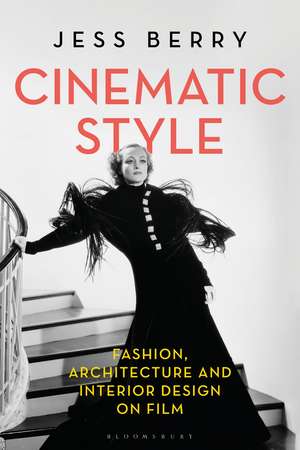
Cinematic Style: Fashion, Architecture and Interior Design on Film
Autor Professor Jess Berryen Limba Engleză Paperback – 24 feb 2022
With examples from Frank Lloyd Wright inspired architecture in Hitchcock's North by Northwest, to Coco Chanel's costumes for Gloria Swanson and a Great Gatsby film-set turned Ralph Lauren flagship, Cinematic Style describes the reciprocal relationship between these cultural forms. Exposing the bleeding lines between fashion and interiors in cinematic and real-life contexts, Berry presents case studies of cinematic styles adopted as brand identities and design movements promoted through filmic fantasy.
Shedding light on consumer culture, social history and gender politics as well as on fashion, film and interior design theory, Cinematic Style considers the leading roles domestic spaces, quaint cafes, little black dresses and sharp suits have played in 20th and 21st-century film.
Preț: 185.53 lei
Preț vechi: 227.49 lei
-18%
Puncte Express: 278
Carte disponibilă
Livrare economică 16-30 noiembrie
Livrare prin curier în România Termenul estimat este afișat lângă disponibilitate.
Transport gratuit de la 400.00 lei Plată online sau ramburs, în funcție de opțiunile comenzii.
Retur gratuit în 14 zile Comandă securizată și suport în română.
Specificații
ISBN-13: 9781350137622
ISBN-10: 1350137626
Pagini: 224
Ilustrații: 48 bw illus
Dimensiuni: 154 x 232 x 16 mm
Greutate: 0.35 kg
Editura: Bloomsbury Publishing
Colecția Bloomsbury Visual Arts
Locul publicării:London, United Kingdom
ISBN-10: 1350137626
Pagini: 224
Ilustrații: 48 bw illus
Dimensiuni: 154 x 232 x 16 mm
Greutate: 0.35 kg
Editura: Bloomsbury Publishing
Colecția Bloomsbury Visual Arts
Locul publicării:London, United Kingdom
V-ar putea interesa
-
 The Mode in Furs: A Historical Survey with 680 IllustrationsR. Turner WilcoxPreț: 93.10 lei
 -
 ShoesRaissa BretañaPreț: 76.68 lei
 -
 Out of the BoxElizabeth SemmelhackPreț: 326.61 lei
 -
 HatsProfessor Clair Hughes-41%Preț: 145.20 lei244.11 lei
 -
 Hair: An Illustrated HistorySusan J. Vincent-37%Preț: 152.65 lei240.79 lei
 -
 Fashioning the Victorians: A Critical SourcebookProfessor Rebecca Mitchell-23%Preț: 208.70 lei272.56 lei
 -
 A Cultural History of Dress and Fashion in the Modern AgeProfessor Alexandra Palmer-23%Preț: 211.49 lei273.80 lei
 -
 A Cultural History of Dress and Fashion in the RenaissanceElizabeth Currie-24%Preț: 204.31 lei269.75 lei
 -
 A Cultural History of Dress and Fashion in the Medieval AgeProfessor Sarah-Grace Heller-18%Preț: 211.70 lei257.41 lei
 -
 The Hidden History of the Smock FrockAlison Toplis-18%Preț: 194.02 lei238.03 lei
 -
 Danger in the Path of Chic: Violence in Fashion between the WarsLucy Moyse Ferreira-26%Preț: 206.77 lei278.57 lei
 -
 The Way We WoreDaphne Selfe-24%Preț: 87.40 lei114.64 lei
 -
 Sex and Suits: The Evolution of Modern DressAnne Hollander-16%Preț: 192.17 lei227.59 lei
 -
 Fabric of Vision: Dress and Drapery in PaintingAnne Hollander-34%Preț: 183.12 lei278.04 lei
 -
 The Sports Shoe: A History from Field to FashionThomas Turner-50%Preț: 190.55 lei382.75 lei
 -
 House of Fashion: Haute Couture and the Modern InteriorProfessor Jess Berry-24%Preț: 205.74 lei272.04 lei
Cuprins
List of Figures
Acknowledgements
Introduction: Cinematic Style-Fashion, Architecture and the Interior on Film
1. Bedrooms, Boudoirs and Bathrooms: Modern Women, Seductive Spaces and Spectacular Silhouettes
2. Evil Lairs and Bachelor Dandies: Modernist Architecture, Spies and the Suit
3. Luxurious Longings: Queer Heterotopias in Décor and Dress
4. Grand Entrances: Staircases, Stages and Fashion Parades
5. Windows and Screens: Cinema, Department Stores and Boutique Displays
6. Dream Spaces: Film Sets as Fashion Flagships and Experiential Retail Environments
Conclusion
Notes
Filmography Bibliography Index
Acknowledgements
Introduction: Cinematic Style-Fashion, Architecture and the Interior on Film
1. Bedrooms, Boudoirs and Bathrooms: Modern Women, Seductive Spaces and Spectacular Silhouettes
2. Evil Lairs and Bachelor Dandies: Modernist Architecture, Spies and the Suit
3. Luxurious Longings: Queer Heterotopias in Décor and Dress
4. Grand Entrances: Staircases, Stages and Fashion Parades
5. Windows and Screens: Cinema, Department Stores and Boutique Displays
6. Dream Spaces: Film Sets as Fashion Flagships and Experiential Retail Environments
Conclusion
Notes
Filmography Bibliography Index
Recenzii
Cinematic Style approaches the long-term disciplinary distinction between fashion, architectural decor and interior design through the lens of cinema, arguing for the interconnectivity of these fields. Abundantly illustrated, with an approachable writing style and innovative story line, it is an essential read for scholars of the domestic, commercial, or fictive interior, fashion historians, architects and historic preservationists alike.
Berry brings themes from feminist theory, and to a lesser degree, Queer theory, to bear on this slice through film history to consider intersections between fashion, design and groupings of films (many canonical) from the 1920s and 1930s, the mid- and late 20th-century, and more recent examples. Anyone with an interest in masquerade, transformation, performativity, staging, interiority, gender, and sexuality, as well as camp, Queer nostalgia, and Queer heterotopias, fashion and luxury, will find much to intrigue them in here.
Berry brings themes from feminist theory, and to a lesser degree, Queer theory, to bear on this slice through film history to consider intersections between fashion, design and groupings of films (many canonical) from the 1920s and 1930s, the mid- and late 20th-century, and more recent examples. Anyone with an interest in masquerade, transformation, performativity, staging, interiority, gender, and sexuality, as well as camp, Queer nostalgia, and Queer heterotopias, fashion and luxury, will find much to intrigue them in here.