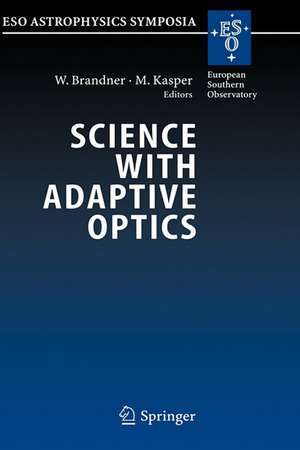
Science with Adaptive Optics: ESO Astrophysics Symposia
Editat de Wolfgang Brandner, Markus E. Kasperen Limba Engleză Paperback – 11 apr 2005
Din seria ESO Astrophysics Symposia
-
 Preț: 383.96 lei
 -
 Preț: 431.55 lei
 -
 Preț: 355.77 lei
 -
 Preț: 442.67 lei
 -
 Preț: 413.81 lei
 -
 Preț: 395.73 lei
 -
 Preț: 414.37 lei
 -
 Preț: 382.65 lei
 -
 Preț: 428.45 lei
 - 20%
 Preț: 606.49 lei
 - 15%
 Preț: 672.92 lei
 -
 Preț: 430.88 lei
 - 15%
 Preț: 673.88 lei
 -
 Preț: 452.18 lei
 -
 Preț: 417.93 lei
 - 15%
 Preț: 673.77 lei
 -
 Preț: 381.92 lei
 - 15%
 Preț: 633.37 lei
 -
 Preț: 448.06 lei
 -
 Preț: 433.81 lei
 -
 Preț: 418.93 lei
 -
 Preț: 416.39 lei
 - 20%
 Preț: 614.42 lei
 - 15%
 Preț: 676.39 lei
 - 15%
 Preț: 670.93 lei
 -
 Preț: 444.63 lei
 - 15%
 Preț: 682.97 lei
 - 15%
 Preț: 683.44 lei
 - 15%
 Preț: 669.40 lei
 - 15%
 Preț: 672.68 lei
 - 20%
 Preț: 653.04 lei
 -
 Preț: 455.66 lei
 -
 Preț: 385.06 lei
 - 18%
 Preț: 1002.35 lei
 -
 Preț: 387.73 lei
 -
 Preț: 420.31 lei
Preț: 430.50 lei
Puncte Express: 646
Carte tipărită la comandă
Livrare economică 25 noiembrie-01 decembrie
Livrare prin curier în România Termenul estimat este afișat lângă disponibilitate.
Transport gratuit pentru acest produs Plată online sau ramburs, în funcție de opțiunile comenzii.
Retur gratuit în 14 zile Comandă securizată și suport în română.
Specificații
ISBN-13: 9783540250340
ISBN-10: 3540250344
Pagini: 412
Ilustrații: XX, 388 p.
Dimensiuni: 155 x 235 x 23 mm
Greutate: 0.62 kg
Ediția:2005
Editura: Springer
Colecția ESO Astrophysics Symposia
Seria ESO Astrophysics Symposia
Locul publicării:Berlin, Heidelberg, Germany
ISBN-10: 3540250344
Pagini: 412
Ilustrații: XX, 388 p.
Dimensiuni: 155 x 235 x 23 mm
Greutate: 0.62 kg
Ediția:2005
Editura: Springer
Colecția ESO Astrophysics Symposia
Seria ESO Astrophysics Symposia
Locul publicării:Berlin, Heidelberg, Germany
V-ar putea interesa
-
 Feynman's Lost LectureDavid L Goodstein-33%Preț: 52.70 lei78.65 lei
 -
 Global Aspects in Gravitation and CosmologyPankaj S. Joshi-28%Preț: 404.36 lei559.18 lei
 -
 The Mathematical Theory of Black HolesS. Chandrasekhar-30%Preț: 666.47 lei958.64 lei
 -
 Advanced AstrophysicsNeb Duric-23%Preț: 770.75 lei1000.98 lei
 -
 Accretion Power in AstrophysicsJuhan Frank-23%Preț: 749.76 lei973.71 lei
 -
 Galaxies in the UniverseLinda S. Sparke-8%Preț: 480.51 lei522.29 lei
 -
 Gravitational Million-Body ProblemDouglas Heggie-23%Preț: 708.77 lei920.48 lei
 -
 -27%Preț: 554.06 lei763.17 lei
 -
 Numerical Methods in Astrophysics: An IntroductionPeter Bodenheimer-18%Preț: 970.14 lei1183.09 lei
 -
 The Sky Is Not the LimitNeil De Grasse TysonPreț: 120.77 lei
 -
 Astrophysics of the Diffuse UniverseMichael A. Dopita-15%Preț: 616.89 lei725.76 lei
Public țintă
ResearchCuprins
Adaptive Optics Instrumentation, Data Acquisition and Reduction Strategies.- The Sun and (Exo-)Planets.- Star Formation and Brown Dwarfs.- Evolved Stars.- Galactic Center and AGN.- Galaxies and Cosmology.
Textul de pe ultima copertă
The field of Adaptive Optics (AO) for astronomy has matured in recent years, and diffraction-limited image resolution in the near-infrared is now routinely achieved by ground-based 8 to 10m class telescopes. This book presents the proceedings of the ESO Workshop on Science with Adaptive Optics held in the fall of 2003. The book provides an overview on AO instrumentation, data acquisition and reduction strategies, and covers observations of the sun, solar system objects, circumstellar disks, substellar companions, HII regions, starburst environments, late-type stars, the galactic center, active galaxies, and quasars. The contributions present a vivid picture of the multitude of science topics being addressed by AO in observational astronomy.