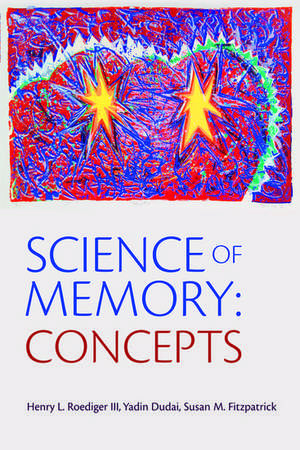
Science of Memory: Concepts
Editat de Henry L. Roediger, Yadin Dudai, Susan M. Fitzpatricken Limba Engleză Paperback – 10 mai 2007
Preț: 351.99 lei
Preț vechi: 485.86 lei
-28%
Puncte Express: 528
Carte tipărită la comandă
Livrare economică 26 noiembrie-01 decembrie
Livrare prin curier în România Termenul estimat este afișat lângă disponibilitate.
Transport gratuit de la 400.00 lei Plată online sau ramburs, în funcție de opțiunile comenzii.
Retur gratuit în 14 zile Comandă securizată și suport în română.
Specificații
ISBN-13: 9780195310443
ISBN-10: 0195310446
Pagini: 464
Ilustrații: 26 black & white photographs and 26 line illustrations
Dimensiuni: 162 x 235 x 24 mm
Greutate: 0.69 kg
Editura: Oxford University Press
Colecția OUP USA
Locul publicării:New York, United States
ISBN-10: 0195310446
Pagini: 464
Ilustrații: 26 black & white photographs and 26 line illustrations
Dimensiuni: 162 x 235 x 24 mm
Greutate: 0.69 kg
Editura: Oxford University Press
Colecția OUP USA
Locul publicării:New York, United States
V-ar putea interesa
-
 The Making Of MemorySteven RosePreț: 124.38 lei
 -
 Memory: A Very Short IntroductionJonathan K. FosterPreț: 68.08 lei
 -
 Episodic Memory: New Directions in ResearchAlan Baddeley-31%Preț: 506.73 lei733.45 lei
 -
 -28%Preț: 519.97 lei725.50 lei
 -
 Working Memory, Thought, and ActionAlan Baddeley-28%Preț: 508.06 lei710.27 lei
 -
 Memory in CultureA. ErllPreț: 213.50 lei
 -
 Working Memory and Academic LearningMilton J Dehn-8%Preț: 422.57 lei459.31 lei
 -
 Make it StickPeter C. BrownPreț: 240.63 lei
 -
 -18%Preț: 704.62 lei859.28 lei
 -
 The Psychology of Eyewitness IdentificationJames Michael Lampinen-18%Preț: 1117.23 lei1362.47 lei
Descriere
The study of learning and memory occurs in several scientific traditions: neurobiology, neurogenetics, neurochemistry; animal learning and behaviour; behavioural neuroscience; ethological and evolutionary approaches; cognitive psychology; neuropsychology, computational modelling, and artifical intelligence all contribute. However, researchers using one approach typically work in relative isolation from those using other approaches. The aim of the volume is to bring together leading researchers in the various fields of learning and memory to discuss the field's core concepts, across disciplinary boundaries, with the hope that such discussion will enhance and reorient the field and lead to a more unified science of memory. Science of Memory: Concepts is not to be simply another edited volume that reports research by contributors, but rather a searching examination of 16 fundamental concepts in the field. For each, three position papers describe how the concept is viewed in the author's particular tradition. There is an integrator for each concept, who will pull together the main themes from the various contributions and elucidates key points of agreement and disagreement. The volume will begin with an introductory chapter by Yadin Dudai, Roddy Roediger, and Endel Tulving, and will end with a concluding chapter by Susan Fitzpatrick. Science of Memory is essential reading for professional researchers and students in all the various fields of learning and memory.
Recenzii
a fascinating book that I would definitely recommend to all interested in memory phenomena.
Rallied under the banner of 'concepts,' these chapters are a treasure trove of theories, controversies, methodologies, and findings.
...our understanding of memory systems has advanced considerably and will continue to do so...[this book] can break down conceptual barriers and push the field into new directions...and inspires us to think more generally about the relationship between various learning and memory traditions; it will have broad academic appeal.
Rallied under the banner of 'concepts,' these chapters are a treasure trove of theories, controversies, methodologies, and findings.
...our understanding of memory systems has advanced considerably and will continue to do so...[this book] can break down conceptual barriers and push the field into new directions...and inspires us to think more generally about the relationship between various learning and memory traditions; it will have broad academic appeal.