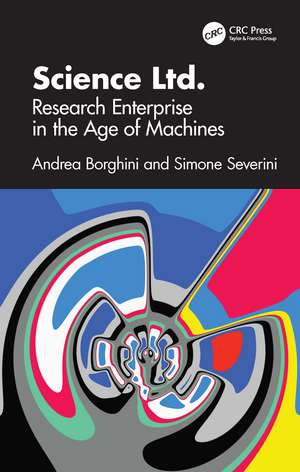
Science Ltd.: Research Enterprise in the Age of Machines
Autor Andrea Borghini, Simone Severinien Limba Engleză Paperback – 17 mar 2026
Science Ltd. tackles critical operational questions about modern science: How is scientific knowledge produced and prioritized? How are research funds distributed? What constitutes effective dissemination and application of discoveries? Chapters examine the journey from laboratory innovation to commercial implementation while exploring two fundamental challenges facing the scientific community. First, the urgent need to reform scientific practices, particularly by rethinking academic publishing and research funding models to create more open and sustainable science. Second, the complex prospect of human-machine collaboration in research, moving beyond traditional instruments to AI assistants with capabilities that exceed human limitations. Enriched with expert interviews and real-world anecdotes, this book provides both practical insights and speculative analysis of science’s automated future.
This accessible work is designed for researchers, entrepreneurs, policymakers, and anyone curious about the intersection of science and technology. It serves academics seeking to understand contemporary research dynamics, industry professionals navigating the deep-tech landscape, and general readers interested in how scientific discovery shapes society. This book offers valuable perspectives for those involved in research funding, science policy, and technology transfer, while remaining engaging for anyone concerned about the future of human-driven versus machine-assisted scientific innovation.
Preț: 233.72 lei
Preț vechi: 292.15 lei
-20%
Puncte Express: 351
Carte disponibilă
Livrare economică 12-26 noiembrie
Livrare express 28 octombrie-03 noiembrie pentru 20.51 lei
Livrare prin curier în România Termenul estimat este afișat lângă disponibilitate.
Transport gratuit de la 400.00 lei Plată online sau ramburs, în funcție de opțiunile comenzii.
Retur gratuit în 14 zile Comandă securizată și suport în română.
Specificații
ISBN-13: 9781041131069
ISBN-10: 1041131062
Pagini: 198
Dimensiuni: 156 x 234 mm
Greutate: 0.29 kg
Ediția:1
Editura: CRC Press
Colecția CRC Press
ISBN-10: 1041131062
Pagini: 198
Dimensiuni: 156 x 234 mm
Greutate: 0.29 kg
Ediția:1
Editura: CRC Press
Colecția CRC Press
V-ar putea interesa
-
 The Science of Can and Can'tChiara Marletto-19%Preț: 63.98 lei78.92 lei
 -
 The Infinite AlphabetCésar A. HidalgoPreț: 191.23 lei
 -
 Don't Burn Anyone at the Stake TodayNaomi AldermanPreț: 121.20 lei
 -
 Shared WisdomAlex PentlandPreț: 153.35 lei
 -
 If Anyone Builds It, Everyone DiesEliezer Yudkowsky-20%Preț: 117.03 lei146.29 lei
 -
 Against the MachinePaul KingsnorthPreț: 194.17 lei
 -
 Hacking HumanityLara LewingtonPreț: 123.80 lei
 -
 Preț: 142.20 lei
 -
 Silicon EmpiresNick SrnicekPreț: 108.16 lei
 -
 Social EpistemologyAlessandra TanesiniPreț: 157.26 lei
 -
 Stop the MachinesMauro LubranoPreț: 138.54 lei
 -
 AlgospeakAdam AleksicPreț: 122.02 leiRecomandat
 -
 Clearing the AirHannah RitchiePreț: 121.89 lei
 -
 The Atomic HumanNeil D. LawrencePreț: 94.41 lei
 -
 The Thinking MachineStephen WittPreț: 123.17 lei
 -
 The ImmortalistsAleks KrotoskiPreț: 123.00 lei
 -
 The AI ConEmily M. BenderPreț: 151.96 lei
 -
 Empire of AIKaren HaoPreț: 163.45 lei
Public țintă
Academic, Postgraduate, Professional Practice & Development, and Undergraduate AdvancedRecenzii
Back Cover:
The application of digital technologies to scientific research suggests new scenarios for the scalability of knowledge. How does this opportunity change our conception of science and how can we use it to make scientific practice more enduring and effective in the long term?
The application of digital technologies to scientific research suggests new scenarios for the scalability of knowledge. How does this opportunity change our conception of science and how can we use it to make scientific practice more enduring and effective in the long term?
Cuprins
Prologue Chapter 1: “Science”: Notes on Science as a Dynamic Activity for Describing and Predicting 1.1 The Practical Value of Science 1.1.1 Exploration and Prediction 1.1.2 Phenomena 1.1.3 Between Practice and Theory 1.2 Scientific Languages 1.2.1 Preliminary Considerations 1.2.2 The Value of Formalization 1.3 Language and Epistemic Value 1.3.1 Communicability and Verifiability 1.3.2 Compactness 1.3.3 Applicability 1.3.4 The Uselessness of Science 1.4 Formal and Applied Truths 1.4.1 Formal Language as a Regulative Ideal 1.4.2 The Limits of Formal Language (through Machines) 1.4.3 Psychological Certainty rather than Truth 1.5 Limitations 1.5.1 The Language of Mathematics Is Fallible 1.5.2 Intractable Problems and Undecidable Problems 1.5.3 Scientific Discovery and the Dynamism of Knowledge Chapter 2: “Technology”: Notes on Technology as the Activity of Building Machines and Procedures to Operate Them 2.1 In the Sea of Technologies 2.1.1 First Intuitions 2.1.2 Observation and Practical Reason 2.1.3 Formulation and Discovery 2.1.4 Serendipitous Discoveries 2.2 Utility, Utopia, Dystopia 2.2.1 Primary and Secondary Technologies 2.2.2 Five Parameters 2.2.3 Storytelling and Technology 2.3 Science and Technology 2.3.1 A Complex Relationship 2.3.2 Impact on Society Chapter 3: Making Science: Notes on How to Support Research while Avoiding Bias and Gossip 3.1 Publishing Today 3.1.1 The Primacy of the Scientific Article 3.1.2 The Literary Form of the Scientific Article 3.1.3 The Peer-Review Process 3.1.4 The Value of Publication 3.2 Looking for Alternatives 3.2.1 Against Peer Review 3.2.2 Open-Ended Scientific Articles 3.2.3 Reputation, Gossip, and Trust 3.2.4 Trust in Science as a Public Value 3.3 Research Funding 3.3.1 Support for Research, Quality, and Quantity 3.3.2 Access Criteria: Degrees and Types of Breakthroughs 3.3.3 The Importance of Context and the Streetlight Effect 3.3.4 How to Improve the System? Chapter 4: Machines for Science: Notes on the Scalability and Sustainability of the Scientific and Technological Enterprise 4.1 Scalability of Science 4.1.1 Technology in Mathematics 4.1.2 Science in a Graph? 4.1.3 Technology in a Graph? 4.1.4 A Science Database 4.1.5 Androids as Muses for Humans or Humans as Muses for Androids? 4.1.6 Science on a Hyperscale 4.1.7 Android Creativity and Human Creativity 4.2 Sustainability of Science 4.2.1 Phronesis 4.2.2 Innovation 4.2.3 Communicability 4.2.4 Risk 4.2.5 The Last Mile 4.2.6 Ordinariness Chapter 5: Epilogue: Notes on How to Guide the Construction of Machines for Future Science 5.1 Machines and People 5.2 Science for a House of Solomon 5.3 Draft of a Solomon's Almanac 5.3.1 What Is Science? 5.3.2 Science Done by Machines 5.3.3 What Is Technology? 5.3.4 Science and Technology I 5.3.5 Science and Technology II 5.3.6 The Value of Technology 5.3.7 The Role of Machines 5.3.8 The Role of Metascience 5.3.9 The Scientific Article 5.3.10 Science for Science's Sake 5.3.11 Science in a Relational Structure (Science beyond Scientific Literature 5.3.12 The Breakthrough 5.3.13 Funding Processes 5.3.14 The Context 5.3.15 Scalability 5.3.16 Words to Bet On 5.4 A Call to Action
Notă biografică
Andrea Borghini is Associate Professor in the Department of Philosophy at the University of Milan.
Simone Severini is a Distinguished Engineer at Google and Professor of Physics of Information at UCL.
Simone Severini is a Distinguished Engineer at Google and Professor of Physics of Information at UCL.
Descriere
Science LTD examines the evolving relationship between scientific knowledge, technology, and society in an era where deep tech companies are increasingly driven by discoveries rather than market demand.