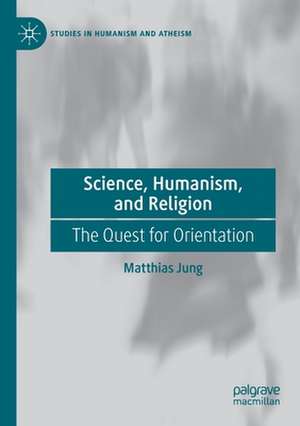
Science, Humanism, and Religion: Studies in Humanism and Atheism
Autor Matthias Jungen Limba Engleză Paperback – 9 aug 2020
Human beings have to relate themselves to the entirety of their lives to achieve orientation. This relation involves a non-methodical, meaningful experience that exhibits the crucial features for understanding worldviews: it comprises cognition, volition, and emotion, is embodied, action-oriented, and expressive. From this starting-point, religious and secular worldviews articulate what is experienced as ultimately meaningful. Yet the plurality and one-sidedness of these life stances necessitates critical engagement for which philosophy provides indispensable means. In the end, some worldviews can be ruled out, but we are still left with a plurality of genuine options for orientation.


Preț: 370.71 lei
Puncte Express: 556
Carte tipărită la comandă
Livrare economică 08-22 iunie
Specificații
ISBN-13: 9783030214944
ISBN-10: 303021494X
Pagini: 240
Ilustrații: VIII, 230 p. 1 illus.
Dimensiuni: 148 x 210 x 14 mm
Greutate: 0.32 kg
Ediția:1st edition 2019
Editura: Palgrave MacMillan
Colecția Studies in Humanism and Atheism
Seria Studies in Humanism and Atheism
Locul publicării:Cham, Switzerland
ISBN-10: 303021494X
Pagini: 240
Ilustrații: VIII, 230 p. 1 illus.
Dimensiuni: 148 x 210 x 14 mm
Greutate: 0.32 kg
Ediția:1st edition 2019
Editura: Palgrave MacMillan
Colecția Studies in Humanism and Atheism
Seria Studies in Humanism and Atheism
Locul publicării:Cham, Switzerland
Cuprins
1. Introduction: Orientation as a Life-Function.- 2. Science versus Scientism: Is There Such a Thing as the Scientific Worldview?.- 3. Varieties of Naturalism and Humanism.- 4. Rediscovering the Importance of Ordinary Experience.- 5. The Unavoidability of Worldviews.- 6. Worldviews and the Limits of Philosophy.- 7. Coda: Blocked Roads and Genuine Options.
Notă biografică
Matthias Jung is full professor of philosophy at the University of Koblenz-Landau, Germany.
Textul de pe ultima copertă
In the human quest for orientation vis-à-vis personal life and comprehensive reality the worldviews of religionists and humanists offer different answers, and science also plays a crucial role. Yet it is the ordinary, embodied experience of meaningful engagement with reality in which all these cultural activities are rooted.
Human beings have to relate themselves to the entirety of their lives to achieve orientation. This relation involves a non-methodical, meaningful experience that exhibits the crucial features for understanding worldviews: it comprises cognition, volition, and emotion, is embodied, action-oriented, and expressive. From this starting-point, religious and secular worldviews articulate what is experienced as ultimately meaningful. Yet the plurality and one-sidedness of these life stances necessitates critical engagement for which philosophy provides indispensable means. In the end, some worldviews can be ruled out, but we are still left with a plurality of genuine options for orientation.
Human beings have to relate themselves to the entirety of their lives to achieve orientation. This relation involves a non-methodical, meaningful experience that exhibits the crucial features for understanding worldviews: it comprises cognition, volition, and emotion, is embodied, action-oriented, and expressive. From this starting-point, religious and secular worldviews articulate what is experienced as ultimately meaningful. Yet the plurality and one-sidedness of these life stances necessitates critical engagement for which philosophy provides indispensable means. In the end, some worldviews can be ruled out, but we are still left with a plurality of genuine options for orientation.
Caracteristici
Fresh view on the science vs. religion debate Takes an analytic approach to humanism, philosophy, and religion Uses research in psychology, cognitive science, and anthropology