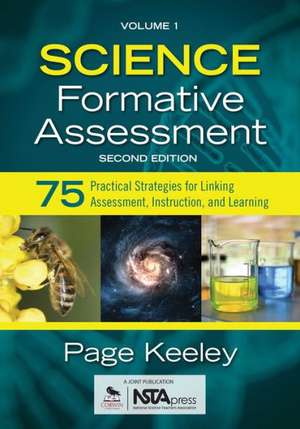
Science Formative Assessment, Volume 1
Autor Page Keeleyen Limba Engleză Paperback – oct 2015
Autoarea Page D. Keeley, o autoritate recunoscută în educația științifică cu o experiență vastă în coordonarea proiectelor finanțate de National Science Foundation, propune în această a doua ediție a Science Formative Assessment, Volume 1 o metodologie riguroasă pentru transformarea sălii de clasă. Observăm că fundamentul acestei lucrări nu este doar teoretic, ci rezultă din decenii de cercetare în dezvoltare profesională și mentorat, oferind cadrelor didactice instrumente concrete pentru a măsura succesul elevilor în timp real. Structura volumului este centrată pe cele 75 de tehnici de evaluare formativă (FACTs), dar progresia conținutului merge dincolo de o simplă listă de metode. Găsim în primele capitole o analiză a modului în care mediul de învățare susține evaluarea, urmată de introducerea ciclului SAIL (Science Assessment, Instruction, and Learning). Acest model facilitează o tranziție fluidă între etapele de implicare, explorare și descoperire, asigurând o punte între gândirea intuitivă a elevului și conceptele științifice acceptate. Cititorii familiarizați cu Formative Assessment Strategies for Enhanced Learning in Science, K-8 de Elizabeth Hammerman vor aprecia în volumul de față focalizarea specifică pe identificarea și corectarea ideilor preconcepute („misconceptions”), un element crucial pentru atingerea standardelor NGSS. Această lucrare extinde viziunea autoarei prezentată în Teaching for Conceptual Understanding in Science, transformând nevoia de înțelegere conceptuală în strategii aplicabile. Față de volumele sale dedicate matematicii, Mathematics Formative Assessment, Volume 1, Page Keeley adaptează aici discursul pentru rigoarea observației și experimentului, oferind un manual esențial pentru profesorii care doresc să echilibreze evaluarea sumativă cu cea formativă.
Preț: 314.01 lei
Carte tipărită la comandă
Livrare economică 14-28 noiembrie
Specificații
ISBN-10: 148335217X
Pagini: 386
Dimensiuni: 178 x 254 x 21 mm
Greutate: 0.72 kg
Ediția:2. Auflage
Editura: Corwin
Locul publicării:Thousand Oaks, United States
V-ar putea interesa
-
 Preț: 364.96 lei
 -
 Understanding Art: A Guide for TeachersMartin W Wenham-8%Preț: 422.27 lei458.99 lei
 -
 Don't Forget to Write for the Elementary Grades826 NationalPreț: 156.91 lei
 -
 Exciting Writing: Activities for 5 to 11 year oldsJacqueline HarrettPreț: 396.16 lei
 -
 Language and Literacy 3-7Jeni Riley-15%Preț: 554.52 lei652.38 lei
 -
 -15%Preț: 540.09 lei635.40 lei
 -
 The Common Core Mathematics StandardsTed H. HullPreț: 247.05 lei
 -
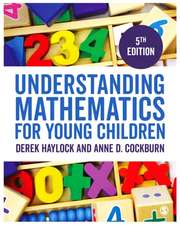 Understanding Mathematics for Young ChildrenDerek HaylockPreț: 348.48 lei
 -
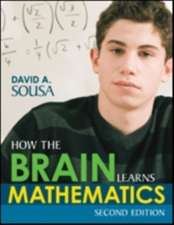 How the Brain Learns MathematicsDavid A. SousaPreț: 226.20 lei
 -
 Hallo Kluger Mond und Schlaue FederJutta FunkPreț: 100.11 lei
De ce să citești această carte
Recomandăm această resursă cadrelor didactice și cercetătorilor care doresc să depășească modelul tradițional de testare. Prin cele 75 de strategii FACTs, cititorul câștigă capacitatea de a diagnostica imediat lacunele în înțelegerea elevilor, adaptând instruirea înainte ca erorile să se sedimenteze. Este un ghid practic care transformă evaluarea dintr-o etapă finală, stresantă, într-un dialog continuu și constructiv despre fenomenele științifice.
Despre autor
Page D. Keeley este un expert de renume în educația științifică, recent retrasă din funcția de Senior Science Program Director la Maine Mathematics and Science Alliance (MMSA). Pe parcursul a 16 ani, a dezvoltat resurse fundamentale pentru standarde de învățare și evaluare formativă. A fost investigator principal (PI) pentru trei proiecte majore finanțate de National Science Foundation, inclusiv proiectul PRISMS, dedicat instruirii științifice în învățământul gimnazial. Expertiza sa este recunoscută prin numeroase premii, fiind o prezență constantă în literatura de specialitate dedicată pedagogiei științelor.
Descriere scurtă
Cuprins
Acknowledgments
About the Author
Chapter 1: An Introduction to Formative Assessment Classroom Techniques (FACTs)
What Does a Formative Assessment-Centered Classroom Look Like?
Why Use FACTs?
How Does Research Support the Use of FACTs?
Classroom Environments That Support Formative Assessment
Connecting Teaching and Learning
Understanding Misconceptions in Science: Misconceptions About Misconceptions
Making the Shift to a Formative Assessment-Centered Classroom
Connections to Current State Standards, <i>A Framework for K–12 Science Education</i>, Next Generation Science Standards, and Literacy Capacities
Chapter 2: Connecting FACTs to Instruction and Learning
Integrating Assessment and Instruction
Assessment That Promotes Thinking and Learning
Linking Assessment, Instruction, and Learning: The Science Assessment, Instruction, and Learning (SAIL) Cycle
Stages in the SAIL Cycle
Engagement and Readiness
Eliciting Prior Knowledge
Exploration and Discovery
Concept and Skill Development
Concept and Skill Transfer
Self-Assessment and Reflection
Selecting and Using FACTs to Strengthen the Link Between Assessment, Instruction, and Learning
Chapter 3: Considerations for Selecting, Implementing, and Using Data From FACTs
Selecting FACTs
Selecting FACTs to Match Learning Goals and Standards
FACTs and Core Disciplinary Content
FACTs and the Scientific and Engineering Practices
Selecting FACTs to Match Teaching Goals
The Critical Importance of Classroom Context in Selecting FACTs
Planning to Use and Implement FACTs
Starting Off With Small Steps
Maintaining and Extending Implementation
25 Way to Lead Learning About Formative Assessment
Using Data From the FACTs
Chapter 4: Get the FACTs! 75 Science Formative Assessment Classroom Techniques (FACTs)
1. A&D Statements
2. Agreement Circles
3. Annotated Student Drawings
4. Card Sorts
5. CCC—Collaborative Clued Corrections
6. Chain Notes
7. Commit and Toss
8. Concept Card Mapping
9. Concept Cartoons
10. Data Match
11. Directed Paraphrasing
12. Explanation Analysis
13. Fact First Questioning
14. Familiar Phenomenon Probes
15. First Word–Last Word
16. Fishbowl Think Aloud
17. Fist to Five
18. Focused Listing
19. Four Corners
20. Frayer Model
21. Friendly Talk Probes
22. Give Me Five
23. Guided Reciprocal Peer Questioning
24. Human Scattergraph
25. Informal Student Interviews
26. Interest Scale
27. I Think–We Think
28. I Used to Think . . . But Now I Know
29. Juicy Questions
30. Justified List
31. Justified True or False Statements
32. K-W-L Variations
33. Learning Goals Inventory (LGI)
34. Look Back
35. Missed Conception
36. Muddiest Point
37. No-Hands Questioning
38. Odd One Out
39. Paint the Picture
40. Partner Speaks
41. Pass the Question
42. A Picture Tells a Thousand Words
43. P-E-O Probes (Predict, Explain, Observe)
44. POMS—Point of Most Significance
45. Popsicle Stick Questioning
46. Prefacing
47. PVF—Paired Verbal Fluency
48. Question Generating
49. Recognizing Exceptions
50. Refutations
51. Representation Analysis
52. RERUN
53. Scientists’ Ideas Comparison
54. Sequencing Cards
55. Sticky Bars
56. STIP—Scientific Terminology Inventory Probe
57. Student Evaluation of Learning Gains
58. Synectics
59. Ten-Two
60. Thinking Log
61. Think-Pair-Share
62. Thought Experiments
63. Three-Minute Pause
64. Three-Two-One
65. Traffic Light Cards
66. Traffic Light Cups
67. Traffic Light Dots
68. Two-Minute Paper
69. Two or Three Before Me
70. Two Stars and a Wish
71. Two-Thirds Testing
72. Volleyball—Not Ping-Pong!
73. Wait Time Variations
74. What Are You Doing and Why?
75. Whiteboarding
Appendix: Annotated Resources for Science Formative Assessment
References
Index