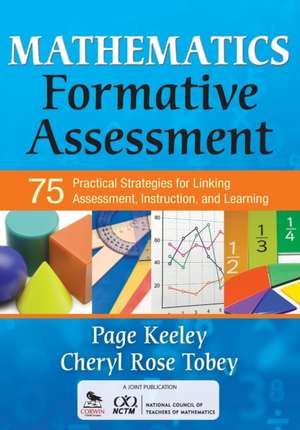
Mathematics Formative Assessment, Volume 1
Autor Page Keeley, Cheryl Rose Tobeyen Limba Engleză Paperback – 15 sep 2011
Observăm în Mathematics Formative Assessment, Volume 1 o extindere necesară a metodologiei premiate dezvoltate de Page Keeley, care transferă rigurozitatea evaluării formative din științe către disciplina matematicii. Această ediție adnotată aduce nou un cadru structurat numit MAIL Cycle (Mathematics Assessment, Instruction, and Learning Cycle), menit să elimine falia dintre momentul evaluării și cel al predării propriu-zise. Față de literatura existentă, lucrarea nu se limitează la teorie, ci oferă 75 de tehnici practice, denumite FACTs, organizate pentru a sprijini diverse etape ale învățării, de la elicitarea cunoștințelor anterioare până la reflecție. Comparabil cu The Formative 5 de Francis M. Fennell în ceea ce privește aplicabilitatea imediată, volumul de față este însă mult mai extensiv, oferind un repertoriu vast de instrumente adaptabile, spre deosebire de concentrarea pe doar cinci tehnici esențiale din titlul menționat. Găsim aici o continuitate clară cu viziunea autoarei din Uncovering Student Ideas in Science, Volume 2, unde accentul cade pe identificarea preconcepțiilor elevilor. În acest volum, Page Keeley și Cheryl Rose Tobey aplică aceleași principii cognitive pentru a revela procesele de gândire matematică. Structura cărții este una progresivă: primele capitole definesc mediul clasei centrate pe evaluare formativă, în timp ce partea a doua se concentrează pe integrarea acestor FACTs în ciclul de instruire. Această abordare sistematică asigură că evaluarea devine un instrument de învățare continuă, nu doar o etapă de verificare finală.
Preț: 247.12 lei
Carte disponibilă
Livrare economică 14-28 noiembrie
Livrare express 03-07 noiembrie pentru 39.62 lei
Specificații
ISBN-10: 1412968127
Pagini: 256
Ilustrații: Illustrations
Dimensiuni: 178 x 254 x 15 mm
Greutate: 0.49 kg
Ediția:annotated ed.
Editura: Corwin
Locul publicării:Thousand Oaks, United States
V-ar putea interesa
-
 Creativity for a New Curriculum: 5-11Lynn D. NewtonPreț: 337.05 lei
 -
 Debates in Physical EducationSusan (Brunel University CapelPreț: 54.52 lei
 -
 -43%Preț: 90.99 lei158.43 lei
 -
 Teaching, Learning and Assessing Science 5 - 12Wynne Harlen-8%Preț: 420.52 lei457.09 lei
 -
 Supporting Children's LearningLyn Overall-23%Preț: 549.49 lei713.63 lei
 -
 Key Concepts in Teaching Primary MathematicsDerek HaylockPreț: 397.02 lei
 -
 Uncovering Student Thinking in Mathematics, Grades K-5Cheryl Rose TobeyPreț: 323.53 lei
 -
 The If Odyssey: A Philosophical Journey Through Greek Myth and Storytelling for 8 - 16-Year-OldsIf Machine Peter Worley-38%Preț: 98.10 lei157.13 lei
 -
 10 Things Every Writer Needs to KnowJeff AndersonPreț: 309.75 lei
 -
 Professional StudiesKate Jacques-23%Preț: 518.41 lei673.27 lei
 -
 Preț: 358.86 lei
 -
 Learning to Teach Primary PEIan Pickup-23%Preț: 424.15 lei550.85 lei
 -
 Behaviour for Learning in the Primary SchoolKate AdamsPreț: 291.30 lei
 -
 -43%Preț: 134.69 lei236.56 lei
De ce să citești această carte
Această resursă este esențială pentru profesorii de matematică și formatorii care doresc să transforme evaluarea într-un dialog activ cu elevul. Cititorul câștigă acces la 75 de tehnici concrete (FACTs) care permit ajustarea predării în timp real. Este un ghid practic care ajută la diagnosticarea rapidă a lacunelor de înțelegere, oferind strategii testate pentru a îmbunătăți performanța școlară prin feedback imediat și precis.
Despre autor
Page Keeley este un expert recunoscut la nivel național în SUA, ocupând funcția de director de programe de știință la Maine Mathematics and Science Alliance. Cu o experiență vastă în dezvoltare profesională și cercetare asupra învățării, ea a coordonat numeroase proiecte finanțate de NSF. Este celebră pentru seria sa de succes „Uncovering Student Ideas”, unde a dezvoltat „probele” de evaluare formativă ca instrumente de diagnosticare a concepțiilor greșite. În colaborare cu Cheryl Rose Tobey, specialistă în educație matematică, Keeley își extinde expertiza pedagogică pentru a oferi soluții pragmatice cadrelor didactice din domeniul STEM.
Descriere scurtă
Recenzii
"This book contains an incredible set of Math FACTs – Formative Assessment Classroom Techniques. If you have been curious about Formative Assessment or how to implement it in your math classroom, this book provides the tools to get you started."
"This book features formative assessment strategies specifically written for math and can be used in any math class. A book that we have been waiting for."
"This book is a game-changer! By putting theory into practical digestible units, Mathematics Formative Assessment gives teachers of all levels a bank of techniques to design standards-aligned classes. I wish I had something like this 20 years ago when I was first teaching."
"Coaches and other teacher leaders will find this compendium of assessment strategies invaluable."
"Most important, Keeley and Tobey discuss extensively the use of teh data generated to inform teaching. Coaches and other teacher leaders will find this compendium of assessment strategies invaluable."
Cuprins
Acknowledgments
About the Authors
1. An Introduction to Formative Assessment Classroom Techniques (FACTs)
What Does a Formative Assessment?Centered Classroom Look Like?
Why Use FACTs?
How Does Research Support the Use of FACTs?
Classroom Environments That Support Formative Assessment
Connecting Teaching and Learning
Making the Shift to a Formative Assessment-Centered Classroom
2. Integrating FACTs With Instruction and Learning
Integrating Assessment and Instruction
Assessment That Promotes Thinking and Learning
Linking Assessment, Instruction, and Learning: The Mathematics Assessment, Instruction, and Learning Cycle (MAIL Cycle)
Stages in the MAIL Cycle
Engagement and Readiness
Eliciting Prior Knowledge
Exploration and Discovery
Concept and Skill Development
Concept and Procedure Transfer
Self-Assessment and Reflection
Selecting and Using FACTs to Strengthen the Link Between Assessment, Instruction, and Learning
3. Considerations for Selecting, Implementing and Using Data From FACTs
Selecting FACTs
Selecting FACTs to Match Learning Goals
FACTs and the Common Core Standards for Mathematics
Selecting FACTs to Match Teaching Goals
The Critical Importance of Classroom Context in Selecting FACTs
Planning to Use and Implement FACTs
Starting Off With Small Steps
Maintaining and Extending Implementation
Using Data From the FACTs
4. Get the FACTs! 75 Mathematics Formative Assessment Classroom Techniques (FACTs)
#1. A & D Statements
#2. Agreement Circles
#3. Always, Sometimes, or Never True
#4. Card Sorts
#5. CCC: Collaborative Clued Corrections
#6. Comments-Only Marking
#7. Commit and Toss
#8. Concept Attainment Cards
#9. Concept Card Mapping
#10. Concept Cartoons
#11. Create the Problem
#12. Every Graph Tells a Story
#13. Example, Nonexample
#14. Fact-First Questioning
#15. Feedback to Feed-Forward
#16. Fist to Five
#17. Four Corners
#18. Frayer Model
#19. Friendly Talk Probes
#20. Give Me Five
#21. Hot Seat Questioning
#22. Human Scatter Graph
#23. Is It Fair?
#24. I Used to Think . . . But Now I Know . . .
#25. Justified List
#26. Justified True-or-False Statements
#27. K-W-L Variations
#28. Learning Goals Inventory (LGI)
#29. Look Back
#30. Matching Cards
#31. Mathematician's Ideas Comparison
#32. More A?More B Probes
#33. Muddiest Point
#34. No-Hands Questioning
#35. Odd One Out
#36. Opposing Views Probes
#37. Overgeneralization Probes
#38. Partner Speaks
#39. Pass the Problem
#40. P-E-O Probes (Predict, Explain, Observe)
#41. Peer-to-Peer Focused Feedback
#42. A Picture Tells a Thousand Words
#43. POMS: Point of Most Significance
#44. Popsicle Stick Questioning
#45. PVF: Paired Verbal Fluency
#46. Question Generating
#47. Response Cards
#48. Same A?Same B Probes
#49. Sequencing Cards
#50. Sticky Bars
#51. Strategy Harvest
#52. Strategy Probe
#53. Student Evaluation of Learning Gains
#54. Student Interviews
#55. Terminology Inventory Probe (TIP)
#56. Ten-Two
#57. Thinking Log
#58. Think-Alouds
#59. Think-Pair-Share
#60. Thought Experiments
#61. Three-Minute Pause
#62. 3-2-1
#63. Thumbs Up, Thumbs Down
#64. Traffic Light Cards
#65. Traffic Light Cups
#66. Traffic Light Dots
#67. Two-Minute Paper
#68. Two or Three Before Me
#69. Two Stars and a Wish
#70. Two Thirds Testing
#71. Volleyball, Not Ping-Pong!
#72. Wait Time Variations
#73. What Are You Doing and Why?
#74. Whiteboarding
#75. Word Sort
Appendix: Annotated Resources for Mathematics Formative Assessment
References
Index
Notă biografică
Prior to leaving the classroom to work at the Maine Mathematics and Science Alliance in 1996, Page taught middle and high school science for 15 years. At that time she was an active teacher leader at the state and national level, serving two terms as President of the Maine Science Teachers Association and NSTA District II Director 1995-1998 and NSTA Executive Board member (prior to the Board and Council restructuring in 1997). She received the Presidential Award for Excellence in Secondary Science Teaching in 1992 and the Milken National Distinguished Educator Award in 1993.
Since leaving the classroom in 1996, her work in leadership and professional development has been nationally recognized. In 2008 she was elected the 63rd President of the National Science Teachers Association (NSTA), the world¿s largest organization of K-12, university, and informal science educators. In 2009 she received the National Staff Development Council's (now Learning Forward) . In 2013 she received the Outstanding Leadership in Science Education award from the National Science Education Leadership Association (NSELA) and in 2018, The Distinguished Service to Science Education Award from NSTA. She has served as an adjunct instructor at the University of Maine, was a Cohort 1 Fellow in the National Academy for Science and Mathematics Education Leadership, was a science literacy leader for the AAAS/Project 2061 Professional Development Program, and served on several national advisory boards. She has a strong interest in global science education and has led science/STEM education delegations to South Africa (2009), China (2010), India (2012), Cuba (2014), Iceland (2017), Panama (2018), and Costa Rica (2019).
Prior to entering the teaching profession, Page was a research assistant for immunogeneticist, Dr. Leonard Shultz, at the Jackson Laboratory of Mammalian Genetics in Bar Harbor, Maine. She received her B.S. in Life Sciences/pre-veterinary studies from the University of New Hampshire and her Masters degree in Science Education from the University of Maine. In her spare time she enjoys travel, reading, photography, fiber art, and dabbles in modernist cooking and culinary art. A Maine resident for almost 40 years, Page and her husband currently reside in Fort Myers, FL and Wickford, RI. Page can be contacted at pagekeeley@gmail.com or through her web site at www.uncoveringstudentideas.org