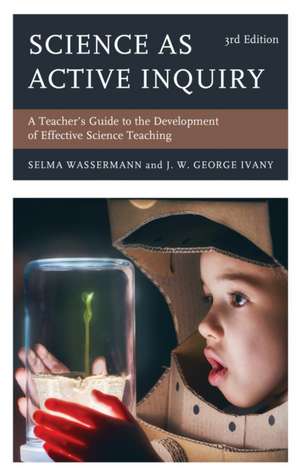
Science as Active Inquiry: A Teacher's Guide to the Development of Effective Science Teaching
Autor Selma Wassermann, J. W. George Ivanyen Limba Engleză Paperback – 15 mai 2022
With the current emphasis on distance learning, the use of IT as instructional tools and more child-centered practices, this new book should serve as a valuable resource for opening teachers' and students' minds to the values of teaching science in the ways in which scientists actually do their work. More than theory, the book offers practical and clear help to teachers to want to pursue teaching science as an investigative process.
Preț: 223.62 lei
Preț vechi: 294.83 lei
-24%
Puncte Express: 335
Carte tipărită la comandă
Livrare economică 07-21 decembrie
Livrare prin curier în România Termenul estimat este afișat lângă disponibilitate.
Transport gratuit de la 400.00 lei Plată online sau ramburs, în funcție de opțiunile comenzii.
Retur gratuit în 14 zile Comandă securizată și suport în română.
Specificații
ISBN-13: 9781475864861
ISBN-10: 1475864868
Pagini: 318
Dimensiuni: 150 x 226 x 22 mm
Greutate: 0.47 kg
Ediția:3rd Edition
Editura: Bloomsbury Publishing
Colecția Rowman & Littlefield
Locul publicării:New York, United States
ISBN-10: 1475864868
Pagini: 318
Dimensiuni: 150 x 226 x 22 mm
Greutate: 0.47 kg
Ediția:3rd Edition
Editura: Bloomsbury Publishing
Colecția Rowman & Littlefield
Locul publicării:New York, United States
Cuprins
Preface
Acknowledgements
Introduction: This Book is for Teachers
Section I: Perspectives
Chapter 1: Perspectives on Science and Sciencing
Chapter 2: Perspectives on Children
Chapter 3: Perspectives on Play
Chapter 4: Perspectives on Teaching for Thinking in Science
Chapter 5: Perspectives from the Classroom: The Play-Debrief-Replay Instructional Model
Section II: Organizing the Classroom for Science as Active Inquiry
Chapter 6: Preparing Students for Sciencing
Chapter 7: Gathering the Materials
Chapter 8: Making Room for Sciencing
Chapter 9: Guidelines and Ground Rules
Chapter 10: Debriefing: Interactions that Promote Thoughtful Inquiry
Chapter 11: Thinking and Decision Making in Science
Section III: 58 Sciencing Activities
Chapter 12: Introduction to the Activities
Chapter 13: Category A: Wet, Wetter, Wettest: Activities 1 - 11
Chapter 14: Category B: No Fuss, No Muss, No Sticky Stuff: Activities 12 - 48
Chapter 15: Category C: Who's Afraid of Spiders?: Activities 49 - 58
Section IV:: Journey Into the Unknown
Chapter 16: Evaluating Student Growth
Chapter 17: Journey Into the Unknown
Appendix
Bibliography
Acknowledgements
Introduction: This Book is for Teachers
Section I: Perspectives
Chapter 1: Perspectives on Science and Sciencing
Chapter 2: Perspectives on Children
Chapter 3: Perspectives on Play
Chapter 4: Perspectives on Teaching for Thinking in Science
Chapter 5: Perspectives from the Classroom: The Play-Debrief-Replay Instructional Model
Section II: Organizing the Classroom for Science as Active Inquiry
Chapter 6: Preparing Students for Sciencing
Chapter 7: Gathering the Materials
Chapter 8: Making Room for Sciencing
Chapter 9: Guidelines and Ground Rules
Chapter 10: Debriefing: Interactions that Promote Thoughtful Inquiry
Chapter 11: Thinking and Decision Making in Science
Section III: 58 Sciencing Activities
Chapter 12: Introduction to the Activities
Chapter 13: Category A: Wet, Wetter, Wettest: Activities 1 - 11
Chapter 14: Category B: No Fuss, No Muss, No Sticky Stuff: Activities 12 - 48
Chapter 15: Category C: Who's Afraid of Spiders?: Activities 49 - 58
Section IV:: Journey Into the Unknown
Chapter 16: Evaluating Student Growth
Chapter 17: Journey Into the Unknown
Appendix
Bibliography
Recenzii
Students love the opportunity to "be scientists!" Wassermann and Ivany have provided engaging, thoughtful and challenging ways to have learners to understand and practice science as inquiry rather than rote memory, as evolving rather than static, and as creative rather than prescriptive. This book is a treasure for all ages!
Teaching Science as Active Inquiry is an outstanding resource for educators interested in inquiry-based teaching who wish to instil a love for science in their students and promote a deeper understanding of and skill in the processes of science. Wassermann and Ivany provide detailed supports for curriculum design, implementation, and the promotion of student autonomy.
In the midst of the pandemic, it is propitious that a new book, Teaching Science as Active Inquiry by Wassermann and Ivany is now available. This new volume utilizes their highly successful Play-Debrief-Replay model that puts students in the central role of scientific investigators. The authors, very much on the side of teachers, provide them with many examples of challenging, hands-on activities to implement their science program. This is very much a book for the 21st century, with the urgency of a subject that impinges on us every minute of our lives. The book's a knockout. It could not be more timely.
What the world needs now is a citizenry that is scientifically literate and knows how to think. The word Science is bandied around by politicians and the media as being a static, certain entity which it is not. Science and thinking are often taught (if taught at all) as having one predetermined correct answer. This book is a delicious alternative for teachers to help students sustain their innate sense of wonder into the world around them through a "play - debrief - replay" teaching strategy and the use of learning centres. It is based on child centered pedagogy and includes 58 inquiry activities that can easily be implemented in the classroom. I highly recommend this book for all teachers.
Teaching Science as Active Inquiry is an outstanding resource for educators interested in inquiry-based teaching who wish to instil a love for science in their students and promote a deeper understanding of and skill in the processes of science. Wassermann and Ivany provide detailed supports for curriculum design, implementation, and the promotion of student autonomy.
In the midst of the pandemic, it is propitious that a new book, Teaching Science as Active Inquiry by Wassermann and Ivany is now available. This new volume utilizes their highly successful Play-Debrief-Replay model that puts students in the central role of scientific investigators. The authors, very much on the side of teachers, provide them with many examples of challenging, hands-on activities to implement their science program. This is very much a book for the 21st century, with the urgency of a subject that impinges on us every minute of our lives. The book's a knockout. It could not be more timely.
What the world needs now is a citizenry that is scientifically literate and knows how to think. The word Science is bandied around by politicians and the media as being a static, certain entity which it is not. Science and thinking are often taught (if taught at all) as having one predetermined correct answer. This book is a delicious alternative for teachers to help students sustain their innate sense of wonder into the world around them through a "play - debrief - replay" teaching strategy and the use of learning centres. It is based on child centered pedagogy and includes 58 inquiry activities that can easily be implemented in the classroom. I highly recommend this book for all teachers.