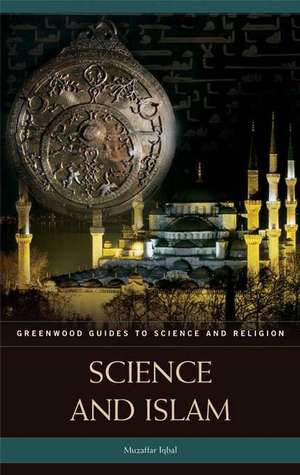
Science and Islam: Greenwood Guides to Science and Religion
Autor Muzaffar Iqbalen Limba Engleză Hardback – 30 mar 2007
Based on primary sources, the book presents a panorama of Islamic views on some of the major issues in the current science and religion discourse. Written in accessible language, Science and Islam is an authentic account of the multi-faceted and complex issues that arise at the interface of Islamic intellectual tradition and science. Rich in historical details, the book is a fascinating survey of the interaction of Islamic beliefs with the enterprise of science.

Preț: 328.34 lei
Preț vechi: 589.84 lei
-44%
Puncte Express: 493
Carte tipărită la comandă
Livrare economică 27 noiembrie-11 decembrie
Livrare prin curier în România Termenul estimat este afișat lângă disponibilitate.
Transport gratuit de la 400.00 lei Plată online sau ramburs, în funcție de opțiunile comenzii.
Retur gratuit în 14 zile Comandă securizată și suport în română.
Specificații
ISBN-13: 9780313335761
ISBN-10: 0313335761
Pagini: 272
Dimensiuni: 156 x 235 x 29 mm
Greutate: 0.56 kg
Editura: Bloomsbury Publishing
Colecția Greenwood
Seria Greenwood Guides to Science and Religion
Locul publicării:New York, United States
ISBN-10: 0313335761
Pagini: 272
Dimensiuni: 156 x 235 x 29 mm
Greutate: 0.56 kg
Editura: Bloomsbury Publishing
Colecția Greenwood
Seria Greenwood Guides to Science and Religion
Locul publicării:New York, United States
V-ar putea interesa
-
 The FellowshipJohn GribbinPreț: 102.40 lei
 -
 The Invention of ScienceDavid Wootton-22%Preț: 114.46 lei145.81 lei
 -
 To Explain the WorldSteven Weinberg-29%Preț: 66.53 lei94.31 lei
 -
 TideHugh Aldersey-Williams-18%Preț: 76.57 lei93.26 lei
 -
 Athanasius Kircher: The Last Man Who Knew EverythingPaula FindlenPreț: 429.59 lei
 -
 Science FirstsRobert E AdlerPreț: 200.07 lei
 -
 SerendipityRoyston M RobertsPreț: 114.86 lei
 -
 The Cambridge Historical Dictionary of DiseaseKenneth F. KiplePreț: 366.63 lei
 -
 Nobel Laureates and Twentieth-Century PhysicsMauro Dardo-11%Preț: 460.27 lei517.16 lei
 -
 From Newton to HawkingKevin KnoxPreț: 278.65 lei
 -
 Preț: 220.99 lei
 -
 Lady Tasting TeaDavid SalsburgPreț: 127.01 lei
 -
 Born-Einstein Letters, 1916-1955A. Einstein-8%Preț: 502.84 lei546.56 lei
 -
 The Comet Sweeper (Icon Science)Claire BrockPreț: 65.16 lei
 -
 Science and IslamEhsan MasoodPreț: 79.49 lei
Recenzii
This is an excellent book. It is a model for any studies on the relation of a particular religious tradition to science.
[The author] has an agreeably caustic and aggressive approach to outdated and erroneous ideas about the history of science. The book is a polemical essay, rather than a history, and welcome as such.
Scientist, Islamic scholar, novelist, and poet Iqbal first explains why the two-entity model of science and religion developed to analyze Western Christianity does not apply to Islam. Then he explores such questions as what was Islamic in Islamic science, whether there were tensions within the Islamic tradition that may have inhibited the full blossoming of scientific activity, how Islamic scientific knowledge was passed to Europe, and what new facets of the relationship between science and Islam have appeared in the post-Scientific Revolution era.
[The author] has an agreeably caustic and aggressive approach to outdated and erroneous ideas about the history of science. The book is a polemical essay, rather than a history, and welcome as such.
Scientist, Islamic scholar, novelist, and poet Iqbal first explains why the two-entity model of science and religion developed to analyze Western Christianity does not apply to Islam. Then he explores such questions as what was Islamic in Islamic science, whether there were tensions within the Islamic tradition that may have inhibited the full blossoming of scientific activity, how Islamic scientific knowledge was passed to Europe, and what new facets of the relationship between science and Islam have appeared in the post-Scientific Revolution era.