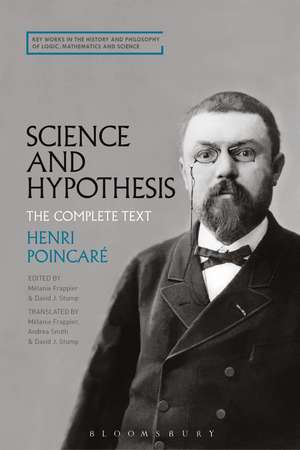
Science and Hypothesis: The Complete Text
Autor Henri Poincaré Editat de David J. Stump Traducere de Mélanie Frappier, Andrea Smithen Limba Engleză Hardback – 16 noi 2017
Addressing errors introduced by Greenstreet and Halsted in their early 20th-century translations, it incorporates all the changes, corrections and additions Poincaré made over the years. Taking care to update the writing for a modern audience, Poincaré's ideas and arguments on the role of hypotheses in mathematics and in science become clearer and closer to his original meaning, while David J. Stump's introduction gives fresh insights into Poincaré's philosophy of science. By approaching Science and Hypothesis from a contemporary perspective, it presents a better understanding of Poincare's hierarchy of the sciences, with arithmetic as the foundation, geometry as the science of space, then mechanics and the rest of physics.
For philosophers of science and scientists working on problems of space, time and relativity, this is a much needed translation of a ground-breaking work which demonstrates why Poincaré is still relevant today.
Preț: 676.79 lei
Preț vechi: 1242.03 lei
-46%
Puncte Express: 1015
Carte tipărită la comandă
Livrare economică 28 noiembrie-12 decembrie
Livrare prin curier în România Termenul estimat este afișat lângă disponibilitate.
Transport gratuit pentru acest produs Plată online sau ramburs, în funcție de opțiunile comenzii.
Retur gratuit în 14 zile Comandă securizată și suport în română.
Specificații
ISBN-13: 9781350026773
ISBN-10: 1350026778
Pagini: 208
Dimensiuni: 162 x 236 x 18 mm
Greutate: 0.46 kg
Editura: Bloomsbury Publishing
Colecția Bloomsbury Academic
Locul publicării:London, United Kingdom
ISBN-10: 1350026778
Pagini: 208
Dimensiuni: 162 x 236 x 18 mm
Greutate: 0.46 kg
Editura: Bloomsbury Publishing
Colecția Bloomsbury Academic
Locul publicării:London, United Kingdom
V-ar putea interesa
-
 The Varieties of Scientific ExperienceCarl SaganPreț: 142.22 lei
 -
 Studies in the Philosophy of the Scottish EnlightenmentM. A. Stewart-28%Preț: 360.88 lei501.92 lei
 -
 The Scenes of Inquiry: On the Reality of Questions in the SciencesNicholas Jardine-28%Preț: 424.97 lei593.79 lei
 -
 Philosophy of Science TodayPeter Clark-20%Preț: 288.93 lei362.54 lei
 -
 -18%Preț: 343.20 lei419.95 lei
 -
 Broca's BrainCarl SaganPreț: 58.77 lei
 -
 Billions & BillionsCarl SaganPreț: 112.31 lei
 -
 The Quark And The Jaguar: Adventures in the Simple and the ComplexMurray Gell-Mann-26%Preț: 79.42 lei107.77 lei
 -
 The Sisterhood of Blackberry CornerAndrea SmithPreț: 103.85 lei
 -
 Understanding Philosophy of ScienceJames LadymanPreț: 379.63 lei
 -
 The Logic of Scientific DiscoveryKarl PopperPreț: 233.98 lei
 -
 Preț: 221.84 lei
 -
 The Turning PointFritjof CapraPreț: 157.38 lei
 -
 Preț: 412.24 lei
 -
 Science in a Free SocietyPaul FeyerabendPreț: 112.58 lei
 -
 The Evolutionary MindRalph AbrahamPreț: 103.71 lei
 -
 The Quantum and the LotusMatthieu RicardPreț: 105.16 lei
Cuprins
1. Introduction by David J. Stump
Origin of the parts of the book
Author's Preface
Part I: Number and Magnitude
2. On the Nature of Mathematical Reasoning
3. Mathematical Magnitude and Experiment
Part II: Space
4. Non-Euclidean Geometries
5. Space and Geometry
6. Experiment and Geometry
Part III: Force
7. Classical Mechanics
8. Relative and Absolute Motion
9. Energy and Thermo-Dynamics
Part IV: Nature
10. Hypotheses in Physics
11. The Theories of Modern Physics
12. The Calculus of Probabilities
13. Optics and Electricity
14. XIII Electro-Dynamics
15. The End of Matter
Index
Origin of the parts of the book
Author's Preface
Part I: Number and Magnitude
2. On the Nature of Mathematical Reasoning
3. Mathematical Magnitude and Experiment
Part II: Space
4. Non-Euclidean Geometries
5. Space and Geometry
6. Experiment and Geometry
Part III: Force
7. Classical Mechanics
8. Relative and Absolute Motion
9. Energy and Thermo-Dynamics
Part IV: Nature
10. Hypotheses in Physics
11. The Theories of Modern Physics
12. The Calculus of Probabilities
13. Optics and Electricity
14. XIII Electro-Dynamics
15. The End of Matter
Index
Recenzii
Frappier et al. have done an excellent job of bringing back-so to speak-Poincaré's masterpiece of philosophical and scientific thought.
I heartily applaud David Stump, Melanie Frappier and Andrea Smith for this splendid new edition of Poincaré's Science and Hypothesis. By bringing language and terminology up-to-date and providing new insights they have ensured that the book can once again reach the wide audience originally reached by Poincaré. At the same time, they give us a fascinating glimpse into the state of philosophy on the eve of the 20th-century revolutions in mathematical and scientific thought.
Poincaré's essays on science and mathematics retain their importance after over a century because he stood back from the day-to-day tasks to reflect on what it is to do research, the kinds of questions that can be asked, and the kind of answers one might get. This new translation displays the lucidity of his thought, and David Stump's Foreword brings out the depths that lie beneath Poincaré's urbane style. There is new material here, too, and altogether this book is a fresh presentation of Poincaré as an intellectual companion for the twenty-first century.
This updated and corrected translation of Science and Hypothesis is an essential addition to both personal and institutional libraries. Scholars who prefer to read Poincaré in English, as well as general readers of philosophy of science, will appreciate this version, which was produced by a team of three translators/editors. In addition to corrections, the volume includes an additional chapter 14: a paper written in 1906 and added to French editions of 1917, but not included in any prior English translations. Happy reading!
This book is a must-read in the foundations of mathematics and physics. For the beginner, the accurate translation of Poincaré's masterpiece is an excellent introduction to the subject, full of verve and good humor. For the expert, the brilliant foreword gives a lucid account of the major interpretations of Poincaré's work.
This is the edition of Poincaré's Science and Hypothesis English-speaking scholars will henceforth want to use in their teaching and research. The translators have made it more readable without sacrificing accuracy, and their helpful notes, references, and explanations reflect the most recent scholarship on this important philosopher and mathematician.
It was certainly about time a new translation of Poincaré's great classic came out. The translators have done a thorough job comparing first and subsequent editions and updating the language. This volume is to become the definitive English edition of Science and Hypothesis.
Poincare's Science and Hypothesis offers one of the deepest and yet most accessible investigations into the nature of science, constituting one of the most significant works in philosophy of science of the 20th century. This excellent new translation and introduction to Poincare's philosophy offers an invaluable resource for anyone interested in the scientific method and the nature of scientific knowledge.
I heartily applaud David Stump, Melanie Frappier and Andrea Smith for this splendid new edition of Poincaré's Science and Hypothesis. By bringing language and terminology up-to-date and providing new insights they have ensured that the book can once again reach the wide audience originally reached by Poincaré. At the same time, they give us a fascinating glimpse into the state of philosophy on the eve of the 20th-century revolutions in mathematical and scientific thought.
Poincaré's essays on science and mathematics retain their importance after over a century because he stood back from the day-to-day tasks to reflect on what it is to do research, the kinds of questions that can be asked, and the kind of answers one might get. This new translation displays the lucidity of his thought, and David Stump's Foreword brings out the depths that lie beneath Poincaré's urbane style. There is new material here, too, and altogether this book is a fresh presentation of Poincaré as an intellectual companion for the twenty-first century.
This updated and corrected translation of Science and Hypothesis is an essential addition to both personal and institutional libraries. Scholars who prefer to read Poincaré in English, as well as general readers of philosophy of science, will appreciate this version, which was produced by a team of three translators/editors. In addition to corrections, the volume includes an additional chapter 14: a paper written in 1906 and added to French editions of 1917, but not included in any prior English translations. Happy reading!
This book is a must-read in the foundations of mathematics and physics. For the beginner, the accurate translation of Poincaré's masterpiece is an excellent introduction to the subject, full of verve and good humor. For the expert, the brilliant foreword gives a lucid account of the major interpretations of Poincaré's work.
This is the edition of Poincaré's Science and Hypothesis English-speaking scholars will henceforth want to use in their teaching and research. The translators have made it more readable without sacrificing accuracy, and their helpful notes, references, and explanations reflect the most recent scholarship on this important philosopher and mathematician.
It was certainly about time a new translation of Poincaré's great classic came out. The translators have done a thorough job comparing first and subsequent editions and updating the language. This volume is to become the definitive English edition of Science and Hypothesis.
Poincare's Science and Hypothesis offers one of the deepest and yet most accessible investigations into the nature of science, constituting one of the most significant works in philosophy of science of the 20th century. This excellent new translation and introduction to Poincare's philosophy offers an invaluable resource for anyone interested in the scientific method and the nature of scientific knowledge.
Notă biografică
Henri Poincaré (1854-1912) was a French mathematician, theoretical physicist, and a philosopher of science.