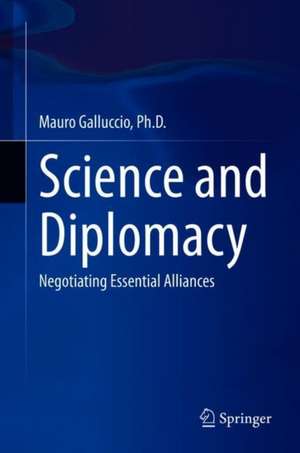
Science and Diplomacy
Autor Galluccioen Limba Engleză Hardback – 7 ian 2021
Preț: 756.00 lei
Preț vechi: 921.94 lei
-18%
Puncte Express: 1134
Carte tipărită la comandă
Livrare economică 05-19 decembrie
Livrare prin curier în România Termenul estimat este afișat lângă disponibilitate.
Transport gratuit pentru acest produs Plată online sau ramburs, în funcție de opțiunile comenzii.
Retur gratuit în 14 zile Comandă securizată și suport în română.
Specificații
ISBN-13: 9783030604134
ISBN-10: 3030604136
Pagini: 240
Ilustrații: XXVII, 211 p. 12 illus., 6 illus. in color.
Dimensiuni: 160 x 241 x 19 mm
Greutate: 0.48 kg
Ediția:1st ed. 2021
Editura: Springer
Locul publicării:Cham, Switzerland
ISBN-10: 3030604136
Pagini: 240
Ilustrații: XXVII, 211 p. 12 illus., 6 illus. in color.
Dimensiuni: 160 x 241 x 19 mm
Greutate: 0.48 kg
Ediția:1st ed. 2021
Editura: Springer
Locul publicării:Cham, Switzerland
Cuprins
Part I: Perception and misperception in science diplomacy.- Introduction - Book organisation.- Adaptive decision-making process in crisis situations.- Part II: Science and Diplomacy: Negotiating a Joint Engagement.- Science Diplomacy.- Science Diplomacy and the EU.- Evidence-Informed Policymaking.- Climate Change and Extreme Hazards.- Evidence-informed policymaking: The Way Forward.- Part III: Biosecurity and Environmental Disaster: Adaptive decision-making in time of uncertainty.- A major challenge to the uncertainty of modern times.- Crisis Management and Risk Assessment in the EU: A General Outline.- International Cooperation.- Part IV: Theory, research, and practice for Science diplomacy: An insight on cooperative processes.- International Alliance for Science Diplomacy. Interpersonal skills as a predictor of a sound negotiation process: American and European self-perception.- Evidence-Informed Policymaking: A European Multi-Actor Innovative Project.- Misunderstanding the first Nuclear crisis with North Korea: The inconvenient science in negotiations.- Scientists meet diplomats: A cognitive insight on interpersonal negotiation process.
Notă biografică
Mauro Galluccio Ph.D. ist Politikwissenschaftler, Psychologe und kognitiver Verhaltenstherapeut in klinischer Praxis. Er schloss sein Post-Doc-Stipendium an der Johns Hopkins University ab, wo er auch zwei Jahre lang als Gastwissenschaftler an der SAIS (School of Advanced International Studies) in Washington D.C. tätig war. Dr. Galluccio ist Präsident der EANAM (European Association for Negotiation and Mediation) mit Sitz in Brüssel. Er ist Berater der Gemeinsamen Forschungsstelle (Joint Research Center, JRC) für evidenzbasierte Politikgestaltung und erfahrener Gutachter, Ethikexperte und Peer Reviewer für den Europäischen Forschungsrat (ERC) und die Exekutivagentur für Forschung (REA) für Gründungsprojekte und Programme der Europäischen Union. Dr. Galluccio hat viele Jahre lang als politischer Analyst und Berater in den europäischen Institutionen gearbeitet. Er ist seit mehr als 20 Jahren als externer Redner und Dozent für die Europäische Kommission (GD COMM - EU-Ratspräsidentschaft)tätig, die für die EU-Institutionen und die politische Entscheidungsfindung zuständig ist. Er war Berater des UNDP (Entwicklungsprogramm der Vereinten Nationen) für ein Mentoring-Programm für Ausbilder. Er ist Herausgeber und Autor des Handbook of International Negotiation: Interpersonal, Intercultural, and Diplomatic Perspectives, 2015, Springer, New York. Er ist Mitautor von Psychological processes in international negotiations: theoretical and practical perspectives (mit F. Aquilar, Springer, New York, 2008) und Mitherausgeber von Psychological and Political Strategies for Peace Negotiation. A Cognitive Approach (mit F. Aquilar, Springer, New York, 2011).
Textul de pe ultima copertă
This book lays the groundwork for a new field of study and research in the intersection between science and diplomacy. It will review the multi-disciplinary research in this burgeoning area in providing the scientific foundation for the application of psychological principles to understanding and facilitating political decisions in an international context. Focusing on how people think, act, and feel on both individual and collective levels, this book takes into account a realistic perspective from which transformative processes can emerge. It follows the ongoing debate in the EU and the world in providing a better understanding of the tools that can be deployed to improve communication and cooperation between scientists, politicians, and diplomats in this field. The failure of communication in this COVID-19 planetary crisis has not been about whether or not objectives have been achieved, but about the ability of major actors to cooperate to forge links with people. The way policymakers and scientists will manage their interpersonal negotiations will be of great importance in fostering international cooperation and coordinated problem-solving behaviours. Otherwise, science diplomacy will lose sight of its most important purpose: that of helping to solve problems, conflicts, and diplomatic processes for the sake of humanity.
Caracteristici
The Author is a political scientist, psychologist and CBT psychotherapist operating in a globally influential setting Defines the issues that bring successful conflict resolution Describes tools for more efficient and effective negotiations Uses an evidenced-informed policymaking approach Includes discussion of cognitive psychology, clinical and affective neuroscience issues Addresses barriers to communication between scientists and diplomats