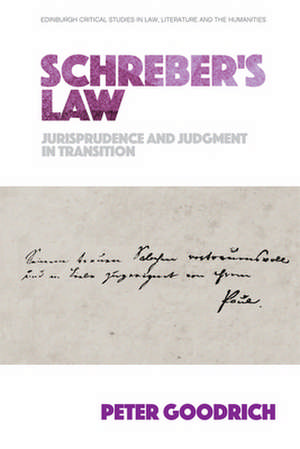
Schreber's Law: Edinburgh Critical Studies in Law, Literature and the Humanities
Autor Peter Goodrichen Limba Engleză Paperback – 4 iun 2020
Peter Goodrich evaluates Schreber's jurisprudence by analysing the Memoirs and his interpreters in detail, and sets his work in the context of both the neo-Kantian pure science of fin de si cle German jurisprudence and 21st-century legal theory. In this way, Goodrich shows how Schreber's work challenges the legal thought of his era and opens up a potentially vital approach to contemporary jurisprudence.



Preț: 171.37 lei
Preț vechi: 207.14 lei
-17%
Puncte Express: 257
Carte disponibilă
Livrare economică 13-27 noiembrie
Livrare express 29 octombrie-04 noiembrie pentru 60.18 lei
Livrare prin curier în România Termenul estimat este afișat lângă disponibilitate.
Transport gratuit de la 400.00 lei Plată online sau ramburs, în funcție de opțiunile comenzii.
Retur gratuit în 14 zile Comandă securizată și suport în română.
Specificații
ISBN-13: 9781474426572
ISBN-10: 1474426573
Pagini: 160
Dimensiuni: 153 x 234 x 13 mm
Greutate: 0.29 kg
Editura: EDINBURGH UNIVERSITY PRESS
Colecția Edinburgh Critical Studies in Law, Literature and the Humanities
Seria Edinburgh Critical Studies in Law, Literature and the Humanities
ISBN-10: 1474426573
Pagini: 160
Dimensiuni: 153 x 234 x 13 mm
Greutate: 0.29 kg
Editura: EDINBURGH UNIVERSITY PRESS
Colecția Edinburgh Critical Studies in Law, Literature and the Humanities
Seria Edinburgh Critical Studies in Law, Literature and the Humanities
Descriere
Peter Goodrich looks beyond Judge Schreber's mental health to evaluate his jurisprudential theory. Goodrich analyses Schreber's Memoirs, interpreters and intellectual context to show how Schreber challenges the legal thought of his era and opens up a potentially vital approach to contemporary jurisprudence.