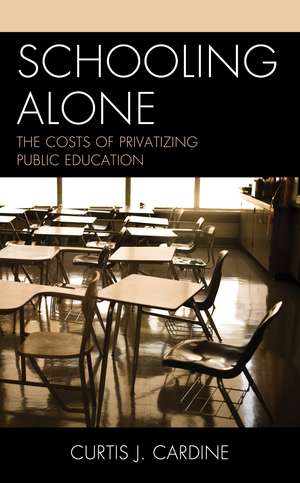
Schooling Alone: The Costs of Privatizing Public Education
Autor Curtis J. Cardineen Limba Engleză Hardback – 8 oct 2019
Preț: 419.25 lei
Preț vechi: 597.91 lei
-30%
Puncte Express: 629
Carte tipărită la comandă
Livrare economică 02-16 decembrie
Livrare prin curier în România Termenul estimat este afișat lângă disponibilitate.
Transport gratuit pentru acest produs Plată online sau ramburs, în funcție de opțiunile comenzii.
Retur gratuit în 14 zile Comandă securizată și suport în română.
Specificații
ISBN-13: 9781475850017
ISBN-10: 1475850018
Pagini: 200
Ilustrații: 17 b/w illustrations;10 tables
Dimensiuni: 159 x 232 x 19 mm
Greutate: 0.45 kg
Editura: Bloomsbury Publishing
Colecția Rowman & Littlefield
Locul publicării:New York, United States
ISBN-10: 1475850018
Pagini: 200
Ilustrații: 17 b/w illustrations;10 tables
Dimensiuni: 159 x 232 x 19 mm
Greutate: 0.45 kg
Editura: Bloomsbury Publishing
Colecția Rowman & Littlefield
Locul publicării:New York, United States
Cuprins
Preface
Chapter 1: Chartering Schools
Chapter 2: An Entitlement Mentality
Students as Business Assets
Chapter 3: Something Happened
Selling the Charter School Concept
Chapter 4: De-professionalizing American Public Education
Repealing Labor Laws
Take Care of Business
Chapter 5: What about the Sermon on the Mount?
Chapter 6: The Good Old Days
Chapter 7: Public or Private
Chapter 8: A Contracted Service
Chapter 9: "All Politics is Local"
Chapter 10: Deregulating a Public Good
Chapter 11: The Myth of Self-Correcting Free Markets
Chapter 12: Financial "Tells"
Comparing Market Sectors' Debt
Chapter 13: Espoused Theories vs Theories in Use
Consumer Choice without Consumer Responsibility for that Choice
Chapter 14: Retirement Heist
Chapter 15: Investing in the General Welfare
Privatization Creep
Chapter 16: Market Meltdown
The Issue with Long Term Leases with a Related Party
Chapter 17: Controlling the Nation's Educational Agenda
Chapter 18: The Economics of School Choice
Chapter 19: False Analogies
Chapter 20: Capitalism and Democracy
An Economic versus a Political Theory of Action
Historical Context
Personal Financial Responsibility is an American Value
The "Greatest Generation" got it Right
Scientific Management
Chapter 21: A Corporate Culture
A Financial House of Cards
Real Estate Acquisition Companies
Exacerbating the Debt Problem
Long Term Leasing Commitments with Related Parties
Underwater Real Estate Holdings
Overleveraged Long Term Debt and Commitments
Chapter 22: Is this Any Way to Run a Business?
Double Standards for Fiscal Accountability
There are No Fail Safes Built into the Model
Defining Unsustainable Losses in a Growing "Free Market"
Theoretical Safeguard
Threatened Educational Capital Sources
Backpacks full of Debt guaranteed by Students' Backpacks full of Cash
Chapter 23: Lost Political Capital
Chapter 24: The Role of the Federal Government in Public Education
Precedents for Federal Involvement in Education
Origins of the Federal, State, and Local Control Debates
Chapter 25: The Goals of an American Public Education
Communities Matter
Celebrate all of our Successes
Chapter 26: Cashing In - Greed is "Good"
The Profit Motive: A Case in Point
The Theory of the Firm
New Rules
Chapter 27: An Educational Vision versus an Economic Theory of Action
Chapter 28: Philosophical Dissonance
The Fight for Equalized Opportunity Funding
Chapter 29: Enough Already
Chapter 1: Chartering Schools
Chapter 2: An Entitlement Mentality
Students as Business Assets
Chapter 3: Something Happened
Selling the Charter School Concept
Chapter 4: De-professionalizing American Public Education
Repealing Labor Laws
Take Care of Business
Chapter 5: What about the Sermon on the Mount?
Chapter 6: The Good Old Days
Chapter 7: Public or Private
Chapter 8: A Contracted Service
Chapter 9: "All Politics is Local"
Chapter 10: Deregulating a Public Good
Chapter 11: The Myth of Self-Correcting Free Markets
Chapter 12: Financial "Tells"
Comparing Market Sectors' Debt
Chapter 13: Espoused Theories vs Theories in Use
Consumer Choice without Consumer Responsibility for that Choice
Chapter 14: Retirement Heist
Chapter 15: Investing in the General Welfare
Privatization Creep
Chapter 16: Market Meltdown
The Issue with Long Term Leases with a Related Party
Chapter 17: Controlling the Nation's Educational Agenda
Chapter 18: The Economics of School Choice
Chapter 19: False Analogies
Chapter 20: Capitalism and Democracy
An Economic versus a Political Theory of Action
Historical Context
Personal Financial Responsibility is an American Value
The "Greatest Generation" got it Right
Scientific Management
Chapter 21: A Corporate Culture
A Financial House of Cards
Real Estate Acquisition Companies
Exacerbating the Debt Problem
Long Term Leasing Commitments with Related Parties
Underwater Real Estate Holdings
Overleveraged Long Term Debt and Commitments
Chapter 22: Is this Any Way to Run a Business?
Double Standards for Fiscal Accountability
There are No Fail Safes Built into the Model
Defining Unsustainable Losses in a Growing "Free Market"
Theoretical Safeguard
Threatened Educational Capital Sources
Backpacks full of Debt guaranteed by Students' Backpacks full of Cash
Chapter 23: Lost Political Capital
Chapter 24: The Role of the Federal Government in Public Education
Precedents for Federal Involvement in Education
Origins of the Federal, State, and Local Control Debates
Chapter 25: The Goals of an American Public Education
Communities Matter
Celebrate all of our Successes
Chapter 26: Cashing In - Greed is "Good"
The Profit Motive: A Case in Point
The Theory of the Firm
New Rules
Chapter 27: An Educational Vision versus an Economic Theory of Action
Chapter 28: Philosophical Dissonance
The Fight for Equalized Opportunity Funding
Chapter 29: Enough Already
Recenzii
Cardine, an educator and research practitioner, builds on ideas of public education chartering developed by the late Ray Budde of the University of Massachusetts, Amherst, to critique the financial models that support the development of US charter schools. The title and focus is analogous to Robert D. Putnam's Bowling Alone (CH, Dec'00, 38-2454), representing a decline in societal cohesion. Accordingly, Cardine views the rise of over 7,000 publicly supported charter schools with over 3,000,000 students as a phenomenon primarily serving school districts that already excel, causing a loss in the common political and social capital formed by community public schools. Cardine describes how charter schools treat teachers as contractors with salary and benefits below the level of neighboring schools, are a tool for deprofessionalizing public education, and fit into the current political movement for deregulation of public goods and services. Charter schools are thus often profit-oriented businesses, with 10 charter groups controlling three-quarters of enrollments, and only 23 percent have local governing boards. As the author concludes, charter providers should "run their charters as a vital part of their communities' educational choices in a democratic republic in partnership with our publicly governed public schools." Summing Up: Highly recommended. Graduate students, faculty, and professionals.
In Schooling Alone, Cardine's passion for the public good is palpable. He lays bear the tensions between the penchant for free markets and the universal commitment to public education via a detailed examination that demonstrates where the once well-meaning idea of school choice has gone awry. He takes on some of the most challenging issues in education policy, such as the societal implications of parents' "freedom to choose" and the adverse economic implications of charter school operators "running schools like businesses." It's a warning about what's at stake in the unfettered expansion of school choice policies.
Curt Cardine believes in quality education and the original idea of charter schools led by innovative teaching professionals. In Schooling Alone he unveils how charter schools have become a for profit industry where corporations make money off children and both government and the market fail to provide sufficient oversight. While we have some wonderful charter schools as initially intended, Cardine shows how the system is failing to remove the bad actors.
In Schooling Alone, Cardine's passion for the public good is palpable. He lays bear the tensions between the penchant for free markets and the universal commitment to public education via a detailed examination that demonstrates where the once well-meaning idea of school choice has gone awry. He takes on some of the most challenging issues in education policy, such as the societal implications of parents' "freedom to choose" and the adverse economic implications of charter school operators "running schools like businesses." It's a warning about what's at stake in the unfettered expansion of school choice policies.
Curt Cardine believes in quality education and the original idea of charter schools led by innovative teaching professionals. In Schooling Alone he unveils how charter schools have become a for profit industry where corporations make money off children and both government and the market fail to provide sufficient oversight. While we have some wonderful charter schools as initially intended, Cardine shows how the system is failing to remove the bad actors.