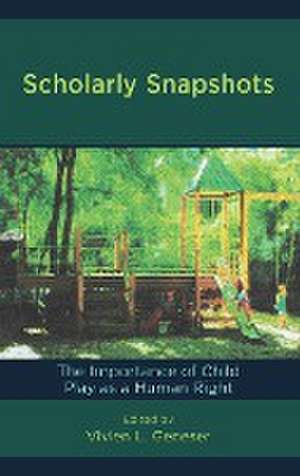
Scholarly Snapshots: The Importance of Child Play as a Human Right
Editat de Vivien L. Geneseren Limba Engleză Hardback – 15 mai 2022
Preț: 370.42 lei
Preț vechi: 467.59 lei
-21%
Puncte Express: 556
Carte tipărită la comandă
Livrare economică 19 septembrie-03 octombrie
Livrare prin curier în România Termenul estimat este afișat lângă disponibilitate.
Transport gratuit de la 400.00 lei Plată online sau ramburs, în funcție de opțiunile comenzii.
Retur gratuit în 14 zile Comandă securizată și suport în română.
Specificații
ISBN-13: 9781475843187
ISBN-10: 1475843186
Pagini: 170
Dimensiuni: 160 x 230 x 18 mm
Greutate: 0.76 kg
Editura: Bloomsbury Publishing
Colecția Rowman & Littlefield
Locul publicării:New York, United States
ISBN-10: 1475843186
Pagini: 170
Dimensiuni: 160 x 230 x 18 mm
Greutate: 0.76 kg
Editura: Bloomsbury Publishing
Colecția Rowman & Littlefield
Locul publicării:New York, United States
Cuprins
Foreword
Introduction
Acknowledgements
Friedrich Froebel 1782-1852Mary Ruth Moore
John Dewey 1859-1952LaDonna Atkins
Maria Montessori 1870-1952Josh Thompson
Johan Huizinga 1872-1945Vivien L. Geneser & David J. Akpata
Arnold Gesell 1880-1961Marcy Guddemi
Margaret Naumburg 1890-1983Blythe Hinitz, Jeroen Staring, & Jerry Aldridge
Jean Piaget 1896-1980Olga Jarrett
Lev Vygotsky 1896-1934Joanna Cemore Brigden
Urie Bronfenbrenner 1917-2005Debra Lawrence
Sara Smilansky 1922-2016Karen Walker & Shelley B. Harris
Brian Sutton-Smith 1924-2015Walter Drew
Vivian Paley 1929-2019Debora Wisneski
Joe L. Frost 1933-2020John Sutterby
Louise Derman-Sparks 1940-
Katie Kenya Wolff
Olivia Saracho 1942-Edith Esparza & Matilde A. Sarmiento
Valora Washington 1953-Vivien L. Geneser & Jerletha McDonald
Article 31D. Reece Wilson
About the Contributors
Introduction
Acknowledgements
Friedrich Froebel 1782-1852Mary Ruth Moore
John Dewey 1859-1952LaDonna Atkins
Maria Montessori 1870-1952Josh Thompson
Johan Huizinga 1872-1945Vivien L. Geneser & David J. Akpata
Arnold Gesell 1880-1961Marcy Guddemi
Margaret Naumburg 1890-1983Blythe Hinitz, Jeroen Staring, & Jerry Aldridge
Jean Piaget 1896-1980Olga Jarrett
Lev Vygotsky 1896-1934Joanna Cemore Brigden
Urie Bronfenbrenner 1917-2005Debra Lawrence
Sara Smilansky 1922-2016Karen Walker & Shelley B. Harris
Brian Sutton-Smith 1924-2015Walter Drew
Vivian Paley 1929-2019Debora Wisneski
Joe L. Frost 1933-2020John Sutterby
Louise Derman-Sparks 1940-
Katie Kenya Wolff
Olivia Saracho 1942-Edith Esparza & Matilde A. Sarmiento
Valora Washington 1953-Vivien L. Geneser & Jerletha McDonald
Article 31D. Reece Wilson
About the Contributors
Recenzii
Scholarly Snapshots is an indispensable jumping off point for anyone seeking to understand the power and vitality of play, not only as the primary mechanism through which children learn, but also as a human right. This concise survey of the work and insights of many of the most important foundational thinkers in the world of play -- from Froebel and Dewey to present day scholars -- is essential reading for anyone who takes play seriously.
Dr. Vivien Geneser and colleagues defend and deeply explore the child's right to play in this exciting text. From perspectives of historical & contemporary theorists, play is given the reverence that it deserves. As a professor of early childhood education, this is the text I will use in my courses to help future teachers of young children, brain architects, gain the knowledge they need in the 21st. century to advocate for every child's right to play.
This book is essential for my early childhood library as a mother, grandmother, teacher educator, and as a human being. Beginning with the title: play as a human right, we learn about the history of play from every angle, knowledge of development, pedagogy, and human experience, and I am inspired to fight for children's right to play. Indeed, I am reminded again and again that we stand on the shoulders of our founding fathers and mothers of early childhood development and education. There are way too many quotes in the book for me to share, but I conclude with Gesell's quote from the book: 'When a child is playing, he concentrates with his whole being and acquires emotional satisfactions which he cannot get from other forms of activities.
This collection is a much-needed counter to the current atmosphere in education of pushing academics earlier and earlier. Children need to play to learn.
So inspiring. A quick, enticing, helpful read. Brilliant format. Wonderful to see a historical overview, which then sparks your own ideas for which ideas you could adopt and use.
For those who have committed to taking schools into new territories with more just ways to learn, it is vitally important to know the past. This volume walks us through the past, beginning with early explorations of the actions of the young up to those more recent contributors to thoughts on encounters in school, the common thread being the elusive endeavor we call, "Play". There are notable subtexts in this important collection which are not hard to read: From the exclusion of all but masculine pronouns in scholars' writings on "play" for the first three hundred years, up to the very late appearance of the voices of women of color in scholarship. And along the way, shifting and interconnected notions on that which we so casually call, "Play". The common thread? That we must take seriously that which students choose: "Play". This volume explores the serious thought that researchers, theorists and educators have put to that which the young choose to do-whether that choice is joyful, or brings conflict, creative or reproductive of injustices, democratic or demagogic, chimeric or characterizable-students choose to play. It is vital that teachers, researchers, administrators, parents and policy-makers understand the centuries-worth of scholarship about that which human beings do from the start. We play. What does a complicated understanding of play help us do? Move forward into those territories with more just ways to learn.
This collection of the histories of play scholars and their contributions written by contemporary play advocates is a much-needed treasure. Just as the book title promises, each chapter provides a brief yet rich description of the scholar, their work, and its context in portions that are manageable for undergraduate students. As a teacher educator, I am eager to bring this book into my Play course to help preservice teachers appreciate the deep history of play and its diverse voices. The illustrations add a lovely touch to each chapter!
Dr. Vivien Geneser and colleagues defend and deeply explore the child's right to play in this exciting text. From perspectives of historical & contemporary theorists, play is given the reverence that it deserves. As a professor of early childhood education, this is the text I will use in my courses to help future teachers of young children, brain architects, gain the knowledge they need in the 21st. century to advocate for every child's right to play.
This book is essential for my early childhood library as a mother, grandmother, teacher educator, and as a human being. Beginning with the title: play as a human right, we learn about the history of play from every angle, knowledge of development, pedagogy, and human experience, and I am inspired to fight for children's right to play. Indeed, I am reminded again and again that we stand on the shoulders of our founding fathers and mothers of early childhood development and education. There are way too many quotes in the book for me to share, but I conclude with Gesell's quote from the book: 'When a child is playing, he concentrates with his whole being and acquires emotional satisfactions which he cannot get from other forms of activities.
This collection is a much-needed counter to the current atmosphere in education of pushing academics earlier and earlier. Children need to play to learn.
So inspiring. A quick, enticing, helpful read. Brilliant format. Wonderful to see a historical overview, which then sparks your own ideas for which ideas you could adopt and use.
For those who have committed to taking schools into new territories with more just ways to learn, it is vitally important to know the past. This volume walks us through the past, beginning with early explorations of the actions of the young up to those more recent contributors to thoughts on encounters in school, the common thread being the elusive endeavor we call, "Play". There are notable subtexts in this important collection which are not hard to read: From the exclusion of all but masculine pronouns in scholars' writings on "play" for the first three hundred years, up to the very late appearance of the voices of women of color in scholarship. And along the way, shifting and interconnected notions on that which we so casually call, "Play". The common thread? That we must take seriously that which students choose: "Play". This volume explores the serious thought that researchers, theorists and educators have put to that which the young choose to do-whether that choice is joyful, or brings conflict, creative or reproductive of injustices, democratic or demagogic, chimeric or characterizable-students choose to play. It is vital that teachers, researchers, administrators, parents and policy-makers understand the centuries-worth of scholarship about that which human beings do from the start. We play. What does a complicated understanding of play help us do? Move forward into those territories with more just ways to learn.
This collection of the histories of play scholars and their contributions written by contemporary play advocates is a much-needed treasure. Just as the book title promises, each chapter provides a brief yet rich description of the scholar, their work, and its context in portions that are manageable for undergraduate students. As a teacher educator, I am eager to bring this book into my Play course to help preservice teachers appreciate the deep history of play and its diverse voices. The illustrations add a lovely touch to each chapter!