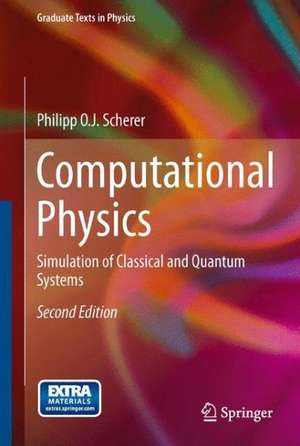
Scherer, P: Computational Physics
en Limba Engleză Hardback – 30 iul 2013
În literatura academică dedicată fizicii computaționale, adesea există o barieră între prezentarea abstractă a algoritmilor și aplicarea lor practică în modelarea fenomenelor complexe. Computational Physics, scrisă de Philipp O. J. Scherer și publicată de Springer, completează această lacună printr-o abordare didactică ce transformă metodele numerice în instrumente de investigație directă. Această a treia ediție, disponibilă în format paperback, rafinează echilibrul dintre teorie și experimentul digital, oferind o bază solidă pentru studenții și cercetătorii care doresc să înțeleagă ce se află în interiorul „cutiilor negre” ale software-ului de simulare. Apreciem organizarea riguroasă a materialului în două secțiuni fundamentale. Prima parte este dedicată metodelor numerice, de la analiza erorilor și interpolare, până la discretizarea ecuațiilor diferențiale și metodele Krylov-space pentru probleme de valori proprii — acestea din urmă beneficiind de o tratare mult mai detaliată în versiunea actuală. A doua parte trece la simularea propriu-zisă a sistemelor fizice, acoperind mecanica moleculară, termodinamica și sistemele cuantice multi-corp. Cititorii familiarizați cu An Introduction to Computational Physics de Tao Pang vor aprecia aici accentul pus pe compararea stabilității și eficienței diferitelor metode pentru procesele de difuzie și unde, precum și introducerea analizei timp-frecvență prin transformate wavelet. Un element distinctiv al volumului este includerea experimentelor pe calculator și a exercițiilor tip applet, care permit explorarea rotației corpurilor rigide sau a sistemelor cuantice pe două niveluri fără a necesita cunoștințe vaste de programare. Progresia de la algoritmi clasici la metode moderne, cum ar fi elementul de frontieră sau simularea unui qubit, indică o acoperire curriculară completă, adaptată cerințelor actuale din fizica matematică.
Preț: 400.11 lei
Preț vechi: 470.72 lei
-15%
Carte disponibilă
Livrare economică 31 octombrie-14 noiembrie
Livrare express 17-23 octombrie pentru 47.82 lei
Specificații
ISBN-10: 331900400X
Pagini: 472
Ilustrații: XVIII, 454 p.
Dimensiuni: 160 x 241 x 30 mm
Greutate: 0.79 kg
Ediția:2nd edition 2013
Editura: Springer
Locul publicării:Cham, Switzerland
Public țintă
GraduateDe ce să citești această carte
Această carte este o resursă esențială pentru studenții de la facultățile de fizică și matematică, oferind nu doar teorie, ci și un laborator digital complet. Cititorul câștigă o înțelegere profundă a modului în care algoritmii modelează realitatea fizică, de la mișcarea browniană la mecanica cuantică. Este un ghid practic care transformă conceptele matematice dificile în simulări vizuale și interactive, facilitând tranziția de la curs la cercetarea aplicată.
Despre autor
Philipp O. J. Scherer este un autor recunoscut în domeniul fizicii computaționale, cunoscut pentru capacitatea sa de a explica algoritmi complecși într-o manieră accesibilă și structurată. Expertiza sa acoperă o arie largă, de la metode numerice fundamentale la simulări avansate în mecanica cuantică și dinamică moleculară. Prin lucrările sale publicate la edituri prestigioase precum Springer, Scherer contribuie la formarea noilor generații de fizicieni, punând accent pe rigoarea matematică și pe aplicațiile practice ale calculului numeric în științele naturii.
Cuprins
Recenzii
“The well-written monograph about computational physics is based on two-semester lecture courses given by the author on a period of several years for undergraduate physics and biophysics students … . convenient for students and practitioners of computer science, chemistry, and mathematics who are interested in applications of numerical methods in physics and engineering sciences. … well-organized book with a concentration to the important ideas of the methods and physical applications including software, examples, illustrations, and references to further reading.” (Georg Hebermehl, zbMATH, Vol. 1303, 2015)
Notă biografică
Textul de pe ultima copertă
The book gives simple but non trivial examples from a broad range of physical topics trying to give the reader insight into the numerical treatment but also the simulated problems. Rotational motion is treated in much detail to describe the motion of rigid rotors which can be just a simple spinning top or a collection of molecules or planets. The behaviour of simple quantum systems is studied thoroughly. One focus is on a two level system in an external field. Solution of the Bloch equations allows the simulation of a quantum bit and to understand elementary principles from quantum optics. As an example of a thermodynamic system, the Lennard Jones liquid is simulated. The principles of molecular dynamics are shown with practical simulations. A second thermodynamic topic is the Ising model in one and two dimensions. The solution of the Poisson Boltzman equation is discussed in detail which is very important in Biophysics as well as in semiconductor physics. Besides the standard finite element methods, also modern boundary element methods are discussed. Waves and diffusion processes are simulated. Different methods are compared with regard to their stability and efficiency. Random walk models are studied with application to basic polymer physics. Nonlinear systems are discussed in detail with application to population dynamics and reaction diffusion systems. The exercises to the book are realized as computer experiments. A large number of Java applets is provided. It can be tried out by the reader even without programming skills. The interested reader can modify the programs with the help of the freely available and platform independent programming environment "netbeans".