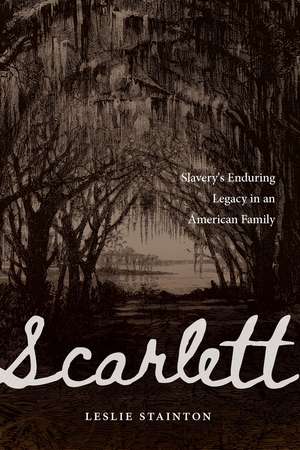
Scarlett: Slavery's Enduring Legacy in an American Family
Autor Leslie Staintonen Limba Engleză Hardback – noi 2025
At its core is the riddle of Stainton’s Georgia-born grandmother, Mary “Mamie” King Hilsman Pettigrew, who embraced the Lost Cause of the Confederacy but was tormented lifelong by her suspicion that Scarlett men had engaged in racial violence in the twentieth century. Mamie gave Stainton her copies of Gone with the Wind and Fanny Kemble’s 1863 Journal of a Resistance on a Georgia Plantation, one of the most explosive indictments of American slavery ever written. These books informed Stainton’s quest to discover the truth about her Scarlett ancestors and her grandmother’s nightmare vision of racial violence involving her family.
By threading the stories of Margaret Mitchell and Fanny Kemble through the narrative of her Scarlett forebears, Stainton raises critical questions about the choices Americans have made, then and now, that have cemented the nation’s complicity in slavery’s persistent legacy.
Preț: 186.58 lei
Nou
Puncte Express: 280
Preț estimativ în valută:
33.02€ • 38.72$ • 28.100£
33.02€ • 38.72$ • 28.100£
Carte disponibilă
Livrare economică 26 ianuarie-09 februarie
Livrare express 09-15 ianuarie pentru 93.68 lei
Preluare comenzi: 021 569.72.76
Specificații
ISBN-13: 9781640126756
ISBN-10: 1640126759
Pagini: 280
Ilustrații: 24 photographs, 1 genealogy, 1 map
Dimensiuni: 152 x 229 x 29 mm
Greutate: 0.57 kg
Editura: Potomac Books Inc
Colecția Potomac Books
Locul publicării:United States
ISBN-10: 1640126759
Pagini: 280
Ilustrații: 24 photographs, 1 genealogy, 1 map
Dimensiuni: 152 x 229 x 29 mm
Greutate: 0.57 kg
Editura: Potomac Books Inc
Colecția Potomac Books
Locul publicării:United States
Notă biografică
Leslie Stainton has served on the board of directors of both the Slave Dwelling Project and Coming to the Table. She is a two-time Fulbright recipient and a former lecturer in creative nonfiction at the University of Michigan Residential College. Stainton is the author of Staging Ground: An American Theater and Its Ghosts and Lorca: A Dream of Life and has published essays in the New York Times, the Washington Post, the American Scholar, and other publications.
Extras
1
MIDNIGHT
Quiet at last. Just the flutter of leaves in the breeze outside and the sound
of my companions unfolding their sleeping gear. We’ve arranged our
belongings so as not to disturb the museum exhibit that occupies the
room by day. A gardening basket in one corner. A pine table set, as if for
breakfast, with two plates and a bowl. A massive brick hearth.
Except hearth isn’t quite the right word, not here at least. Not inside
this pine cabin on the Georgia coast, fifteen miles north of Brunswick.
As I unzip the sleeping bag I’ve borrowed from my stepson, it occurs to
me that nothing in this space is what it claims to be. Not the faux table
setting or the curtained windows or the wicker chair or the narrow cot
with the chenille spread and embroidered pillow in the pseudo-bedroom
to my left and not the sign outside on the path to the door: “Servants
Quarters.”
I know the kind of scene we’re meant to conjure: a plump Mammy
in a kerchief standing at the fireplace, stirring a pot of something while
children frolic on the floor behind her—the same pine floor where I’ve
laid out my make-believe bed on top of a yoga mat, which, I now realize,
does nothing to cushion my back against the hard wood planks.
It’s been decades since I’ve come this close to roughing it. I spent
the past two nights under a chintz duvet on a queen-sized canopy bed
in an air-conditioned Savannah hotel room. Before heading south on
I-95 today, I treated myself to lunch in the hotel restaurant, a restored
eighteenth-century tavern. Glass of sauvignon blanc, locally sourced
fried-green tomato sandwich with aioli, espresso.
I crawl inside the flannel interior of my camping gear and try to court
sleep, but I’m distracted by my two companions. Joe’s stretched out
behind me on the floor, posting updates to his Facebook page. Prinny’s
half-asleep beside me, breathing softly. It’s her tenth or eleventh overnight
in a cabin, and she’s got the drill down. Flashlight neatly positioned
on a nearby chair, on top of her neatly folded clothes. Thick foam pad
under her back.
I close my eyes and listen to the mournful pings of Joe’s phone as he
sends the last of his missives into the world. Then silence. The room
goes dark. Just the three of us arrayed like mannequins on a moonlit
stage set on the Georgia coast. This is why I came, isn’t it? Except I can’t
get comfortable. Roll to one side, yank at my T-shirt,
imagine I’m back home in Michigan with my husband.
“I don’t know why I’m doing this,” I snarled a week ago, as I stood
over my open suitcase, fretting.
“You’ll figure it out,” he said.
But I haven’t. Lying here, feigning sleep, my mind hurtles into its
familiar spin cycle. What if I’m awake all night? What if I step on a
snake on my way to the bathroom? There are rattlers on the plantation
grounds, alligators in the marshes where they used to grow rice. Ticks.
Spiders. Joe likes to tell about the time he woke in a cabin to find spiders
crawling all over him. He’s never seen a ghost on a sleepover, but
spiders, yes. They terrify him.
“You have to visit these places to see what they endured,” he said earlier
tonight in a talk to docents inside the visitors’ center of the plantation.
He wore narrow, wire-rimmed glasses and a collarless white shirt
under the thick blue wool uniform of a Union soldier. A dozen people,
all white, mostly retirees, sat attentively in rows of plastic chairs. On the
screen above his head, he unveiled slide after slide of the kinds of places
he meant: weatherbeaten shacks in Tennessee, wooden cabins in South
Carolina, a two-story brick tenement behind an urban mansion in North
Carolina, attic rooms in New York and Pennsylvania.
“Because they hung in there,” Joe said of the people who once lived
in these spaces, “we’re here today. African Americans. They acquiesced
because of us, their descendants. Anything beyond acquiescence could
be their death.”
This morning’s Georgia Times-Union had advertised his talk and our
overnight stay, noting that, as a descendant of enslavers from the region,
I’d be joining Joe McGill, founder of the Slave Dwelling Project, and
Prinny Anderson, a white descendant of Thomas Jefferson, on the latest
of Joe’s sleepovers in a slave dwelling, this one at the Hofwyl-Broadfield
State Historical Site in Glynn County. I was startled by the front-page
coverage, the realization that, without meaning to, I had exposed my
family—the distant cousins who don’t return my texts or emails when
I visit the area, the nameless person who planted a Confederate flag
in front of the granite obelisk that marks my ancestors’ cemetery in
Brunswick. “Sleepover Puts Spotlight on Glynn’s Slave-Holding
Past,” the Times-Union headline announced.
And now here I am, rolling onto my left side, scrunching the single
pillow I’ve remembered to bring with me, wondering how long my
bladder will hold out before I have to make my way in the dark with
Prinny’s flashlight to the bathroom that’s been installed on the other
side of the wall behind the fireplace, in another tiny space originally
built to house as many as twelve people. Who knows what I’ll trip over
on my way there? I’ve learned to step gingerly in this part of the world.
My grandmother, born in Brunswick in 1898, was taught as a child to
kill any snake she found that wasn’t poisonous and to call for an uncle
with a gun whenever she spotted one that was. In her seventies, on a
visit to the family homestead in the woods outside Brunswick, she nearly
stepped on a diamondback one day as she was getting out of her car.
She loved this hardscrabble strip of Atlantic coastline, halfway between
Jacksonville and Savannah. Although she and my grandfather retired to
a small town in tidewater Virginia, she never reconciled herself to the
place. “Virginia is as far north as I will ever go,” she declared and pressed
her tiny foot into the carpet as if to mark a line.
She had a bird’s beaked nose and mouth and wore her hair in long,
graying ropes looped around her skull. She dressed in brown or at most
a drab olive. Much of the time she terrified me: the stern reminders to
buckle my seatbelt, the drumbeat of her shoes climbing the stairs to
inform me of yet another unwitting household infraction. The stories
of ancestral hardship meant to show me how good I had it. The Scarlett
O’Hara prettiness of what life was like before the war versus the shabbiness
of what came after. Her own widowed mother, forced to open a
boardinghouse and take in strangers to make ends meet.
Mary King Hilsman Pettigrew, my maternal grandmother—whom
we called “Mamie.” She’s the reason I’m here tonight, twenty minutes
up the highway from her birthplace. She’s the one who insisted I know
the kind of people I came from: strong people—strong
women in particular. Like my grandmother herself, who knew more about roughing
it than I’d ever learn. She spent twenty years living in the Caribbean
with my Navy-officer grandfather, braving scorpions and malaria while
raising three children. At the end of it all she only wanted more—more
island sunsets and patois songs, more solitary rambles in the countryside
searching for pre-Columbian relics. My grandmother, the excavator.
Except when it came to our family. She and her sisters devoted years
to assembling the ancestral story, compiling photos, deciphering letters,
filling in cemetery maps and genealogical charts. It was no secret we
had “owned slaves,” as they put it. But it wasn’t something they dwelt
on. “There are things we don’t talk about,” Mamie said briskly and often.
Little room in this scenario for what I’m doing tonight. My grandmother
would have winced at this morning’s front-page coverage. She
and her sisters gave their share of interviews to the local press, but always
with an emphasis on the salutary: the family patriarch, Francis Muir
Scarlett, a penniless British immigrant who made his way to Georgia
as a teenager in the late eighteenth century and became one of Glynn
County’s richest planters; his eleven exemplary children; their illustrious
twentieth-century heirs.
And the story everyone liked best: the coincidence that Margaret
Mitchell chose our family name for her infamous heroine.
Born in the last years of the nineteenth century and raised on the same
postwar brew of recrimination and regret that nourished Mitchell, my
grandmother Mamie could not forget. “It still makes me angry at the
Yankees stripping the Southern families,” she said in her late seventies.
She preferred the golden age that preceded her birth, the years when the
family fields stretched to the edge of the ocean that spelled misery to
millions and wealth to us, when palmettoes shimmered in the twilight,
and blushing belles cavorted with suitors at parties like the ones Scarlett
O’Hara attended, she who carried our name.
MIDNIGHT
Quiet at last. Just the flutter of leaves in the breeze outside and the sound
of my companions unfolding their sleeping gear. We’ve arranged our
belongings so as not to disturb the museum exhibit that occupies the
room by day. A gardening basket in one corner. A pine table set, as if for
breakfast, with two plates and a bowl. A massive brick hearth.
Except hearth isn’t quite the right word, not here at least. Not inside
this pine cabin on the Georgia coast, fifteen miles north of Brunswick.
As I unzip the sleeping bag I’ve borrowed from my stepson, it occurs to
me that nothing in this space is what it claims to be. Not the faux table
setting or the curtained windows or the wicker chair or the narrow cot
with the chenille spread and embroidered pillow in the pseudo-bedroom
to my left and not the sign outside on the path to the door: “Servants
Quarters.”
I know the kind of scene we’re meant to conjure: a plump Mammy
in a kerchief standing at the fireplace, stirring a pot of something while
children frolic on the floor behind her—the same pine floor where I’ve
laid out my make-believe bed on top of a yoga mat, which, I now realize,
does nothing to cushion my back against the hard wood planks.
It’s been decades since I’ve come this close to roughing it. I spent
the past two nights under a chintz duvet on a queen-sized canopy bed
in an air-conditioned Savannah hotel room. Before heading south on
I-95 today, I treated myself to lunch in the hotel restaurant, a restored
eighteenth-century tavern. Glass of sauvignon blanc, locally sourced
fried-green tomato sandwich with aioli, espresso.
I crawl inside the flannel interior of my camping gear and try to court
sleep, but I’m distracted by my two companions. Joe’s stretched out
behind me on the floor, posting updates to his Facebook page. Prinny’s
half-asleep beside me, breathing softly. It’s her tenth or eleventh overnight
in a cabin, and she’s got the drill down. Flashlight neatly positioned
on a nearby chair, on top of her neatly folded clothes. Thick foam pad
under her back.
I close my eyes and listen to the mournful pings of Joe’s phone as he
sends the last of his missives into the world. Then silence. The room
goes dark. Just the three of us arrayed like mannequins on a moonlit
stage set on the Georgia coast. This is why I came, isn’t it? Except I can’t
get comfortable. Roll to one side, yank at my T-shirt,
imagine I’m back home in Michigan with my husband.
“I don’t know why I’m doing this,” I snarled a week ago, as I stood
over my open suitcase, fretting.
“You’ll figure it out,” he said.
But I haven’t. Lying here, feigning sleep, my mind hurtles into its
familiar spin cycle. What if I’m awake all night? What if I step on a
snake on my way to the bathroom? There are rattlers on the plantation
grounds, alligators in the marshes where they used to grow rice. Ticks.
Spiders. Joe likes to tell about the time he woke in a cabin to find spiders
crawling all over him. He’s never seen a ghost on a sleepover, but
spiders, yes. They terrify him.
“You have to visit these places to see what they endured,” he said earlier
tonight in a talk to docents inside the visitors’ center of the plantation.
He wore narrow, wire-rimmed glasses and a collarless white shirt
under the thick blue wool uniform of a Union soldier. A dozen people,
all white, mostly retirees, sat attentively in rows of plastic chairs. On the
screen above his head, he unveiled slide after slide of the kinds of places
he meant: weatherbeaten shacks in Tennessee, wooden cabins in South
Carolina, a two-story brick tenement behind an urban mansion in North
Carolina, attic rooms in New York and Pennsylvania.
“Because they hung in there,” Joe said of the people who once lived
in these spaces, “we’re here today. African Americans. They acquiesced
because of us, their descendants. Anything beyond acquiescence could
be their death.”
This morning’s Georgia Times-Union had advertised his talk and our
overnight stay, noting that, as a descendant of enslavers from the region,
I’d be joining Joe McGill, founder of the Slave Dwelling Project, and
Prinny Anderson, a white descendant of Thomas Jefferson, on the latest
of Joe’s sleepovers in a slave dwelling, this one at the Hofwyl-Broadfield
State Historical Site in Glynn County. I was startled by the front-page
coverage, the realization that, without meaning to, I had exposed my
family—the distant cousins who don’t return my texts or emails when
I visit the area, the nameless person who planted a Confederate flag
in front of the granite obelisk that marks my ancestors’ cemetery in
Brunswick. “Sleepover Puts Spotlight on Glynn’s Slave-Holding
Past,” the Times-Union headline announced.
And now here I am, rolling onto my left side, scrunching the single
pillow I’ve remembered to bring with me, wondering how long my
bladder will hold out before I have to make my way in the dark with
Prinny’s flashlight to the bathroom that’s been installed on the other
side of the wall behind the fireplace, in another tiny space originally
built to house as many as twelve people. Who knows what I’ll trip over
on my way there? I’ve learned to step gingerly in this part of the world.
My grandmother, born in Brunswick in 1898, was taught as a child to
kill any snake she found that wasn’t poisonous and to call for an uncle
with a gun whenever she spotted one that was. In her seventies, on a
visit to the family homestead in the woods outside Brunswick, she nearly
stepped on a diamondback one day as she was getting out of her car.
She loved this hardscrabble strip of Atlantic coastline, halfway between
Jacksonville and Savannah. Although she and my grandfather retired to
a small town in tidewater Virginia, she never reconciled herself to the
place. “Virginia is as far north as I will ever go,” she declared and pressed
her tiny foot into the carpet as if to mark a line.
She had a bird’s beaked nose and mouth and wore her hair in long,
graying ropes looped around her skull. She dressed in brown or at most
a drab olive. Much of the time she terrified me: the stern reminders to
buckle my seatbelt, the drumbeat of her shoes climbing the stairs to
inform me of yet another unwitting household infraction. The stories
of ancestral hardship meant to show me how good I had it. The Scarlett
O’Hara prettiness of what life was like before the war versus the shabbiness
of what came after. Her own widowed mother, forced to open a
boardinghouse and take in strangers to make ends meet.
Mary King Hilsman Pettigrew, my maternal grandmother—whom
we called “Mamie.” She’s the reason I’m here tonight, twenty minutes
up the highway from her birthplace. She’s the one who insisted I know
the kind of people I came from: strong people—strong
women in particular. Like my grandmother herself, who knew more about roughing
it than I’d ever learn. She spent twenty years living in the Caribbean
with my Navy-officer grandfather, braving scorpions and malaria while
raising three children. At the end of it all she only wanted more—more
island sunsets and patois songs, more solitary rambles in the countryside
searching for pre-Columbian relics. My grandmother, the excavator.
Except when it came to our family. She and her sisters devoted years
to assembling the ancestral story, compiling photos, deciphering letters,
filling in cemetery maps and genealogical charts. It was no secret we
had “owned slaves,” as they put it. But it wasn’t something they dwelt
on. “There are things we don’t talk about,” Mamie said briskly and often.
Little room in this scenario for what I’m doing tonight. My grandmother
would have winced at this morning’s front-page coverage. She
and her sisters gave their share of interviews to the local press, but always
with an emphasis on the salutary: the family patriarch, Francis Muir
Scarlett, a penniless British immigrant who made his way to Georgia
as a teenager in the late eighteenth century and became one of Glynn
County’s richest planters; his eleven exemplary children; their illustrious
twentieth-century heirs.
And the story everyone liked best: the coincidence that Margaret
Mitchell chose our family name for her infamous heroine.
Born in the last years of the nineteenth century and raised on the same
postwar brew of recrimination and regret that nourished Mitchell, my
grandmother Mamie could not forget. “It still makes me angry at the
Yankees stripping the Southern families,” she said in her late seventies.
She preferred the golden age that preceded her birth, the years when the
family fields stretched to the edge of the ocean that spelled misery to
millions and wealth to us, when palmettoes shimmered in the twilight,
and blushing belles cavorted with suitors at parties like the ones Scarlett
O’Hara attended, she who carried our name.
Cuprins
List of Illustrations
Acknowledgments
List of Abbreviations
Note on Language
Before
Part 1. Myth
1. Midnight
2. The Family Album
3. Fanny Kemble
Part 2. Excavation
4. Letters
5. Property
6. Daughters’ Work
7. Secrets
8. Lost
Part 3. Betrayals
9. Trouble
10. Revolt
11. Let Them Flow
12. New Order
Part 4. Inheritance
13. Industry
14. Matilda
15. Songs
16. Justice
Part 5. A Grandmother’s Nightmare
17. State v. Fricie Griffin
18. Mr. Scarlett
After
Notes on Sources
Bibliography
Index
Acknowledgments
List of Abbreviations
Note on Language
Before
Part 1. Myth
1. Midnight
2. The Family Album
3. Fanny Kemble
Part 2. Excavation
4. Letters
5. Property
6. Daughters’ Work
7. Secrets
8. Lost
Part 3. Betrayals
9. Trouble
10. Revolt
11. Let Them Flow
12. New Order
Part 4. Inheritance
13. Industry
14. Matilda
15. Songs
16. Justice
Part 5. A Grandmother’s Nightmare
17. State v. Fricie Griffin
18. Mr. Scarlett
After
Notes on Sources
Bibliography
Index
Recenzii
“Scarlett is both a deeply intimate family history as well as a candid consideration of the history of slavery and racism in the United States. Perhaps more importantly, Scarlett demonstrates the ways that these two histories are inextricably bound for American families on all sides of the color line. Much in the tradition of Edward Ball’s Slaves in the Family, Scarlett faces a difficult history head-on, showing how slavery continues to reverberate in the lives of all Americans.”—Jason R. Young, author of Rituals of Resistance: African Atlantic Religion in Kongo and the Lowcountry South in the Era of Slavery
“Many of us who came of age in the bruising, suffocating silence of an enslaver family are awakening to how this silence cripples us all and deeply endangers our nation. . . . Leslie Stainton’s Scarlett awakens us as it issues its summons, both elegant and heartbreaking. While refusing to look away from her Georgia cotton-empire family’s many racist sins and their effects on the present, Stainton’s exquisite writing and personal transformation shines a sure and steady light for others who would, like her, answer those summonses that our long-stifled grandmothers issued to us in childhood.”—Karen Branan, author of The Family Tree: A Lynching in Georgia, a Legacy of Secrets, and My Search for the Truth
“Leslie Stainton ‘gets it.’ This modern-day Fanny Kemble didn’t marry into the slavocracy of coastal Georgia; she inherited its wealth, its mythology, and its ‘Scarlett’ letters. Her lyrical and rewarding book, rich in historical detail, recounts with candor a brave journey of self-discovery. Stainton’s deeply personal odyssey links present to past and dares other privileged Americans with troubling family roots to do the hard emotional and archival work of confronting their real ancestral story. This way lies healing, for self and society.”—Peter H. Wood, author of Black Majority: Race, Rice, and Rebellion in South Carolina, 1670–1740
“With history again being weaponized, it makes perfect timing for the release of Leslie Stainton’s vital story.”—Joseph McGill Jr., founder of the Slave Dwelling Project and coauthor, with Herb Frazer, of Sleeping with the Ancestors: How I Followed the Footprints of Slavery
“Beautiful, elegiac, and urgent, Scarlett resonates with tidal force. Leslie Stainton takes us on a search for the truth about her enslaving Georgia ancestors, the Scarletts, and through a reckoning with the myths and distortions of their painful history, from Gone with the Wind to today. In her family as in the American nation, the truth about slavery and segregation lay buried under denial, delusion, and pride. Pulling us all into its depths, this is a memoir that manages to be both bracingly honest and profoundly hopeful.”—William G. Thomas III, author of A Question Of Freedom: The Families Who Challenged Slavery from the Nation’s Founding to the Civil War
“This timely and powerful book . . . sheds important new light on the evils of historic slavery and its persistent and profound present-day impacts on all Americans. With searing detail, Leslie Stainton traces her ancestors’ complicity in the barbarous practices of buying, selling, hunting, and violating enslaved men, women, and children. Scarlett exemplifies the kind of candor and courage we so urgently need if we are ever to undo the cruelties and lies of racism and heal as a nation.”—Thomas Norman DeWolf, author of Inheriting the Trade and coauthor of Gather at the Table
“An unflinching look at one Southern family’s ties to slavery, Scarlett is a richly wrought portrait of how the complex legacy of enslavement echoes down to today. Leslie Stainton has given us a remarkable, brave, and beautifully written book.”—Scott Ellsworth, author of Midnight on the Potomac: The Last Year of the Civil War, the Lincoln Assassination, and the Rebirth of America
“Leslie Stainton’s beautifully written and heartfelt personal memoir about her own family’s history, so intertwined with American slavery, should be read by all those interested in the complicated nature of America’s racial past. As William Faulkner wrote, the past is neither dead nor truly past.”—Jonathan Daniel Wells, author of The Kidnapping Club: Wall Street, Slavery, and Resistance on the Eve of the Civil War
“Leslie Stainton is a talented storyteller, gradually revealing how this white Georgia family’s history is interwoven with stories of enslaving and what the lives of those enslaved persons were like.”—Phoebe Kilby, coauthor with Betty Kilby Baldwin of Cousins: Connected through Slavery, a Black Woman and a White Woman Discover Their Past—and Each Other
Descriere
From a sixth-generation descendant of the enslaving Scarletts of Georgia, this searing account of one family’s complicity in slavery and its violent aftermath unravels the lies of Margaret Mitchell’s Gone with the Wind and shows how slavery’s legacy persists today.