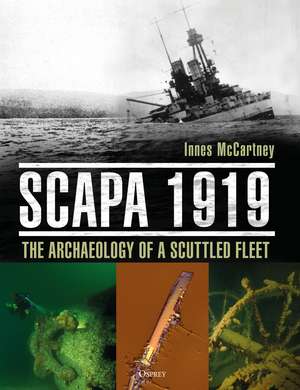
Scapa 1919: The Archaeology of a Scuttled Fleet
Autor Innes McCartneyen Limba Engleză Hardback – 30 mai 2019
Autorul Innes McCartney, un reputat arheolog marin și istoric cu o experiență de peste un sfert de secol în explorarea epavelor, propune în Scapa 1919 o analiză riguroasă a unuia dintre cele mai dramatice episoade din istoria navală. Bazându-se pe cercetări de teren și investigații subacvatice, McCartney documentează pentru prima dată starea celor 25 de nave germane care au rămas pe fundul mării după sabordarea flotei din iunie 1919. Această lucrare extinde cadrul propus de Jutland 1916 cu date noi obținute prin tehnologii moderne de scanare și scufundări sistematice, oferind o perspectivă arheologică asupra unei flote care a sfidat capturarea prin autodistrugere.
Subliniem rigoarea cu care este structurat volumul, acesta fiind împărțit în șase părți care urmăresc cronologic evenimentele: de la internarea flotei germane după armistițiu, până la eforturile gigantice de recuperare și ranfluare coordonate de firme precum Cox & Danks sau Metal Industries. Reținem că autorul nu se limitează la o simplă trecere în revistă a evenimentelor, ci poziționează Scapa 1919 în continuarea preocupărilor sale pentru tehnologia navală, temă explorată anterior în British Submarines 1939–45. Spre deosebire de U-47 in Scapa Flow de Angus Konstam, care se concentrează pe un raid specific din Al Doilea Război Mondial, volumul de față oferă o cartografiere exhaustivă a întregii moșteniri arheologice a flotei germane de suprafață.
Ediția de față, publicată de Osprey Publishing, este bogat ilustrată cu fotografii de epocă și diagrame subacvatice, fiind un instrument esențial pentru înțelegerea modului în care arheologia modernă poate corecta sau completa înregistrările istorice oficiale. Progresia narativă, de la contextul politic al Tratatului de la Versailles până la starea actuală a epavelor supraviețuitoare, precum SMS Konig și SMS Markgraf, transformă textul într-o resursă fundamentală pentru studiul forțelor navale.
Preț: 180.06 lei
Preț vechi: 268.96 lei
-33%
Carte disponibilă
Livrare economică 09-23 noiembrie
Specificații
ISBN-10: 1472828909
Pagini: 336
Ilustrații: Colour and black and white photographs and diagrams
Dimensiuni: 196 x 276 x 26 mm
Greutate: 1.22 kg
Editura: Bloomsbury Publishing
Colecția Osprey Publishing
Locul publicării:London, United Kingdom
V-ar putea interesa
-
 Great War Britain ManchesterAndrew SimpsonPreț: 95.36 lei
 -
 British Battle Insignia (1)Mike Chappell-34%Preț: 64.80 lei97.61 lei
 -
 -18%Preț: 1256.91 lei1532.82 lei
 -
 Jutland 1916: The Archaeology of a Naval BattlefieldInnes McCartney-24%Preț: 170.03 lei224.69 lei
 -
 -37%Preț: 857.36 lei1361.86 lei
 -
 Preț: 62.69 lei
 -
 -20%Preț: 145.92 lei182.57 lei
 -
 -38%Preț: 774.01 lei1244.68 lei
 -
 War News in India: The Punjabi Press During World War IAndrew Tait Jarboe-33%Preț: 834.07 lei1241.69 lei
 -
 -19%Preț: 345.01 lei425.80 lei
 -
 British Submarines 1939–45Innes McCartney-32%Preț: 67.02 lei99.18 lei
 -
 British Submarines of World War IInnes McCartney-32%Preț: 67.23 lei99.31 lei
 -
 Coronel and Falklands 1914: Duel in the South AtlanticMichael McNally-31%Preț: 90.51 lei131.22 lei
 -
 Preț: 104.38 lei
 -
 Phillip Warner - PasschendaeleWarner, PhillipPreț: 97.30 lei
 -
 Phillip Warner - Zeebrugge RaidWarner, PhillipPreț: 97.90 lei
 -
 Preț: 85.73 lei
 -
 Preț: 141.38 lei
 -
 Preț: 135.30 lei
 -
 With Innocence and HopeMichael WilliamsPreț: 83.83 lei
 -
 Preț: 134.41 lei
 -
 Preț: 335.34 lei
 -
 Preț: 103.09 lei
 -
 Lettere Dal Fronte.Federico AdamoliPreț: 82.48 lei
 -
 Preț: 100.88 lei
De ce să citești această carte
Recomandăm această lucrare oricărui pasionat de istorie navală și arheologie industrială. Cititorul câștigă o înțelegere profundă a logisticii complexe din spatele salvării epavelor și o hartă precisă a ceea ce a mai rămas din Flota de Înaltă Mare germană. Este un volum de referință care demonstrează cum dovezile materiale de pe fundul oceanului pot rescrie narațiunile istorice despre sfârșitul Primului Război Mondial.
Descriere
The German High Seas Fleet was one of the most powerful naval forces in the world, and had fought the pride of the Royal Navy to a stalemate at the battle of Jutland in 1916. After the armistice was signed, ending fighting in World War I, it surrendered to the British and was interned in Scapa Flow pending the outcome of the Treaty of Versailles.
In June 1919, the entire fleet attempted to sink itself in the Flow to prevent it being broken up as war prizes. Of the 74 ships present, 52 sunk and 22 were prevented from doing so by circumstance and British intervention.
Marine archaeologist and historian Dr Innes McCartney reveals for the first time what became of the warships that were scuttled, examining the circumstances behind the loss of each ship and reconciling what was known at the time to what the archaeology is telling us today. This fascinating study reveals a fleet lost for nearly a century beneath the waves.
Cuprins
Introduction
PART ONE: The Scuttling of the German Fleet
1. Surrender and Internment
2. The Scuttle
3. Reaction and disposal of the rump of the German Fleet
PART TWO: Cox & Danks: The Salvage Pioneers
4. The Salvage of the Battlecruisers and their archaeology today
5. The Salvage of the Destroyers and SMS Bremse and their archaeology today
PART THREE: Metal Industries and Locally based salvage
6. The Salvage of the Battleships and their archaeology today
7. SMS Derfflinger and her archaeology today
8. The Royal Navy
9. Scapa Flow Salvage & Shipbreaking Co.
PART FOUR: The Survivors: Battleships
10. SMS Konig
11. SMS Markgraf
12. SMS Kronprinz
13. SMS Dresden
PART FIVE: The Survivors: Cruisers and Destroyers
14. SMS Coln
15. SMS Karlsrhue
16. SMS Brummer
19. SMS V83 ans SMS S54
PART SIX: Scapa 100 years on
20. Conclusions: The Archaeology of a Scuttled Fleet
Appendices:
1. HMS Vanguard
2. HMS Royal Oak
3. Other Scapa Shipwrecks
Bibliography
Index
Recenzii
Extremely authoritative, very well referenced throughout - this really is a seminal text on the subject, and I would heartily recommend it.
Fascinating, crisply written, and handsomely produced (Jutland 1916)
A worthy companion for anyone studying the battle ... highly readable with some fascinating photos (Jutland 1916)
A timely and valuable record of an important battlefield (Jutland 1916)