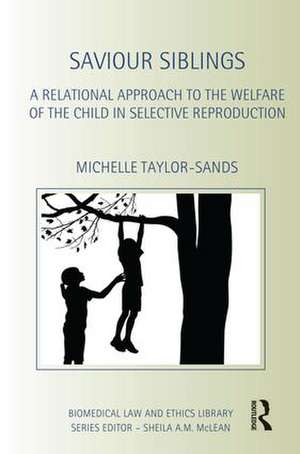
Saviour Siblings: A Relational Approach to the Welfare of the Child in Selective Reproduction: Biomedical Law and Ethics Library
Autor Michelle Taylor-Sandsen Limba Engleză Paperback – 21 aug 2015
Currently, concerns about the welfare of the child in selective reproduction have focused on the individual interests of the child to be born. This book re-evaluates the welfare of the child through the controversial topic of saviour sibling selection. Drawing on relational feminist and communitarian ethics, Michelle Taylor-Sands argues that the welfare of the child to be born is inextricably linked with the welfare of his/her family. The author proposes a relational model for selective reproduction based on a broad conception of the welfare of the child that includes both individual and collective family interests. By comparing regulation in the UK and Australia, the book maps out how law and policy might support a relational model for saviour sibling selection.
With an interdisciplinary focus, Saviour Siblings: A Relational Approach to the Welfare of the Child in Selective Reproduction will be of particular interest to academics and students of bioethics and law as well as practitioners and policymakers concerned with the ethics of selective reproduction.
Din seria Biomedical Law and Ethics Library
- 18%
 Preț: 1150.18 lei
 -
 Preț: 419.12 lei
 - 18%
 Preț: 1259.34 lei
 - 18%
 Preț: 1252.71 lei
 -
 Preț: 344.40 lei
 - 18%
 Preț: 1413.05 lei
 -
 Preț: 466.69 lei
 - 5%
 Preț: 483.19 lei
 - 15%
 Preț: 498.29 lei
 -
 Preț: 307.99 lei
 - 18%
 Preț: 1254.81 lei
 - 18%
 Preț: 1313.09 lei
 - 15%
 Preț: 435.94 lei
 - 18%
 Preț: 1343.10 lei
 -
 Preț: 476.08 lei
 - 15%
 Preț: 444.77 lei
 - 18%
 Preț: 1251.34 lei
 - 15%
 Preț: 422.92 lei
 -
 Preț: 458.61 lei
 - 18%
 Preț: 1296.30 lei
 -
 Preț: 427.17 lei
 - 15%
 Preț: 431.15 lei
 - 15%
 Preț: 438.34 lei
 -
 Preț: 405.21 lei
 -
 Preț: 347.19 lei
 - 18%
 Preț: 1113.42 lei
 -
 Preț: 469.10 lei
 - 18%
 Preț: 1118.66 lei
 - 15%
 Preț: 432.69 lei
 - 15%
 Preț: 456.79 lei
 -
 Preț: 405.49 lei
 -
 Preț: 422.92 lei
 -
 Preț: 424.32 lei
 - 15%
 Preț: 433.41 lei
 - 15%
 Preț: 430.08 lei
Preț: 487.81 lei
Puncte Express: 732
Carte tipărită la comandă
Livrare economică 07-21 decembrie
Livrare prin curier în România Termenul estimat este afișat lângă disponibilitate.
Transport gratuit pentru acest produs Plată online sau ramburs, în funcție de opțiunile comenzii.
Retur gratuit în 14 zile Comandă securizată și suport în română.
Specificații
ISBN-13: 9781138935310
ISBN-10: 113893531X
Pagini: 272
Dimensiuni: 156 x 234 mm
Greutate: 0.32 kg
Ediția:1
Editura: Taylor & Francis
Colecția Routledge
Seria Biomedical Law and Ethics Library
Locul publicării:Oxford, United Kingdom
ISBN-10: 113893531X
Pagini: 272
Dimensiuni: 156 x 234 mm
Greutate: 0.32 kg
Ediția:1
Editura: Taylor & Francis
Colecția Routledge
Seria Biomedical Law and Ethics Library
Locul publicării:Oxford, United Kingdom
V-ar putea interesa
-
 Assisted Death: A Study in Ethics and LawL. W. Sumner-11%Preț: 312.20 lei352.60 lei
 -
 -5%Preț: 1512.16 lei1591.75 lei
 -
 Preț: 230.30 lei
 -
 -15%Preț: 439.04 lei516.52 lei
 -
 -15%Preț: 463.17 lei544.91 lei
 -
 Corporeality, Medical Technologies and Contemporary CultureFrancisco Ortega-15%Preț: 419.64 lei493.69 lei
 -
 Preț: 307.99 lei
 -
 Preț: 307.23 lei
 -
 Law, Immunization and the Right to DieJennifer Hardes-5%Preț: 1284.28 lei1351.88 lei
 -
 -5%Preț: 331.49 lei348.94 lei
 -
 The Law and Ethics of DementiaCharles Foster-23%Preț: 628.03 lei819.44 lei
Public țintă
PostgraduateCuprins
1. Introduction 2. Selective Reproduction: Ethics and the law 3. The Welfare of the Child to be Born 4. A Relational Approach to the Welfare of the Child 5. A Relational Model for Selective Reproduction 6. A Relational Framework for Regulating Saviour Sibling Selection 7. Conclusion
Recenzii
"Michelle Taylor-Sands’ new book cuts through debate by arguing that the focus of each of these opposing positions is unduly individualistic, and that we should instead focus upon the interests of the family within which the child will live." - Emily Jackson, Journal of Medical Ethics (2014)
"One of Taylor-Sands’ most interesting suggestions is that there might a difference between selecting a (future) child because it is congenitally deaf and some other forms of selective reproduction." - Wilkinson for Journal of Medical Ethics (2014)
"I think Taylor-Sands may be onto something with her claim that it is more honest to admit that many medical decisions are made not for the benefit of the patient, but because they confer enormous benefit on others at little cost to the patients themselves." - Gavaghan for Journal of Medical Ethics (2014)
"One of Taylor-Sands’ most interesting suggestions is that there might a difference between selecting a (future) child because it is congenitally deaf and some other forms of selective reproduction." - Wilkinson for Journal of Medical Ethics (2014)
"I think Taylor-Sands may be onto something with her claim that it is more honest to admit that many medical decisions are made not for the benefit of the patient, but because they confer enormous benefit on others at little cost to the patients themselves." - Gavaghan for Journal of Medical Ethics (2014)
Descriere
Genetic screening technologies involving pre-implantation genetic diagnosis (PGD) raise particular issues about selective reproduction and the welfare of the child to be born. This book re-evaluates the welfare of the child through the controversial topic of saviour sibling selection. From analysing existing Australian and UK legal frameworks for regulating saviour siblings, the author proposes a new relational model for selective reproduction. With an interdisciplinary focus, the book will be of particular interest to academics and students of bioethics and law as well as practitioners and policymakers concerned with the ethics of selective reproduction.