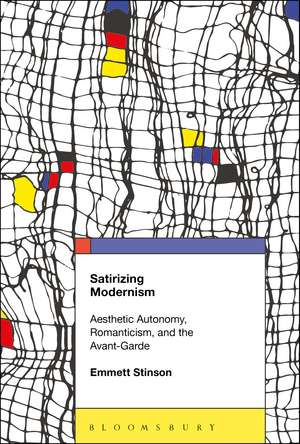
Satirizing Modernism: Aesthetic Autonomy, Romanticism, and the Avant-Garde
Autor Dr. Emmett Stinsonen Limba Engleză Paperback – 27 dec 2018
Preț: 248.53 lei
Preț vechi: 340.56 lei
-27%
Puncte Express: 373
Carte tipărită la comandă
Livrare economică 27 noiembrie-11 decembrie
Livrare prin curier în România Termenul estimat este afișat lângă disponibilitate.
Transport gratuit de la 400.00 lei Plată online sau ramburs, în funcție de opțiunile comenzii.
Retur gratuit în 14 zile Comandă securizată și suport în română.
Specificații
ISBN-13: 9781501348082
ISBN-10: 1501348086
Pagini: 232
Dimensiuni: 152 x 229 x 13 mm
Greutate: 0.31 kg
Editura: Bloomsbury Publishing
Colecția Bloomsbury Academic
Locul publicării:New York, United States
ISBN-10: 1501348086
Pagini: 232
Dimensiuni: 152 x 229 x 13 mm
Greutate: 0.31 kg
Editura: Bloomsbury Publishing
Colecția Bloomsbury Academic
Locul publicării:New York, United States
V-ar putea interesa
-
 Critical Theory and Practice: A CoursebookKeith GreenPreț: 395.76 lei
 -
 The Green Studies Reader: From Romanticism to EcocriticismLaurence CoupePreț: 407.77 lei
 -
 The Post-Colonial Critic: Interviews, Strategies, DialoguesGayatri Chakravorty SpivakPreț: 446.93 lei
 -
 The Death of the CriticDr Ronan McDonald-41%Preț: 72.16 lei122.13 lei
 -
 Preț: 232.00 lei
 -
 Women in CultureBonnie Kime ScottPreț: 511.13 lei
 -
 Literary TheoryJulie RivkinPreț: 332.80 lei
 -
 Why We Need the HumanitiesDonald DrakemanPreț: 237.61 lei
 -
 Lucretius and ModernityJacques LezraPreț: 177.92 lei
 -
 Literary Theory: A Complete IntroductionSara Upstone-25%Preț: 81.26 lei109.04 lei
 -
 BookshelfLydia Pyne-32%Preț: 51.44 lei75.57 lei
 -
 Cigarette LighterJack Pendarvis-33%Preț: 50.64 lei75.31 lei
 -
 HoodAlison Kinney-32%Preț: 51.00 lei75.39 lei
 -
 In Praise of LiteratureZygmunt BaumanPreț: 468.59 lei
 -
 In Praise of LiteratureZygmunt BaumanPreț: 129.60 lei
 -
 The Friendship of Roland BarthesPhilippe SollersPreț: 131.93 lei
 -
 Criticism: Ideas in ProfileCatherine Belsey-20%Preț: 56.88 lei71.08 lei
Cuprins
Acknowledgments
1. Introduction: Autonomy, Satire, Romanticism, Avant-Garde
2. The Romantic Satire of Romanticism: Thomas Love Peacock's Nightmare Abbey
3. Modernism Against Itself: Wyndham Lewis's The Apes of God
4. Exhausting Modernism: Satire, Sublimity and Late Modernism in William Gaddis's The Recognitions
5. Aporia and the Satiric Imagination: The Limit-Modernism of Gilbert Sorrentino's Imaginative Qualities of Actual Things
6. Conclusion: Satire and Radical Apophasis in Evan Dara's The Easy Chain
Bibliography
Index
1. Introduction: Autonomy, Satire, Romanticism, Avant-Garde
2. The Romantic Satire of Romanticism: Thomas Love Peacock's Nightmare Abbey
3. Modernism Against Itself: Wyndham Lewis's The Apes of God
4. Exhausting Modernism: Satire, Sublimity and Late Modernism in William Gaddis's The Recognitions
5. Aporia and the Satiric Imagination: The Limit-Modernism of Gilbert Sorrentino's Imaginative Qualities of Actual Things
6. Conclusion: Satire and Radical Apophasis in Evan Dara's The Easy Chain
Bibliography
Index
Recenzii
What happened to satire after its golden age in the eighteenth century? Many critics seem to assume that satire mostly faded away, as romantics turned their attention from political and social folly to poetic genius and natural beauty. ... Emmett Stinson convincingly proposes an alternative narrative in Satirizing Modernism. He argues that a new, self-reflexive kind of satire-dedicated less to social commentary and more to probing the limits of artistic innovation-emerged during romanticism and came to fruition during modernism. . Stinson has successfully pulled on a string that could continue to be untangled for a long time, not only within modernist studies but also within humor studies, American studies, and other fields.
Stinson is compelling when he suggests that modernist literature may always be mocking the values to which it simultaneously subscribes.
An invigorating re-assessment of modernism's susceptibility to its own formal and thematic critiques, rivalries, and negations, one that charts with interpretive flair new ways to think about the political and aesthetic implications of autonomy. This is a must-read book not only for scholars of modernism in general but also for scholars working on the experimental writers Stinson foregrounds (Wyndham Lewis, William Gaddis, and Gilbert Sorrentino). It is an exceptionally judicious reconsideration of the limits and possibilities of an essential emphasis in cultural history.
Satires that relentlessly satirize themselves; artworks that assert their own autonomy only ruthlessly to undermine it. In Emmett Stinson's dazzling account, Romantic and avant-garde satires emerge as forms intent on demolishing the grounds on which they stand in the pursuit of an impossible vision of autonomy from every external value. Dexterously argued, deeply researched, and forcefully written, Satirizing Modernism reveals an extended modernist lineage never more itself than when most at odds with itself.
In Satirizing Modernism, Stinson reveals how modernist strivings for formal autonomy could be traversed by the centrifugal forces of satire and avant-garde aggression. From precursors in romantic prose through modern and contemporary avatars including Wyndham Lewis, William Gaddis, Gilbert Sorrentino, and Evan Dara, Stinson illuminates an innovative counter-tradition of satire turned back upon itself and of autonomous forms reopened by broad, external concerns.
Stinson is compelling when he suggests that modernist literature may always be mocking the values to which it simultaneously subscribes.
An invigorating re-assessment of modernism's susceptibility to its own formal and thematic critiques, rivalries, and negations, one that charts with interpretive flair new ways to think about the political and aesthetic implications of autonomy. This is a must-read book not only for scholars of modernism in general but also for scholars working on the experimental writers Stinson foregrounds (Wyndham Lewis, William Gaddis, and Gilbert Sorrentino). It is an exceptionally judicious reconsideration of the limits and possibilities of an essential emphasis in cultural history.
Satires that relentlessly satirize themselves; artworks that assert their own autonomy only ruthlessly to undermine it. In Emmett Stinson's dazzling account, Romantic and avant-garde satires emerge as forms intent on demolishing the grounds on which they stand in the pursuit of an impossible vision of autonomy from every external value. Dexterously argued, deeply researched, and forcefully written, Satirizing Modernism reveals an extended modernist lineage never more itself than when most at odds with itself.
In Satirizing Modernism, Stinson reveals how modernist strivings for formal autonomy could be traversed by the centrifugal forces of satire and avant-garde aggression. From precursors in romantic prose through modern and contemporary avatars including Wyndham Lewis, William Gaddis, Gilbert Sorrentino, and Evan Dara, Stinson illuminates an innovative counter-tradition of satire turned back upon itself and of autonomous forms reopened by broad, external concerns.