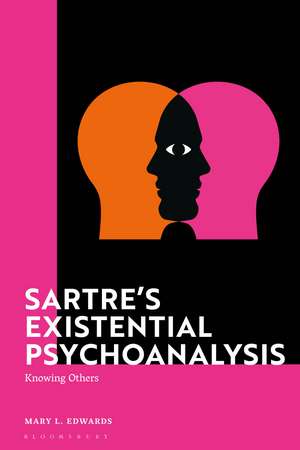
Sartre’s Existential Psychoanalysis: Knowing Others
Autor Dr Mary Edwardsen Limba Engleză Hardback – 17 noi 2022
Sartre's Existential Psychoanalysis integrates, for the first time, Sartre's psychoanalysis into his overarching philosophical project. By offering a critical interrogation of the role his psychoanalytical studies played in the development of his existentialism, Mary Edwards uncovers the overlooked philosophical significance of his existential psychoanalysis and brings it into a new and productive dialogue with current research in the fields of philosophy, psychology, and psychotherapy.
Preț: 559.36 lei
Preț vechi: 884.23 lei
-37%
Puncte Express: 839
Carte tipărită la comandă
Livrare economică 12-26 august
Livrare prin curier în România Termenul estimat este afișat lângă disponibilitate.
Transport gratuit pentru acest produs Plată online sau ramburs, în funcție de opțiunile comenzii.
Retur gratuit în 14 zile Comandă securizată și suport în română.
Specificații
ISBN-13: 9781350173477
ISBN-10: 1350173479
Pagini: 272
Ilustrații: 2 bw illus
Dimensiuni: 156 x 236 x 20 mm
Greutate: 0.56 kg
Editura: Bloomsbury Publishing
Colecția Bloomsbury Academic
Locul publicării:London, United Kingdom
ISBN-10: 1350173479
Pagini: 272
Ilustrații: 2 bw illus
Dimensiuni: 156 x 236 x 20 mm
Greutate: 0.56 kg
Editura: Bloomsbury Publishing
Colecția Bloomsbury Academic
Locul publicării:London, United Kingdom
Cuprins
1. Sartre's Theory of the Self
2. Knowledge of Selves
3. Situated Selves: The Development of Sartre's Existential Psychoanalysis
4. The Family Idiot and the Objectification of a Self
5. Objectivity in Sartre's Study of Flaubert
6. Imagining the Selves of Others
7. The Future of Sartrean Existential Psychoanalysis
2. Knowledge of Selves
3. Situated Selves: The Development of Sartre's Existential Psychoanalysis
4. The Family Idiot and the Objectification of a Self
5. Objectivity in Sartre's Study of Flaubert
6. Imagining the Selves of Others
7. The Future of Sartrean Existential Psychoanalysis
Recenzii
This book is of great importance to both Sartre Studies and the wider question of how we can know and understand others. It shows, in an utterly compelling and innovative way, how Sartre's engagement with psychoanalysis is interwoven with his philosophical work. The insights of the earlier discussions on existential psychoanalysis are interwoven with the discussion of dialectics in the Critique of Dialectical Reason and shown to be exemplified in the neglected late work on Flaubert, L'idiot de la famille. Consequently, the intersecting discussions throughout Sartre's oeuvre on the possibility of understanding others, the relation between the subjective and the objective, the role of empathy, and the relation between the real and the imaginary, are made explicit. Focusing on the psychoanalytic thread in Sartre's work, it is essential reading for those interested in Sartre, but also more widely for those engaged with the question of our relation to others.