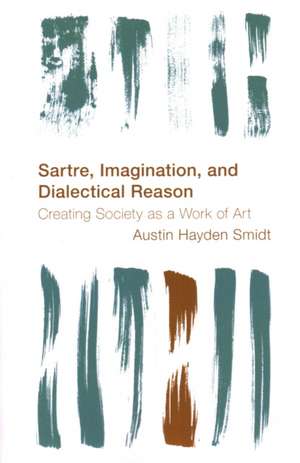
Sartre, Imagination and Dialectical Reason: Creating Society as a Work of Art: Reframing the Boundaries: Thinking the Political
Autor Austin Hayden Smidten Limba Engleză Paperback – 11 mar 2022
In Critique of Dialectical Reason, Sartre sought to develop an historical and structural heuristic; one that would enable future theorists and activists alike to assess the pressing problems facing the various milieux of capitalist life. Through this heuristic, his intent was to develop an orientation enabling humans to transform their world in their perpetual creation of themselves (and vice versa).
However, the stylistic difficulties of the text, as well as a general agreement among previous interpreters, has prevented the richness of the investigation from taking root. This book sets a new course, and invites further collaboration as - together - we create society as a work of art.



Preț: 258.70 lei
Preț vechi: 336.15 lei
-23%
Puncte Express: 388
Carte tipărită la comandă
Livrare economică 03-17 decembrie
Livrare prin curier în România Termenul estimat este afișat lângă disponibilitate.
Transport gratuit de la 400.00 lei Plată online sau ramburs, în funcție de opțiunile comenzii.
Retur gratuit în 14 zile Comandă securizată și suport în română.
Specificații
ISBN-13: 9781538153079
ISBN-10: 1538153076
Pagini: 302
Ilustrații: 4 b/w illustrations;2 tables;
Dimensiuni: 154 x 219 x 16 mm
Greutate: 0.45 kg
Editura: Bloomsbury Publishing
Colecția Rowman & Littlefield
Seria Reframing the Boundaries: Thinking the Political
Locul publicării:New York, United States
ISBN-10: 1538153076
Pagini: 302
Ilustrații: 4 b/w illustrations;2 tables;
Dimensiuni: 154 x 219 x 16 mm
Greutate: 0.45 kg
Editura: Bloomsbury Publishing
Colecția Rowman & Littlefield
Seria Reframing the Boundaries: Thinking the Political
Locul publicării:New York, United States
Cuprins
Acknowledgements
Abbreviations
Glossary of Terms
Introduction: Rediscovering Sartre in a Completely Natural Way
Introduction Notes
Part One: The Living Logic of Action in Critique of Dialectical Reason
Chapter 1: Dialectical Reason and the Paradoxico-Critical Orientation of Thought
Chapter 2: Dialectical Logic and The Pervasion of Seriality: Towards a Fresh Reading of Sartre's Critique of Dialectical Reason
Chapter 3: The Field of Possibles: the Practico-inert and the Exigency of Objective Conditions
Chapter 4: Pluridimensional Seriality
Chapter 5: Freedom and the Logic of the Group
Part Two: Toward an Imaginative Logic of Action
Chapter 6: The Logic of Poetic Imagination
Chapter 7: A Tale of Two Logics
Chapter 8: Creating Society as a Work of Art
Chapter 9: Prolegomena to Any Future Critique of Political Economy
Conclusion
Conclusion Notes
Bibliography
Index
Abbreviations
Glossary of Terms
Introduction: Rediscovering Sartre in a Completely Natural Way
Introduction Notes
Part One: The Living Logic of Action in Critique of Dialectical Reason
Chapter 1: Dialectical Reason and the Paradoxico-Critical Orientation of Thought
Chapter 2: Dialectical Logic and The Pervasion of Seriality: Towards a Fresh Reading of Sartre's Critique of Dialectical Reason
Chapter 3: The Field of Possibles: the Practico-inert and the Exigency of Objective Conditions
Chapter 4: Pluridimensional Seriality
Chapter 5: Freedom and the Logic of the Group
Part Two: Toward an Imaginative Logic of Action
Chapter 6: The Logic of Poetic Imagination
Chapter 7: A Tale of Two Logics
Chapter 8: Creating Society as a Work of Art
Chapter 9: Prolegomena to Any Future Critique of Political Economy
Conclusion
Conclusion Notes
Bibliography
Index
Recenzii
Smidt's book is essential to anyone dealing with Critique of Dialectical Reason in a substantial manner and provides an entry point . . .for those interested in a critical and well-articulated overview of Sartre's positions.
Through a series of carefully executed and highly engaging analyses, Austin Hayden Smidt proposes an original perspective on Sartre's philosophical project. Exploring in detail Sartre's critique of dialectical reason and the way it allows us to rethink not just key issues in philosophy but also important aspects of political economy in the neoliberal era, he makes a strong case for the relevance of Sartre's thought in the current moment.
Sartre, Imagination, and Dialectical Reason is an original and profound contribution to Sartre scholarship and contemporary critical theory. Against conventional readings, Austin Smidt argues meticulously and compellingly that Sartre's second major philosophical treatise is better than a work of social ontology; it is a work of 'formal logic,' a transformative and liberatory logic of social creation. In keeping with Sartre's lifelong and too often underappreciated fascination with the imaginary, Smidt reaffirms the centrality of imagination for critical theory, both in our efforts to understand the world better than we do, and more importantly, in our efforts to make the world a better place than it is.
This is an important and elaborate rethinking of Sartre's all too often neglected Critique of Dialectical Reason. Through a patient and systematic unpacking of this work, set in dialogue with Marx and other critical thinkers, Smidt convincingly demonstrates the power, relevance, and utility that Sartre's thought continues to hold for us today. Highly recommended!
Through a series of carefully executed and highly engaging analyses, Austin Hayden Smidt proposes an original perspective on Sartre's philosophical project. Exploring in detail Sartre's critique of dialectical reason and the way it allows us to rethink not just key issues in philosophy but also important aspects of political economy in the neoliberal era, he makes a strong case for the relevance of Sartre's thought in the current moment.
Sartre, Imagination, and Dialectical Reason is an original and profound contribution to Sartre scholarship and contemporary critical theory. Against conventional readings, Austin Smidt argues meticulously and compellingly that Sartre's second major philosophical treatise is better than a work of social ontology; it is a work of 'formal logic,' a transformative and liberatory logic of social creation. In keeping with Sartre's lifelong and too often underappreciated fascination with the imaginary, Smidt reaffirms the centrality of imagination for critical theory, both in our efforts to understand the world better than we do, and more importantly, in our efforts to make the world a better place than it is.
This is an important and elaborate rethinking of Sartre's all too often neglected Critique of Dialectical Reason. Through a patient and systematic unpacking of this work, set in dialogue with Marx and other critical thinkers, Smidt convincingly demonstrates the power, relevance, and utility that Sartre's thought continues to hold for us today. Highly recommended!