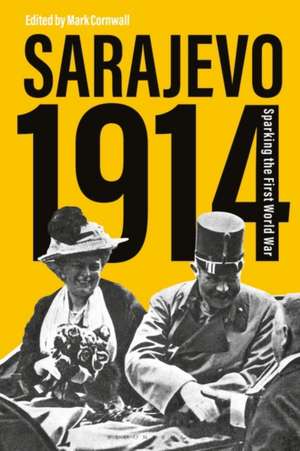
Sarajevo 1914: Sparking the First World War
Editat de Prof. Mark Cornwallen Limba Engleză Paperback – 3 sep 2020
The volume assesses from a variety of regional perspectives how the 'South Slav Question' destabilized the empire's southern provinces, provoking violent discontent in Croatia and Bosnia, and exacerbating the empire's relations with Serbia, regarded by Austria-Hungary as a dangerous state. It then explores the ripples of the Sarajevo event, from its evolution into a European crisis to the creation of a new independent state of Yugoslavia.
Bringing together fresh perspectives by historians from Austria, Croatia, Slovenia and Serbia, as well as leading British historians of Austria-Hungary, this book is essential reading for anyone wanting to understand the Sarajevo violence and how it shaped modern Balkan history.
Preț: 196.28 lei
Preț vechi: 242.29 lei
-19%
Puncte Express: 294
Carte disponibilă
Livrare economică 12-26 noiembrie
Livrare express 28 octombrie-03 noiembrie pentru 80.30 lei
Livrare prin curier în România Termenul estimat este afișat lângă disponibilitate.
Transport gratuit de la 400.00 lei Plată online sau ramburs, în funcție de opțiunile comenzii.
Retur gratuit în 14 zile Comandă securizată și suport în română.
Specificații
ISBN-13: 9781350093201
ISBN-10: 1350093203
Pagini: 320
Ilustrații: 16 bw illus
Dimensiuni: 156 x 234 x 20 mm
Greutate: 0.5 kg
Editura: Bloomsbury Publishing
Colecția Bloomsbury Academic
Locul publicării:London, United Kingdom
ISBN-10: 1350093203
Pagini: 320
Ilustrații: 16 bw illus
Dimensiuni: 156 x 234 x 20 mm
Greutate: 0.5 kg
Editura: Bloomsbury Publishing
Colecția Bloomsbury Academic
Locul publicării:London, United Kingdom
Cuprins
List of Illustrations
Introduction: The Southern Slav Question, Mark Cornwall (University of Southampton, UK)
Part I - Tinder and Spark
1. Franz Ferdinand: Power and Image, Alma Hannig (University of Bonn, Germany)
2. Great Expectations: The Habsburgh Heir-Apparent and the Southern Slavs, Andrej Rahten (Slovene Academy of Sciences, Slovenia)
3. Mlada Bosna: The Educational and Cultural Context, Robin Okey (University of Warwick, UK)
4. Bosnian, Croatian, Serbian, or Serbo-Croatian?: Frictions over the Language Question in the Habsburg Army, Tamara Scheer (University of Vienna, Austria)
5. The Mentality of the Croatian Aristocracy, Iskra Iveljic (University of Zagreb, Croatia)
Part II - International Blaze
6. Why Did Nobody Control Apis?: Serbian Military Intelligence and the Sarajevo Assassinations, Danilo Sarenac (University of Belgrade, Serbia)
7. Why Fight a Third Balkan War?: The Habsburg Mindset in 1914, Lothar Höbelt (University of Vienna, Austria)
8. 'Six Powers Appalled by War': The July Crisis and the Limits of Crisis Management, Thomas Otte (University of East Anglia, UK)
9. The British Elite and the Sarajevo Assassinations, Roy Bridge (University of Leeds, UK)
Part III - Regional Blaze
10. The Outbreak of War in Habsburg Trieste, Borut Klabjan (University of Koper, Slovenia)
11. Defining Traitors and Loyalists in Habsburg Croatia, Mark Cornwall (University of Southampton, UK)
12. The Inner Enemy: The Habsburg State and its Serb Citizens in Herzegovina 1913-1918, Heiner Grunert (Ludwig Maximilian University Munich, Germany)
13. The Sarajevo Assassinations in Czech Memory after the Great War, Dagmar Hajková (Czech Academic of Sciences, Czech Republic)
14. The Combustible Impact of Sarajevo, Cathie Carmichael (University of East Anglia, UK)
Index
Introduction: The Southern Slav Question, Mark Cornwall (University of Southampton, UK)
Part I - Tinder and Spark
1. Franz Ferdinand: Power and Image, Alma Hannig (University of Bonn, Germany)
2. Great Expectations: The Habsburgh Heir-Apparent and the Southern Slavs, Andrej Rahten (Slovene Academy of Sciences, Slovenia)
3. Mlada Bosna: The Educational and Cultural Context, Robin Okey (University of Warwick, UK)
4. Bosnian, Croatian, Serbian, or Serbo-Croatian?: Frictions over the Language Question in the Habsburg Army, Tamara Scheer (University of Vienna, Austria)
5. The Mentality of the Croatian Aristocracy, Iskra Iveljic (University of Zagreb, Croatia)
Part II - International Blaze
6. Why Did Nobody Control Apis?: Serbian Military Intelligence and the Sarajevo Assassinations, Danilo Sarenac (University of Belgrade, Serbia)
7. Why Fight a Third Balkan War?: The Habsburg Mindset in 1914, Lothar Höbelt (University of Vienna, Austria)
8. 'Six Powers Appalled by War': The July Crisis and the Limits of Crisis Management, Thomas Otte (University of East Anglia, UK)
9. The British Elite and the Sarajevo Assassinations, Roy Bridge (University of Leeds, UK)
Part III - Regional Blaze
10. The Outbreak of War in Habsburg Trieste, Borut Klabjan (University of Koper, Slovenia)
11. Defining Traitors and Loyalists in Habsburg Croatia, Mark Cornwall (University of Southampton, UK)
12. The Inner Enemy: The Habsburg State and its Serb Citizens in Herzegovina 1913-1918, Heiner Grunert (Ludwig Maximilian University Munich, Germany)
13. The Sarajevo Assassinations in Czech Memory after the Great War, Dagmar Hajková (Czech Academic of Sciences, Czech Republic)
14. The Combustible Impact of Sarajevo, Cathie Carmichael (University of East Anglia, UK)
Index
Recenzii
An excellent collection of essays that brings original insight to an historical topic that has occupied historians for over a century. Too often, the Sarajevo assassination is treated as the opening act in a war drama whose most important actions took place elsewhere. Not here: Sarajevo 1914 puts Franz Ferdinand and the Southern South question at the centre of its narrative, exploring its causes and consequences from a range of perspective and casting new light onto one of the most consequential events of the twentieth century.
Sarajevo 1914 is a rigorous and well-researched collection of essays that will be essential reading for any student, scholar or lay reader wishing to understand the impact and implications, both regionally and internationally, of the fateful assassination of Archduke Franz Ferdinand.
Sarajevo 1914 offers students, scholars and non-specialists alike a genuinely fresh perspective on a topic too often consigned to a historical footnote in more general histories, or one that simply begins and ends with Princip firing those two shots. This alone has earned it a place on any essential reading list concerning the history of the First World War.
Sarajevo 1914 is a rigorous and well-researched collection of essays that will be essential reading for any student, scholar or lay reader wishing to understand the impact and implications, both regionally and internationally, of the fateful assassination of Archduke Franz Ferdinand.
Sarajevo 1914 offers students, scholars and non-specialists alike a genuinely fresh perspective on a topic too often consigned to a historical footnote in more general histories, or one that simply begins and ends with Princip firing those two shots. This alone has earned it a place on any essential reading list concerning the history of the First World War.