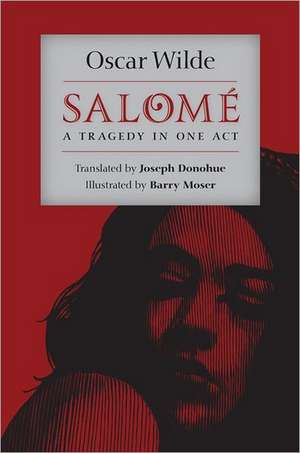
Salome: A Tragedy in One Act
Autor Oscar Wilde Ilustrat de Barry Moser Traducere de Joseph Donohueen Limba Engleză Hardback – 31 oct 2011 – vârsta de la 22 ani
Adresată studenților la litere, cercetătorilor curentului decadentist și practicienilor din artele spectacolului, această ediție a piesei Salome oferă o perspectivă lingvistică radicală asupra uneia dintre cele mai controversate lucrări semnate de Oscar Wilde. Considerăm că principala valoare a acestui volum rezidă în traducerea semnată de Joseph Donohue, care reușește să înlocuiască limbajul biblic artificial al versiunilor clasice cu o engleză americană directă și modernă. Această abordare elimină distanța auto-impusă de traducerile victoriene, aducând cititorul într-o confruntare brutală cu temele erotismului și ale violenței ritualice.
Structura volumului este una academică, dar accesibilă. Dincolo de textul piesei, reținem prezența unui aparat critic impresionant în Appendix A, unde sunt explorate sursele literare care l-au influențat pe Wilde, de la Flaubert la Mallarmé. Această ediție funcționează ca o alternativă necesară la Salomé (versiunea standard), fiind ideală pentru cursurile de dramaturgie universală prin avantajul adus de integrarea contextului vizual; gravurile lui Barry Moser și istoria iconografică (Moreau, Beardsley) oferă o experiență senzorială completă.
Poziționată în opera autorului, Salome reprezintă experimentul său cel mai îndrăzneț, îndepărtându-se de comediile de moravuri precum Plays of Oscar Wilde pentru a explora simbolismul întunecat. Dacă în The Picture of Dorian Gray Wilde analiza decadența prin proză, aici el distilează obsesia pentru frumusețe și moarte într-o formă dramatică fixă, oferind o viziune asupra unei lumi aflate la pragul unei noi ordini spirituale.
Preț: 639.15 lei
Preț vechi: 830.06 lei
-23%
Carte disponibilă
Livrare economică 11-25 noiembrie
Specificații
ISBN-10: 0813931924
Pagini: 108
Dimensiuni: 156 x 235 mm
Greutate: 0.23 kg
Ediția:New.
Editura: University of Virginia Press
V-ar putea interesa
-
 Complete Works of Oscar WildeOscar WildePreț: 117.65 lei
 -
 The Plays of Oscar WildeOscar WildePreț: 28.01 lei
 -
 Oscar Wilde - The Major WorksOscar Wilde-16%Preț: 81.84 lei96.96 lei
 -
 Salome: The woman behind the danceJoanna CourtneyPreț: 71.53 lei
 -
 The Birth of Tragedy and The Case of WagnerFriedrich NietzschePreț: 78.08 lei
 -
 The Importance of Being Earnest and Other PlaysOscar WildePreț: 35.30 lei
 -
 The Picture of Dorian GrayOscar WildePreț: 35.93 lei
 -
 Cyrano de BergeracEdmond RostandPreț: 49.42 lei
 -
 An Ideal HusbandOscar WildePreț: 42.58 lei
 -
 Ubu RoiAlfred JarryPreț: 28.65 lei
 -
 Preț: 343.22 lei
 -
 The Importance of Being Earnest & Other PlaysOscar Wilde-33%Preț: 53.16 lei79.50 lei
 -
 The ProphetKahlil GibranPreț: 27.21 lei
 -
 SalomeOscar WildePreț: 43.97 lei
 -
 Wilde, O: The Picture of Dorian GrayOscar WildePreț: 69.67 lei
 -
 After OscarMerlin HollandPreț: 235.61 lei
 -
 Selected PlaysOscar WildePreț: 58.65 lei
 -
 The Picture of Dorian GrayOscar WildePreț: 30.08 lei
 -
 SaloméOscar WildePreț: 58.77 lei
 -
 Preț: 34.20 lei
De ce să citești această carte
Recomandăm această ediție pentru oricine dorește să descopere piesa Salome dincolo de clișeele victoriene. Cititorul câștigă o înțelegere profundă a intertextualității modernismului internațional, susținută de bibliografia extinsă și ilustrațiile contemporane ale lui Barry Moser. Este un instrument esențial pentru studiu, dar și o piesă de colecție datorită esteticii grafice deosebite, oferind o lectură fluidă printr-o traducere care sună natural urechii moderne.
Despre autor
Oscar Wilde (1854–1900) a fost un dramaturg, poet și romancier irlandez, figură centrală a mișcării estetice. Educat la Trinity College Dublin și Oxford, Wilde a devenit celebru pentru spiritul său caustic și stilul de viață extravagant. Deși este recunoscut la nivel mondial pentru capodopera The Picture of Dorian Gray și pentru comediile sale de salon, piesa Salome, scrisă inițial în franceză, demonstrează versatilitatea sa lingvistică și afinitatea pentru simbolismul european. Cariera sa strălucitoare a fost întreruptă de procesele răsunătoare și condamnarea pentru „indecență gravă”, Wilde rămânând până astăzi un simbol al libertății artistice și al luptei împotriva prejudecăților sociale.
Descriere scurtă
Unique among his works, Oscar Wilde's play "Salome" (1893) was written originally in French. Joseph Donohue's new translation of the horrific New Testament story has recast Wilde's shockingly radical drama in the natural idiomatic language of our own day. Presenting a colloquial and spare American English version of Wilde's consciously stylized French, Donohue's approach gives full value to the Irish author's dark ruminations on evil and perversity in a world on the brink of a new, unsettling Christian dispensation.
The play was first translated into English in 1894 by Wilde's young friend Lord Alfred Douglas, but Wilde was far from pleased with the outcome. And yet Douglas's stilted, inaccurate version has somehow retained a long-standing place on the stage and in the study. Donohue's lucid vernacular transformation of Douglas's safe, thee-and-thou faux-biblical language has the quality of a startling modern-dress remounting of an overly familiar classic play. This new "Salome" is calculated to bring both readers and playgoers into close, disturbing confrontation with one of the most erotic and bloodiest sequences of testamentary lore.
Brilliantly complementing Donohue's unprecedented approach is a set of engravings by a master illustrator of our time. Barry Moser is an artist who speaks the blunt yet fluent language of present-day communication through the penetrating gestural vocabulary of the graphic arts. The resulting combination of words and images directly engages with Wilde's characters and their story, setting a bold new standard for the melding of literary and pictorial excellence. At the same time, it leads readers and audiences alike to rediscover perennially significant themes of love, death, power, and individuality.
A signed and numbered limited edition is available for $100.00."
Descriere
Salome is Oscar Wilde’s most experimental—and controversial—play. In its own time, the play, written in French, was described by a reviewer as “an arrangement in blood and ferocity, morbid, bizarre, repulsive.” None, however, could deny the importance of Wilde’s creation. Contemporary audiences and reviewers variously regarded Salome as the symbol of a thrilling modernity, a challenge to patriarchy, a confession of desire, a sign of moral decay, a new form of art, and a revolt against the restraints of Victorian society. Less well known than Wilde’s beloved comedies, Salome is as enduringly modern and relevant.
This edition uses the English translation done by Wilde’s lover, Lord Alfred Douglas, and overseen and corrected by Wilde himself. Appendices detail the play’s sources and provide extensive materials on its contemporary reception and dramatic productions.
Recenzii
This edition uses the English translation done by Wilde’s lover, Lord Alfred Douglas, and overseen and corrected by Wilde himself. Appendices detail the play’s sources and provide extensive materials on its contemporary reception and dramatic productions.
“Salome illuminated! This edition presents Salome as a formally complex, richly intertextual, and generative phenomenon of international modernism. Kimberly Stern sets a superbly annotated text between an extensive introduction and several appendices documenting the play’s literary, cultural, and visual sources, its reception, and its translation, illustration, and performance histories. The edition offers copious source materials to augment the text, some requisite and some unexpected. Stern’s adept and unprecedented selection of contextual sources enhances the powerful and recurrent fascination of a play that has continuously spawned adaptations as well as controversy. This is where all students of Salome should start.” — Heidi Hartwig, Central Connecticut State University
Cuprins
Introduction
Oscar Wilde: A Brief Chronology
A Note on the Text
Salome
Appendix A: Sources
- Matthew 14:1-12, The Bible: Authorized King James Versionwith Apocrypha (2008)
- “Descent of the Goddess Ishtar into the Lower World,”The Sacred Books and Early Literature of the East (1917)
- From Heinrich Heine, Atta Troll (1843)
- From J.C. Heywood, Herodias: A Dramatic Poem (1867)
- From Oscar Wilde, “Review of J.C. Heywood’s Salome,”Pall Mall Gazette (15 February 1888)
- From Stéphane Mallarmé, “La scéne: Nourrice—Hérodiade”(1864-67)
- From Gustave Flaubert, “Hérodias” (1877)
- William Wilde, “Salome” (1878)
- From Joris-Karl Huysmans, Á Rebours (1884)
- From Maurice Maeterlinck, La Princesse Maleine (1889)
- Gustave Moreau, “The Apparition” (1876)
- Aubrey Beardsley, Design for the Title Page to the English Edition of Salome (1894)
- Aubrey Beardsley, Final Design for the Title Page (1894)
- Aubrey Beardsley, “The Woman in the Moon” (1894)
- Aubrey Beardsley, “The Climax” (1894)
- From Edgar Saltus, Oscar Wilde: An Idler’s Impression (1917)
- Pierre Louÿs, “Salomé: à Oscar W.” (30 June 1892)
- Letter from Oscar Wilde to Richard Le Gallienne (22/23 February 1893)
- From a Letter from Bernard Shaw to Oscar Wilde (28 February 1893)
- From a Letter from Max Beerbohm to Reginald Turner (February 1893)
- From “Salomé,” The Times (23 February 1893)
- From a Review of Salomé, Pall Mall Gazette (27 February 1893)
- Letter from Stéphane Mallarmé to Oscar Wilde (March 1893)
- From William Archer, “Mr. Oscar Wilde’s New Play,”Black and White (11 May 1893)
- From Lord Alfred Douglas, “Salomé: A Critical Overview,” The Spirit Lamp (1893)
- Letter from Lord Alfred Douglas to John Lane (30 September 1893)
- From a Letter from Lord Alfred Douglas to John Lane (16 November 1893)
- From a Letter from Oscar Wilde to Lord Alfred Douglas (January-March 1897)
- From a Letter from Robert Ross to Frank Harris (undated)
- From Lord Alfred Douglas, Autobiography (1929)
- Translation Chart
- From Charles Ricketts, Self-Portrait (1939)
- From Graham Robertson, Time Was (1931)
- Photograph of Sarah Bernhardt in Costume as Salome (1891)
- From a Letter from Oscar Wilde to William Rothenstein (July 1892)
- “Mr. Oscar Wilde on Salome,” The Times (2 March 1893)
- From Oscar Wilde, “The Censure and Salome,” Pall Mall Budget (30 June 1892)
- Bernard Partridge, “A Wilde Idea,” Punch Magazine (9 July 1892)
- From a Letter from Max Beerbohm to Reginald Turner (June 1892)
- Oscar Wilde, “Plan de la scene” (1891)
- From M.J. du Tillet, “Théâtres” [review of the Paris premiere of Salome], Revue bleue politique et littéraire (1896)
- From Jean de Tinan, “Théâtre de l’oeuvre: Salomé” [review of the Paris premiere], Mercure de France (March 1896)
- From “Salome,” The Saturday Review (13 May 1905)
- Photograph of Alice Guszalewicz in Costume as Salome (c. 1910)
- “The Cult of the Clitoris,” The Vigilante (16 February 1918)
- From the Verbatim Report of the Trial of Noel Pemberton Billington, MP, on a Charge of Criminal Libel (1918)