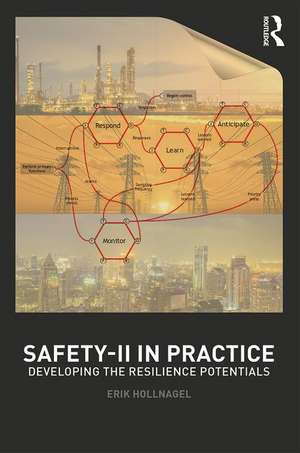
Safety-II in Practice: Developing the Resilience Potentials
Autor Erik Hollnagelen Limba Engleză Paperback – 21 iun 2017
Structura volumului Safety-II in Practice este riguros proiectată pentru a ghida cititorul de la înțelegerea conceptuală a rezilienței către implementarea unui instrument de diagnosticare specific. Primele capitole redefinesc managementul siguranței în contextul anului 2016, urmate de o analiză a potențialelor de reziliență, culminând cu prezentarea detaliată a Resilience Assessment Grid (RAG). Această progresie logică transformă o teorie complexă într-un set de patru seturi de întrebări formative care pot fi adaptate oricărei organizații.
Observăm în această lucrare o evoluție clară față de volumele anterioare ale lui Erik Hollnagel. Dacă în FRAM: The Functional Resonance Analysis Method autorul se concentra pe modelarea accidentelor dincolo de eroarea umană, iar în The ETTO Principle analiza compromisul dintre eficiență și rigoare, Safety-II in Practice face pasul decisiv către execuție. Credem că importanța acestei cărți rezidă în trecerea de la „siguranța protectivă” (limitarea daunelor) la „siguranța productivă” (optimizarea modului în care lucrurile merg bine).
Complementar volumului From Safety to Safely, care explorează paradoxul măsurării siguranței prin absența ei, lucrarea de față acoperă zona instrumentelor concrete de monitorizare și anticipare. În timp ce alte titluri din domeniu, precum Resilience Engineering in Practice, Volume 2, oferă studii de caz din diverse sectoare, Safety-II in Practice se distinge prin oferirea unei metodologii universale, RAG, validată prin experiență practică. Notăm cu interes modul în care Erik Hollnagel elimină jargonul academic inutil pentru a oferi profesioniștilor un cadru de lucru prin care pot dezvolta capacitatea de adaptare a unei organizații în fața neprevăzutului.
Preț: 310.06 lei
Carte disponibilă
Livrare economică 18 mai-01 iunie
Livrare express 02-08 mai pentru 24.95 lei
Specificații
ISBN-10: 1138708925
Pagini: 144
Ilustrații: 38
Dimensiuni: 156 x 234 x 16 mm
Greutate: 0.23 kg
Ediția:1
Editura: CRC Press
Colecția Routledge
V-ar putea interesa
-
 Resilient Forest ManagementPhilip J. Burton-33%Preț: 822.12 lei1229.37 lei
 -
 Handbook of Perioperative and Procedural Patient SafetyJuan A. Sanchez-5%Preț: 704.34 lei741.41 lei
 -
 Normal AccidentsCharles PerrowPreț: 270.66 lei
 -
 Resilience: Why Things Bounce BackAndrew Zolli-8%Preț: 70.73 lei76.85 lei
 -
 Preț: 319.89 lei
 -
 -5%Preț: 280.83 lei295.62 lei
 -
 Railway Safety Management: Systems, Practices, and Emerging TrendsKatarzyna Chruzik-15%Preț: 420.53 lei494.75 lei
 -
 -23%Preț: 816.78 lei1060.75 lei
 -
 Organizational Risk ManagementCharles F Redinger-23%Preț: 662.23 lei860.03 lei
 -
 ABC of Clinical ResilienceAnna Frain-5%Preț: 315.93 lei332.56 lei
 -
 Alive and Well at the End of the DayPaul D Balmert-19%Preț: 495.76 lei612.04 lei
 -
 Reliability and Safety In Hazardous Work Systems: Approaches To Analysis And DesignBerlin Bernhard Wilpert Technische UniversitaetPreț: 390.13 lei
 -
 The Leader's Guide to ResilienceAudrey TangPreț: 127.55 lei
 -
 The Science of ResilienceTed G Lewis-19%Preț: 615.45 lei759.82 lei
 -
 Preț: 86.28 lei
 -
 Preț: 369.01 lei
 -
 Safe DangerBen SwirePreț: 138.05 lei
 -
 LifehouseAdam GreenfieldPreț: 87.86 lei
 -
 Preț: 385.26 lei
 -
 Preț: 284.58 lei
Public țintă
Academic, Professional, and Professional Practice & DevelopmentDe ce să citești această carte
Această carte este esențială pentru specialiștii în protecția muncii și managerii operaționali care doresc să depășească modelul reactiv de gestionare a riscurilor. Cititorul va câștiga un instrument pragmatic, Resilience Assessment Grid, care permite evaluarea capacității de învățare și anticipare a echipei sale. Este o resursă valoroasă pentru cei care vor să construiască sisteme robuste, capabile să funcționeze optim nu doar în condiții normale, ci și sub presiune.
Descriere scurtă
Safety-II changes safety management from protective safety and a focus on how things can go wrong, to productive safety and a focus on how things can and do go well. For Safety-II, the aim is not just the elimination of hazards and the prevention of failures and malfunctions but also how best to develop an organisation’s potentials for resilient performance – the way it responds, monitors, learns, and anticipates. That requires models and methods that go beyond the Safety-I toolbox. This book introduces a comprehensive approach for the management of Safety-II, called the Resilience Assessment Grid (RAG). It explains the principles of the RAG and how it can be used to develop the resilience potentials. The RAG provides four sets of diagnostic and formative questions that can be tailored to any organisation. The questions are based on the principles of resilience engineering and backed by practical experience from several domains.
Safety-II in Practice is for both the safety professional and academic reader. For the professional, it presents a workable method (RAG) for the management of Safety-II, with a proven track record. For academic and student readers, the book is a concise and practical presentation of resilience engineering.
Cuprins
Chapter 1: Safety Management Anno 2016
Chapter 2: What Does ‘Resilience’ Mean?
Chapter 3: The Basis For Resilient Performance
Chapter 4: The Resilience Potentials
Chapter 5: RAG – The Resilience Assessment Grid
Chapter 6: RAG – Towards a Model of Resilient Performance
Chapter 7: Developing Resilience Potentials
Chapter 8: The Changing Face of Safety
References
Glossary
Recenzii
This approach could also give us powerful new leverage with directors and senior leaders – by changing the agenda from how we can meet the minutiae of safety and health law to how we can best work together to ensure our organisations survive and thrive."
Paul Smith MA CFIOSH, IOSH Magazine and former Health & Safety Executive inspector