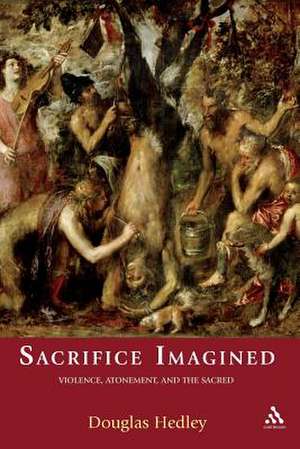
Sacrifice Imagined: Violence, Atonement, and the Sacred
Autor Professor Douglas Hedleyen Limba Engleză Paperback – 10 noi 2011
Despisers of religion have poured scorn upon the idea of sacrifice as an index of the irrational and wicked in religious practice. Nor does its secularised form seem much more appealing. One need only think of the appalling cult of sacrifice in numerous totalitarian regimes of the twentieth century. Yet sacrifice remains a part of our cultural and intellectual 'imaginary'. Hedley proposes good reasons to think that issues of global conflict and the ecological crisis highlight the continuing relevance of the topic of sacrifice for contemporary culture.
The subject of sacrifice has been decisively influenced by two books: Girard's The Violence and the Sacred and Burkert's Homo Necans. Both of these are theories of sacrifice as violence. Hedley's book challenges both of these highly influential theories and presents a theory of sacrifice as renunciation of the will. His guiding influences in this are the much misunderstood Joseph de Maistre and the Cambridge Platonists.
Preț: 279.66 lei
Preț vechi: 330.44 lei
-15%
Puncte Express: 419
Carte tipărită la comandă
Livrare economică 04-18 decembrie
Livrare prin curier în România Termenul estimat este afișat lângă disponibilitate.
Transport gratuit de la 400.00 lei Plată online sau ramburs, în funcție de opțiunile comenzii.
Retur gratuit în 14 zile Comandă securizată și suport în română.
Specificații
ISBN-13: 9781441194459
ISBN-10: 1441194452
Pagini: 258
Dimensiuni: 156 x 234 x 14 mm
Greutate: 0.43 kg
Ediția:New.
Editura: Bloomsbury Publishing
Colecția Continuum
Locul publicării:New York, United States
ISBN-10: 1441194452
Pagini: 258
Dimensiuni: 156 x 234 x 14 mm
Greutate: 0.43 kg
Ediția:New.
Editura: Bloomsbury Publishing
Colecția Continuum
Locul publicării:New York, United States
V-ar putea interesa
-
 Religion ExplainedPascal BoyerPreț: 122.53 lei
 -
 Breaking the SpellDaniel C. Dennett-18%Preț: 77.41 lei94.34 lei
 -
 Classical ThoughtTerence Irwin-13%Preț: 331.21 lei380.15 lei
 -
 The Christian GodRichard Swinburne-28%Preț: 352.16 lei491.39 lei
 -
 Providence and the Problem of EvilRichard Swinburne-27%Preț: 384.64 lei528.54 lei
 -
 Nietzsche and Buddhism: A Study in Nihilism and Ironic AffinitiesRobert G. Morrison-27%Preț: 384.15 lei528.26 lei
 -
 George Berkeley: Idealism and the ManDavid Berman-18%Preț: 378.32 lei462.18 lei
 -
 Epistemic JustificationRichard Swinburne-22%Preț: 375.58 lei482.51 lei
 -
 Faith with ReasonPaul Helm-20%Preț: 363.56 lei454.56 lei
 -
 Creation and the World of Science: The Reshaping of BeliefA. R. Peacocke-19%Preț: 341.74 lei419.78 lei
 -
 Persons: Human and DivinePeter Van Inwagen-27%Preț: 415.51 lei568.45 lei
 -
 -20%Preț: 303.04 lei380.77 lei
 -
 Mind and Emergence: From Quantum to ConsciousnessPhilip Clayton-18%Preț: 339.57 lei414.63 lei
 -
 The Future of ReligionRichard RortyPreț: 164.24 lei
 -
 Preț: 158.39 lei
 -
 The Evolving God: Charles Darwin on the Naturalness of ReligionProfessor J. David PleinsPreț: 205.33 lei
 -
 The Case For ReligionKeith WardPreț: 105.27 lei
Cuprins
Prologue
1. The Theophanic Imagination, 'Making Sacred' and the Sublime
2. Costly Signalling or Hallowed Violence: explaining sacrifice?
3. Failed Oblations and the Tragic Imagination
4. Thraldom, Liberty and Licence: freedom and renunciation
5. Immolation, Suffering and the Blood-stained Logos
6. Responsibility, Atonement and Sacrifice transformed
7. Metamorphosis and the pathetic Divine: Dionysus and the Crucified
8. The 'Quire-Musick' of the Temple and the Heavenly Banquet
Epilogue
Bibliography
Index of subjects
Index of names
1. The Theophanic Imagination, 'Making Sacred' and the Sublime
2. Costly Signalling or Hallowed Violence: explaining sacrifice?
3. Failed Oblations and the Tragic Imagination
4. Thraldom, Liberty and Licence: freedom and renunciation
5. Immolation, Suffering and the Blood-stained Logos
6. Responsibility, Atonement and Sacrifice transformed
7. Metamorphosis and the pathetic Divine: Dionysus and the Crucified
8. The 'Quire-Musick' of the Temple and the Heavenly Banquet
Epilogue
Bibliography
Index of subjects
Index of names
Recenzii
"Douglas Hedley calls on the resources of philosophy, theology, poetry, and art to look into the deep and difficult subject of sacrifice, suffering, and atonement. This is a remarkable, profound, and erudite new study, which no one who wants to think hard about these issues should ignore." --Timothy Chappell, Professor of Philosophy, The Open University, UK.
"In this impressively learned work Douglas Hedley has two related goals both of which challenge contemporary scholarship. The first and more important is to recover the role of sacrifice in the imagination, not as something purely negative but as a path towards human transformation. This he does in part through his second goal: re-establishing the significance of a largely forgotten figure, Joseph de Maistre. Hedley plausibly argues that, so far from being merely a reactionary thinker, de Maistre offers a profound critique of much Enlightenment and modern thought. Rich in insights, the work challenges numerous contemporary orthodoxies in both philosophy and theology, and at the same time succeeds in defending the continuing relevance of the Platonist tradition. " -- David Brown, FBA, Wardlaw Professor of Theology, Aesthetics and Culture, University of St Andrews, UK
"Sacrifice has, in recent years, become once again the subject of an interdisciplinary, scholarly debate. Dr. Hedley's book will make an important contribution to this debate. Written from a perspective that is consciously theological and consciously Platonic, it argues for the abiding significance of sacrifice as a dimension of human culture. For Dr. Hedley, sacrifice ultimately is the work of human imagination and indispensable from an epistemic, metaphysical, ethical, and religious point of view. Given the tradition of radical critique of sacrifice in both Christian and post-Christian theories, this argument will inevitably be controversial. Yet even those readers who may not be fully persuaded by Dr. Hedley's thesis must be immensely grateful for the wealth of references to past and present thinkers and for the subtle analysis of their ideas that is here put at their disposal." -- Johannes Zachhuber, Reader in Theology, Trinity College, University of Oxford, UK
"Anthropologists might want to read Sacrifice Imagined to learn about Christian thought and literature or to learn that Christian exegesis is alive and well."-- Anthropology Review Database
"Hedley's erudition and knowledge of literature dealing with sacrifice and religion is very apparent in his textual references, and extensive bibliography [...] the book is a marvel of scholarly work on a controversial topic [...] recommended to all college and university libraries with graduate programs in religious studies." -- Catholic Library World
"In this impressively learned work Douglas Hedley has two related goals both of which challenge contemporary scholarship. The first and more important is to recover the role of sacrifice in the imagination, not as something purely negative but as a path towards human transformation. This he does in part through his second goal: re-establishing the significance of a largely forgotten figure, Joseph de Maistre. Hedley plausibly argues that, so far from being merely a reactionary thinker, de Maistre offers a profound critique of much Enlightenment and modern thought. Rich in insights, the work challenges numerous contemporary orthodoxies in both philosophy and theology, and at the same time succeeds in defending the continuing relevance of the Platonist tradition. " -- David Brown, FBA, Wardlaw Professor of Theology, Aesthetics and Culture, University of St Andrews, UK
"Sacrifice has, in recent years, become once again the subject of an interdisciplinary, scholarly debate. Dr. Hedley's book will make an important contribution to this debate. Written from a perspective that is consciously theological and consciously Platonic, it argues for the abiding significance of sacrifice as a dimension of human culture. For Dr. Hedley, sacrifice ultimately is the work of human imagination and indispensable from an epistemic, metaphysical, ethical, and religious point of view. Given the tradition of radical critique of sacrifice in both Christian and post-Christian theories, this argument will inevitably be controversial. Yet even those readers who may not be fully persuaded by Dr. Hedley's thesis must be immensely grateful for the wealth of references to past and present thinkers and for the subtle analysis of their ideas that is here put at their disposal." -- Johannes Zachhuber, Reader in Theology, Trinity College, University of Oxford, UK
"Anthropologists might want to read Sacrifice Imagined to learn about Christian thought and literature or to learn that Christian exegesis is alive and well."-- Anthropology Review Database
"Hedley's erudition and knowledge of literature dealing with sacrifice and religion is very apparent in his textual references, and extensive bibliography [...] the book is a marvel of scholarly work on a controversial topic [...] recommended to all college and university libraries with graduate programs in religious studies." -- Catholic Library World